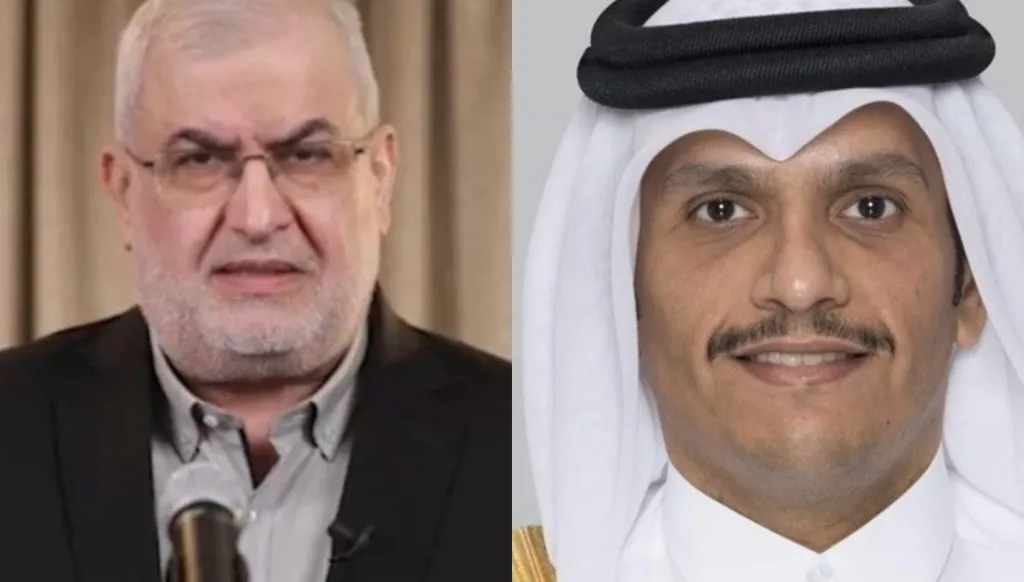
Although Hezbollah has never denied that its ties with Qatar have at times been strained, despite disagreements over the Syrian file during the former regime that escalated to the point of confrontation, what is striking is the party's decision to shroud in secrecy the recent meeting between Hezbollah parliamentary bloc leader Mohammad Raad and Qatar's Prime Minister and Foreign Minister, Sheikh Mohammed bin Abdulrahman bin Jassim Al Thani, during the latter's visit to Beirut a few days ago. Hezbollah did not issue any statement about the meeting or its contents, even though Lebanese, Arab and US official sources confirmed that it had taken place.
More than a week after the meeting, some are still seeking answers to three questions related to it:
Why did Hezbollah choose not to highlight the meeting, despite its significance, both in terms of the issues discussed and the timing?
What concerns and information did the Qatari guest bring with him, and, consequently, how did Raad respond to what the Qatari official conveyed?
Do the issues discussed at the meeting remain relevant and pertinent in the days ahead, or did their relevance expire at the time?
According to sources close to Hezbollah, one of the meeting's key points of significance was that it took place shortly before Israeli voters were due to head to the polls in a general election that would determine who would assume the premiership in Tel Aviv. At the time, concerns were growing over two possible scenarios:
First, that Israeli Prime Minister Benjamin Netanyahu might embark on a military adventure against Lebanon to strengthen his political position and improve his chances of returning to the office he has held for years.
Second, that Hezbollah might be warned of the dangers of taking military action that would give Netanyahu a pretext to retaliate, thereby opening the door to renewed confrontations.
In this context, the same sources acknowledge that the Qatari official, after urging Hezbollah to avoid any escalation during this "sensitive phase" and outlining the risks and consequences of such a move, went on to ask Raad whether, under these circumstances, the party could commit to exercising "restraint" and maintaining calm.
It appears that Hezbollah, which is keen to preserve its longstanding good relationship with Doha, sensed that the senior Qatari official's visit was driven by an unspoken desire to obtain a clear and firm commitment from the party to refrain from any military action that could open the door to renewed confrontations.
It also appears that what made Hezbollah particularly sensitive to the request was that, although Qatar framed it as a wish or piece of advice from a "friend", the party saw it as an extension of similar appeals it had recently received from several other quarters. Taken together, these appeals appeared to reflect a covert effort to constrain Hezbollah within a particular framework, whose broad objective was to convince it of the need to "act prudently and comply", under the pretext that such an approach was essential at a stage fraught with dangerous possibilities.
More broadly, Hezbollah sensed that a domestic and regional effort was underway to portray the party as having become open to the option of distancing itself from developments on the regional scene, should tensions escalate. This, in turn, would serve as a prelude to turning this temporary calm into an indefinite, permanent truce, paving the way for a new status quo.
Hezbollah also sensed that it was being warned of an Israeli response on a scale greater than anything seen before should it take action. This amounted to a veiled threat of unleashing Israel's ever-ready heavy hand, allowing it to resort to force and aggression without offering any incentive or promise in return.
Because Hezbollah does not want to create the impression that it is now open to receiving offers of this kind, it took two steps:
First, it refrained from making any commitment whatsoever.
Second, it chose not to publicize the meeting between Raad and the senior Qatari official, thereby signaling to those concerned that its position remains unchanged and is well known to all.
Disclaimer: The opinions expressed by the writers are their own and do not necessarily represent the views of Annahar