First, the traditional alliances have collapsed, and Benjamin Netanyahu's Likud has lost ground for a number of reasons, including strategic ones relating to the management of the war from day one, and political ones concerning the nature of decision-making at every turning point in the ongoing, escalating and open-ended war.
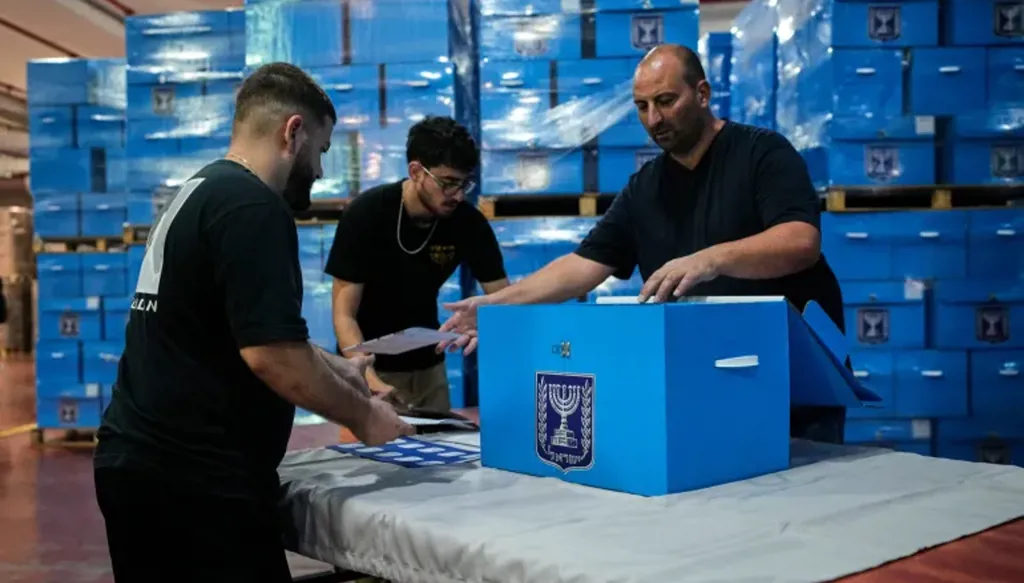
Second, the majority has become hostage to the "minority game" in forming the new government, should one be formed, as many believe. Netanyahu's camp has lost 11 seats compared with the 2022 elections. It previously held 64 seats but has now fallen to 53, including 27 for the Likud bloc.
Gadi Eisenkot's Yashar party, Netanyahu's main rival, secured 21 seats. Eisenkot, however, appears to be on course to lose seven seats from his camp, which won 48 seats, following the departure of Avigdor Lieberman and his group. The ultra-Orthodox parties, which had been Netanyahu's allies in exchange for exempting their members from military service, have seen their bloc shrink from 18 to 13 seats. The exemption was accused of reflecting a double standard, motivated by electoral considerations toward Jewish citizens in Israel, while reflecting a fundamental ideological position on the part of the ultra-Orthodox that is non-negotiable. These parties therefore remain capable of providing Netanyahu with the majority needed to form the new government, despite growing criticism from all political blocs of his policy, which is based on "electoral rather than national considerations."
On another front, the ultra-Orthodox parties cannot form an alliance with Eisenkot, who insists on imposing military service on everyone. One of the biggest surprises of the elections was the Arab parties' performance, securing 19 seats compared with just 10 in the 2022 elections. These parties, of course, cannot enter an electoral alliance with Netanyahu, a possibility he categorically and fundamentally rejects. An alliance between Eisenkot and the Arab parties would also be extremely difficult, although some believe it cannot be entirely ruled out. One possible way forward would be for Eisenkot to "not oppose" granting Palestinians some form of self-rule, however limited that concept might be. Some describe this as giving them a form of "municipal powers" under Israel's tight and comprehensive control.
However, this remains highly unlikely, as it would be unacceptable to the Palestinians. Meanwhile, the accelerating policy of Judaization in the West Bank, through the expansion of strategic settlement activity aimed at exerting every possible form of pressure to gradually displace West Bank residents, does not point in that direction. Nevertheless, some believe that the Arab parties, or some of them, may resort to a form of "punitive voting" by casting their votes for Eisenkot's party, without reaching any agreement with him, in an effort to prevent Netanyahu from returning to power.
Netanyahu believes that one of his main cards in securing the majority required to form a government lies in continuing his war on Lebanon, the West Bank and Gaza, albeit through different forms and varying degrees of military and security operations. The continuation of wars and the escalation of tensions serve his strategy for returning to power.
Several scenarios are on the table. The most likely is that Netanyahu will form the new government on the basis of an alliance that will remain fragile because of the nature of relations among its constituent parties. If this happens, its eventual collapse cannot be ruled out as external challenges mount and domestic pressures intensify.
A second scenario would see Eisenkot secure a narrow majority to form a government. This, too, would create a fragile situation given the nature of the alliances involved and the possibility that the government could fall apart in the face of further domestic and external challenges.
The third scenario cannot be ruled out either: a political deadlock that prevents the formation of a coalition government, regardless of which party takes the lead, paving the way for new elections whose results might, this time, make it possible to form a government.
All these scenarios remain possible, albeit with varying degrees of impact on Israel and on the conduct of Israeli policy in the Levant and the broader Middle East.