Two hundred and fifty years ago, Americans did not rise up against the British Crown only to place an American crown on another man's head. Nor did they write their Constitution to immortalise a ruler, but rather to enshrine the nation's right to hold him accountable.
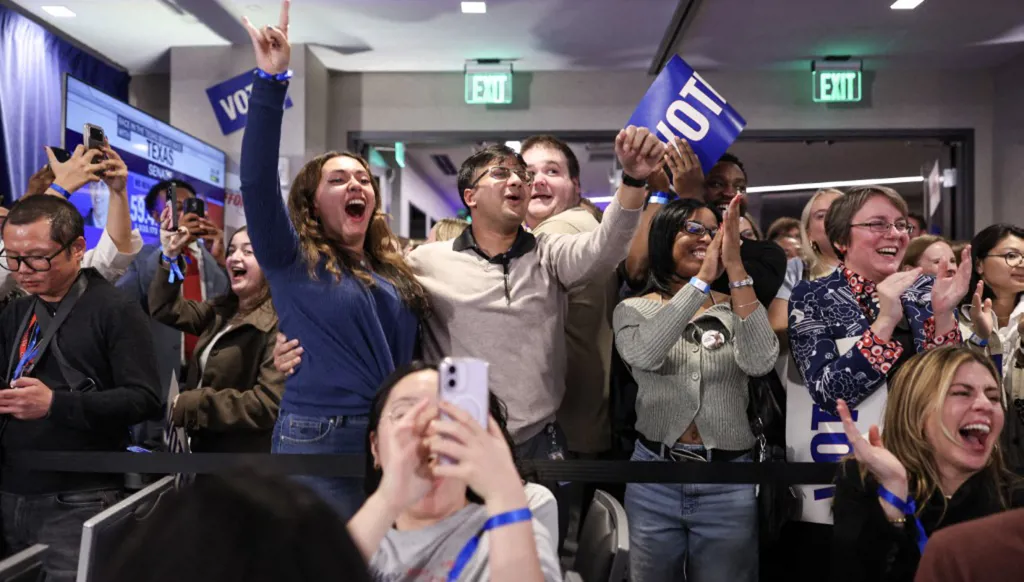
From Philadelphia, where the first promise was born, to the ballot boxes on November 3, history extended its hand, as though restoring to the republic a founding principle that had nearly been forgotten. Americans took to the streets chanting "No Kings", then returned to the ballot boxes to give that chant its constitutional voice. Strongholds once thought unassailable fell, and electoral maps accustomed to a single colour bowed before a will that no one could dictate. This was not merely a victory for blue over red, but a reminder that the White House is no throne, that the people are no subjects, and that America, despite the burden of its leaders' mistakes, still possesses what makes it great: the ability to stand up to power without bringing down the state, and to correct its course without betraying its history.
In the House of Representatives, Democrats crossed the threshold of a majority. Yet, in a striking twist, districts redrawn by Republicans to strengthen their grip failed to secure their seats. Maps may be drawn on paper, but loyalties cannot be dictated with a pen. As for Trump, who urged his supporters to vote as though his name were on the ballot, he said after the defeat: "My name wasn't on it." He was present when victory was expected, only to invoke his absence when the time came to answer for the results.
In the Senate, it was not just the balance of power that changed; the states' political memory was shaken. Texas, the formidable Republican stronghold, elected James Talarico, the first Democrat to reach the Senate from the state since 1988. He spoke of the more than $300 million spent against his campaign, then declared that all the money in the world could not overcome the people of Texas. In this way, progressive Christian rhetoric converged with voters' rejection of the influence of political money. In Kansas, a Democratic drought dating back to 1932 came to an end. In South Carolina, paediatrician Annie Andrews defeated the sister of the late Senator Lindsey Graham, ending a Republican monopoly that had lasted since 1998, in a state where Trump had enjoyed an 18-point lead just two years earlier. Sherrod Brown also returned in Ohio after losing his seat two years ago.
Michigan, meanwhile, sent Abdul El-Sayed to the Senate, making him the first Muslim elected to the chamber, despite attacks on his faith and disagreements over Israel. He will sit alongside a Christian pastor who won in Kansas and a progressive politician of faith in Texas. These diverse victories show that Democrats did not reach voters through a single message. And if JD Vance administers El-Sayed's oath of office in January, the moment will capture in a single image what campaign rhetoric had failed to achieve through its attempts at exclusion.
The ballot boxes did not stop at reshaping the legislative branch; their impact extended to state executives, where other Republican strongholds also fell. In Texas, Gina Hinojosa was elected the state's first Latina governor. In Georgia, Keisha Lance Bottoms became the first Black woman elected governor of a state, despite her opponent, billionaire Rick Jackson, spending more than $200 million of his personal fortune on the race. Jon Ossoff also retained his Senate seat. In Iowa, Democrats returned to the governor's office after two decades. In Minnesota, the first Native American woman took office as governor, while Democrats were also elected to govern Ohio. It was not just seats that changed hands; the keys to decision-making across the states changed hands with them.
Yet voters' anger was not driven by constitutional concerns alone. Prices, tariffs and the war against Iran weighed heavily on their calculations. Though absent from the ballot, Tehran was present in the election, making its way through voters' wallets. From the Strait of Hormuz to American petrol pumps, the cost of war became a political bill. The irony is that Trump, who disavowed responsibility for the defeat on the grounds that his name was not on the ballot, acknowledged that Iran had been "part" of it, before insisting that, given the chance to turn back time, he would make the same decision to go to war. Will he pay an electoral price for that decision without reconsidering its strategic merits? And with a Congress whose majority has shifted to the opposition, Washington's allies in the Middle East face an even more consequential question: will the defeat translate into a settlement that brings the war to an end, or will it lead to escalation in pursuit of a victory beyond America's borders, now that its power at home has receded?
It is worth noting that the blue wave that swept across the American electoral map yesterday was not so much a victory for the donkey over the elephant as an expression of anger at an elephant whose heavy footsteps had weighed down the land until even the strongholds it had long sheltered behind could no longer contain it. Not everyone who voted Democrat necessarily believed in the party's promises; some simply wanted to withdraw their trust from those who had failed to deliver on theirs.
Perhaps this is the greatness of the republic that deserves to be reclaimed: that the mistakes of those in power must never become destiny, and that voters' political affiliations must never become lifelong constraints. Two hundred and fifty years on, the American promise remains greater than one colour prevailing and another receding: no man, however loud his voice, owns the nation; no party inherits the people; and no authority is exempt from scrutiny. If crowns teach kings to bow before them, ballot boxes remind nations that they were created to hold their heads high.
Disclaimer: The opinions expressed by the writers are their own and do not necessarily represent the views of Annahar