The United States and Iran are sending clear signals that they are capable of handling the next war, should one break out. President Donald Trump insists that his administration has funding that will not run out before January, warning Democrats against turning America's "victory" in the war into a defeat. Meanwhile, Iranian Revolutionary Guard Corps Commander Ahmad Vahidi maintains that "victories should not make us stop" and that Iran is "stronger and better prepared on the ground."
Washington and Tehran are both acting as though war is inevitable, or as though it is the necessary passage to another phase in which each side is confident that events will ultimately work in its favor. The US television network NBC reported, citing an American official, that the Trump administration is considering targeting senior Iranian leaders to remove hardliners within the Iranian regime, thereby paving the way for a deal to end the war with Iran.
However, taking such a step carries several risks, including the possibility of sliding into a full-scale war, as well as the resulting erosion of trust and the undermining of ongoing diplomatic efforts. Trump may therefore choose to retain the option of "economic strangulation" for the time being. The continued decline in oil prices is encouraging him to do so.
In an interview with the New York Post, Trump was careful to distinguish his position on the war from Israel's, saying that his goal was to prevent Iran from acquiring nuclear weapons, whereas Israel's goal was to bring down the regime there.
Israel recently presented intelligence indicating that Iran had developed a chemical weapon, making urgent Israeli-American action necessary. Israeli Defense Minister Israel Katz said that Iran intended to use these weapons against Israel, while simultaneously working to "strengthen its capabilities and support Hezbollah in Lebanon and Hamas in Gaza, and seeking to regain its influence in parts of Syria."
Given that Israel's calls for war are driven by domestic political motives, the difficulties facing Yashar party leader Gadi Eisenkot in forming a government have reshuffled the political deck, making outgoing Prime Minister Benjamin Netanyahu the favorite to form the new government or call fresh elections in March. Netanyahu had been pressing for months for a strike against Iran, seeking to force the opposition into an emergency "unity" government under his leadership.
Iran is seeking to project the impression that it can withstand economic pressure. In this context, Iranian Vice President Mohammad Reza Aref said that Tehran was "not concerned about the US blockade" of Iran's southern ports. For his part, Secretary of the Supreme National Security Council Mohsen Rezaei stressed that "the Iranian people and their armed forces are determined to break the blockade."
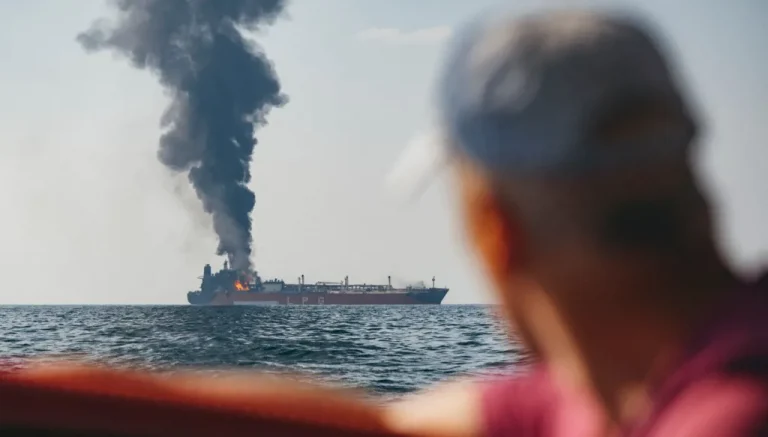
Iranian forces continue to target commercial vessels passing through the Strait of Hormuz without authorization from the Revolutionary Guard Corps. Six ships were hit by projectiles over the past two days while transiting the strait through the Omani (southern) route.
While Iran's aim in disrupting navigation through the strait may be to drive up global oil prices as a means of pressuring Trump, expectations of a global supply surplus are pushing prices down, outweighing geopolitical risks in the Middle East. The decline comes ahead of an expected OPEC+ alliance meeting over the weekend, with investors awaiting producers' decisions on production levels and supply policies for the coming period.
As Washington and Tehran seek to convey the inevitability of another war in the region, the question remains: Are they capable of containing its repercussions on the region and beyond?