If mutual economic pressure between Washington and Tehran is one of the alternatives to military confrontation, oil remains the main lever both sides are using to influence political decisions. The American maritime blockade imposed on Iran’s southern ports for 131 days aims to deprive Tehran of its oil exports and the revenues they generate. Meanwhile, closing the Strait of Hormuz is Iran’s tool to drive up global energy prices, fuel inflation in the United States, and pressure U.S. President Donald Trump to change his policy.
Trump, known for his exaggerations, describes the American maritime blockade as “the greatest siege in history.” Nevertheless, the blockade has failed to deter Iranian officials from refusing to return to the negotiating table or from demanding that Washington fulfill seven Iranian conditions before negotiations begin. As a result, the United States has resorted to facilitating the passage of oil tankers along the southern route adjacent to the coast of the Sultanate of Oman. The measure has succeeded in restoring oil flows to levels close to those recorded before the war. Among other factors, this helped bring prices down from approximately $117 per barrel in late October to below $90 earlier this week.
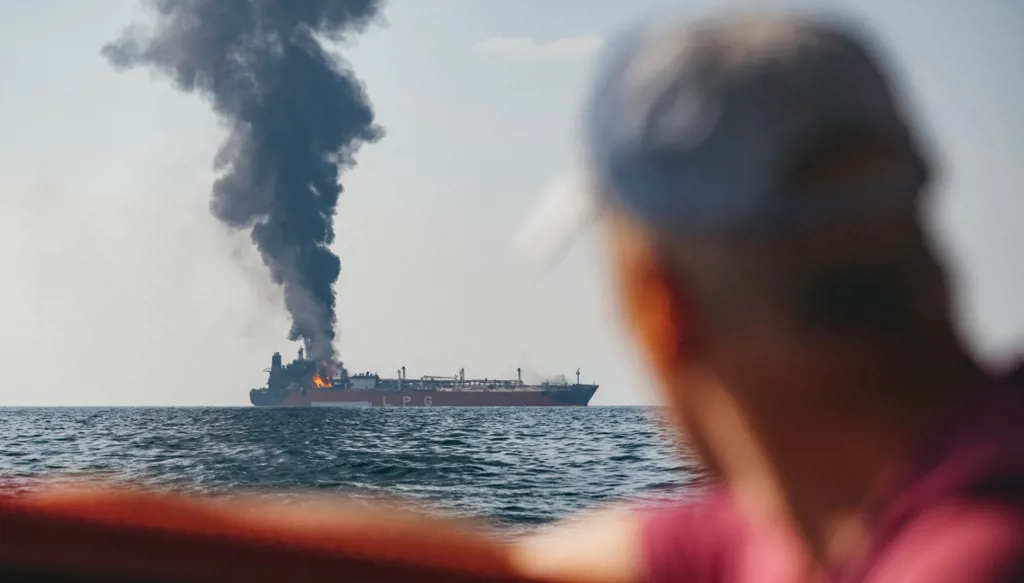
When Iran realized that the Hormuz card was slipping from its grasp, it began intensifying attacks on commercial ships crossing the Strait from the Omani route in October. The attacks reached their highest level since the start of the war, aiming to disrupt navigation through the Strait and regain the most valuable pressure card at its disposal. According to the British Maritime Trade Operations Center, 30 attacks on ships were recorded in October, while 22 were recorded between the beginning of November and last Sunday.
Recently, markets, which had remained unaffected by the wave of Iranian attacks in recent weeks, began sensing renewed risks to oil supplies. This sentiment was reinforced by Houthi attacks in Yemen on Saudi oil refineries, the latest of which targeted the Ras Tanura refinery, considered the largest in the Kingdom.
With Iranian attacks increasing in and around Hormuz and Houthi attacks targeting refineries in Saudi Arabia, the price of a barrel of oil rose to more than $94 in Thursday’s trading.
In what appeared to be a race between the pressures exerted by Washington and Tehran, Iran’s oil revenues have declined significantly due to the American maritime blockade, which aims to prevent Iranian oil from reaching global markets. According to Kepler, a company specializing in tracking international navigation, Iran’s oil stocks outside the American blockade area had been depleted by November. Consequently, oil revenues could drop to zero by mid-December.
This may have prompted Iranian President Masoud Bazashkian to speak frankly during an interview with state television earlier in the week, saying: “We have no money.” He also affirmed that Iran is experiencing a “silent war” that is more challenging than a missile war.
The blockade and declining revenues have led to an unprecedented fall in the Iranian rial, while food price inflation has exceeded 110 percent, doubling the daily living burden on citizens. Iranian officials warn of impending difficulties as winter approaches.
Faced with this reality, Trump is increasingly betting on a strategy of “economic strangulation” to force Iran to make concessions, believing it will ultimately compel the regime to yield.
Conversely, Iran is betting that the costs America bears as a result of the blockade, combined with the Revolutionary Guard’s return to firmly closing the Strait and driving oil prices up again, could increase pressure on Trump to lift the blockade and accept Iran’s seven conditions.
Between these two bets, the Middle East hangs in the balance.