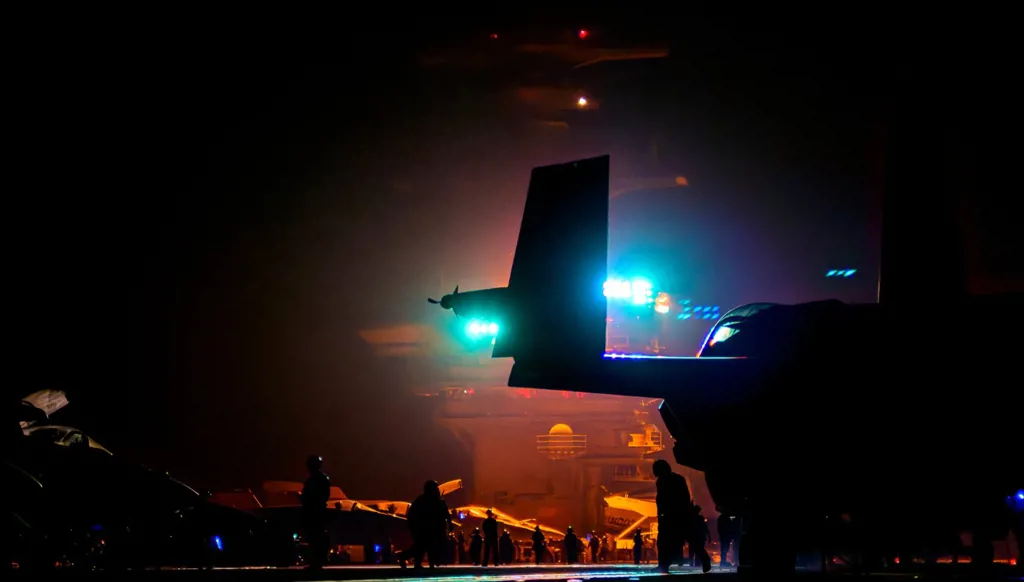
The U.S. military buildup in the Middle East has reached its highest level since the 2003 Iraq War, with the aircraft carrier USS Theodore Roosevelt arriving in the U.S. Central Command area on Monday, joining the George Washington and George H. W. Bush. These reinforcements give President Donald Trump a range of options should he decide to launch new strikes against Iran or intensify military pressure alongside economic sanctions in an effort to bring Tehran back to the negotiating table.
For now, Trump appears to have no clear options beyond continuing to exert economic pressure on Iran while signaling that the military option remains on the table if mediation efforts fail to break the deadlock. U.S. Vice President J.D. Vance acknowledged that some parties appear interested in prolonging the war against Iran indefinitely. His remarks could be interpreted in several ways, perhaps as a reference to figures within the U.S. administration or to Israeli Prime Minister Benjamin Netanyahu, who has been vigorously urging the White House to pursue another round of war.
Vance, whom Trump asked to abandon his efforts to initiate negotiations with Iran, believes the U.S. president can increase both military and diplomatic pressure on Tehran. He expressed his view that Trump is currently considering this approach to avoid another endless war, in remarks aimed at reassuring American public opinion.
As Trump prepares for a trilateral summit with Chinese President Xi Jinping and Russian President Vladimir Putin in Shenzhen, China, on Thursday, he has maintained his usual contradictory positions. On Monday, he endorsed an article by Republican Senator Tim Sheyhi in The Wall Street Journal, which urged the White House to continue confronting Iran despite the political and military costs of war.
American hesitation over whether to pursue this or another option comes amid an increasingly volatile situation on the ground. Iran has stepped up its targeting of oil tankers transiting the Strait of Hormuz along the southern route near the Omani coast, under U.S. Navy escort. On Monday, four tankers were struck by mines laid by Iran in the strait. Iranian drones also carried out a third attack on what Tehran claimed was an American radar system in Bahrain.
These attacks point to Iran's determination to regain full control of the strait and challenge the American narrative of success in bringing shipping traffic close to normal levels. However, the escalating tensions are not confined to the Gulf. CNN broadcast an intelligence report stating that Iran is developing plans to target senior officials in Trump's administration in Washington with a "dirty bomb or chemical weapon," prompting U.S. authorities to draw up emergency plans to counter the alleged threat.
Nevertheless, Tehran continues to keep communication channels open. In a phone call, Iranian Foreign Minister Abbas Araqchi and his Omani counterpart, Badr al-Busaidi, discussed ways to "protect waterways" and find a way out of the conflict. Pakistan is also seizing the opportunity presented by the Economic Cooperation Organization meeting in Islamabad, attended by Araqchi, to discuss reviving efforts to de-escalate regional tensions. Russian Foreign Minister Sergei Lavrov also contacted Araqchi for the same purpose.
The key question remains: Can intensified diplomatic contacts, unfolding alongside U.S. military reinforcements and escalating Iranian attacks, persuade Washington and Tehran to step back and avert the worst?
Disclaimer: The opinions expressed by the writers are their own and do not necessarily represent the views of Annahar.