At a time when US President Donald Trump is rallying his ranks in preparation for the next round of domestic and foreign political battles, Lebanon’s official leadership appears to have fallen into political confusion, tipping the balance in favour of waiting to see which way the international and regional winds will blow.
In this sense, Lebanon’s current political leadership is no different from its predecessors in approaching major decisions by seeking shelter in the prevailing balance of power. The Republican Party and President Donald Trump’s heavy losses in the midterm elections held on November 3 of this year are highly likely to have had a profound impact, shaking the foundations of Lebanon’s legitimacy, which has recently come to resemble an elevator stuck between two floors, unable either to move up or to go back down.
Yet while Lebanon’s legitimate institutions remain paralysed, a striking statement by Army Commander Rodolphe Haykal stands out. In practical terms, he takes aim at those who criticise the army’s timid steps regarding Hezbollah and its weapons, particularly amid the stalled implementation of the Lebanese government's decisions adopted on August 5 and 7, 2025. These decisions stipulate that weapons must be placed exclusively under the authority of the Lebanese state. This was followed by the government's March 2, 2026 decision, adopted in response to Iran's war of support, which bans Hezbollah's security and military activities. In other words, any security or military activity by the group is now illegal and outside the bounds of Lebanese legitimacy.
In practice, decisions have been issued but never fully implemented. The state has failed to seize the opportunity, available for nearly two consecutive years, to expand the scope of Lebanese sovereignty at the expense of Hezbollah's parallel state. Throughout this period, clear contradictions have emerged between the positions of President Joseph Aoun, based on the pledges made in his inaugural address on January 9, 2025, and the reality on the ground. Army Commander Rodolphe Haykal's positions on several occasions in 2025 and 2026 may have brought these contradictions into sharper focus, to the point that questions have arisen about why the army commander has refrained from translating the decisions of Lebanon's legitimate authorities into action on the ground.
Some, of course, direct their suspicions towards early presidential ambitions, while others question whether ideological backgrounds or political convictions lie behind this stance, using the slogan of "civil peace" as a shield against calls to move Lebanon's sovereignty project forward. This has led broad segments of the Lebanese population to believe that the institution is refusing to implement government decisions and international community demands concerning the need to disarm Hezbollah and reaffirm the state's control over its entire territory, as a prerequisite for engaging with a new and different Lebanon, one no longer held hostage by a cross-border Iranian proxy.
The issue is not about the army commander, nor even the president, who enjoys considerable respect both at home and abroad. It is about the Lebanese people's deeply rooted choice to revive the state-building project and translate it into concrete action on the ground. No one will engage with a Lebanon held hostage by force by an armed group classified as a "terrorist" organisation in most countries around the world. The political capital currently enjoyed by the presidents of the republic and the Council of Ministers could well be squandered, returning Lebanon to the state it was in under former President Michel Aoun: a country shunned both domestically and internationally. It is therefore crucial to recognise how critical the situation has become, and how we may have trapped ourselves in a vicious circle.
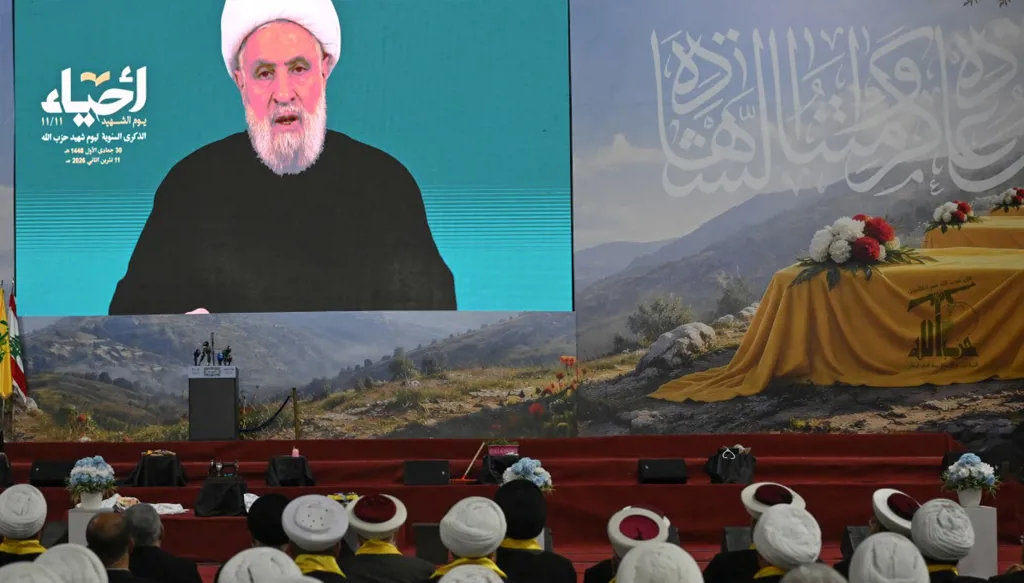
The president's defence of the army commander's positions does not absolve either of them of the responsibility to acknowledge the vast gap between rhetoric and implementation. Is it possible to look beyond invoking "civil peace" as a cover for the deadly paralysis gripping Lebanon, particularly when Hezbollah, through its secretary-general, who remains in hiding underground, wasted little time in resuming his attacks on the legitimate authorities and their decisions, denouncing as traitors all those calling for a state that exercises control over its territory and requires its citizens to respect the law?
Allowing the current situation to continue will inevitably lead to major upheavals in Lebanon:
First, the outbreak of a war between Israel and Hezbollah, which would complete the destruction of what remains of southern Lebanon.
Second, the displacement of hundreds of thousands of residents of southern Lebanon and the southern suburbs of Beirut, along with a destabilisation of relations among Lebanon's various communities.
Third, the renewed isolation of Lebanon's legitimate authorities, both regionally and internationally.
The time has come to reject the blackmail of Iran's proxy and summon the courage and determination to act!
Disclaimer: The opinions expressed by the writers are their own and do not necessarily represent the views of Annahar