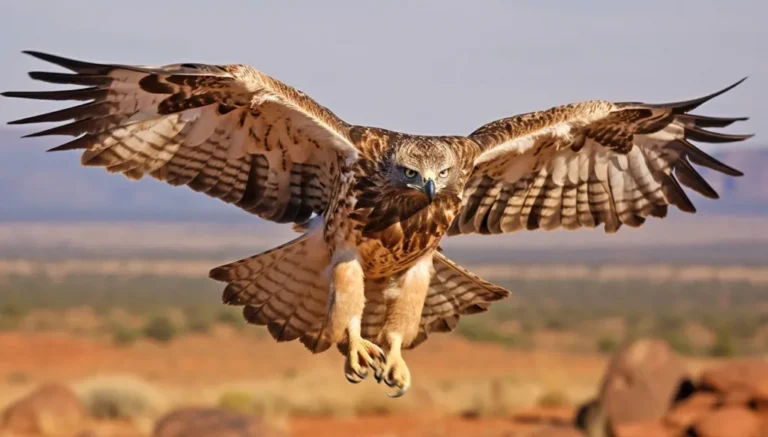
When Arabs wanted to describe courage, they borrowed the strength of the falcon. When they spoke of pride and freedom, they found in its soaring flight a close reflection of their own aspirations. The falcon found its way into poetry, proverbs, and stories, eventually becoming deeply rooted in Arab memory. Yet its status was not born in poems. It was preceded by a long history in the desert, where humans observed the bird in the sky and learned how to enlist its help in hunting. Arabs knew the falcon long before writing about it, discovering through experience that dealing with it required patience, skill, and a precise understanding of its nature.
In the famous Gulf saying, "He who does not know the falcon grills it," popular memory captures part of this status. The falcon becomes a measure of one's ability to recognize value, while ignorance of it serves as an example of squandering something precious.
From a hunting companion in Bedouin life to an enduring symbol of Emirati and Gulf identity, the falcon has travelled a long journey through history. It is the story of a bird associated with freedom, courage, and patience, and of a craft passed down through generations until UNESCO recognized it as part of humanity's intangible cultural heritage. Today, however, environmental challenges are raising new questions about humanity's responsibility toward this legacy.
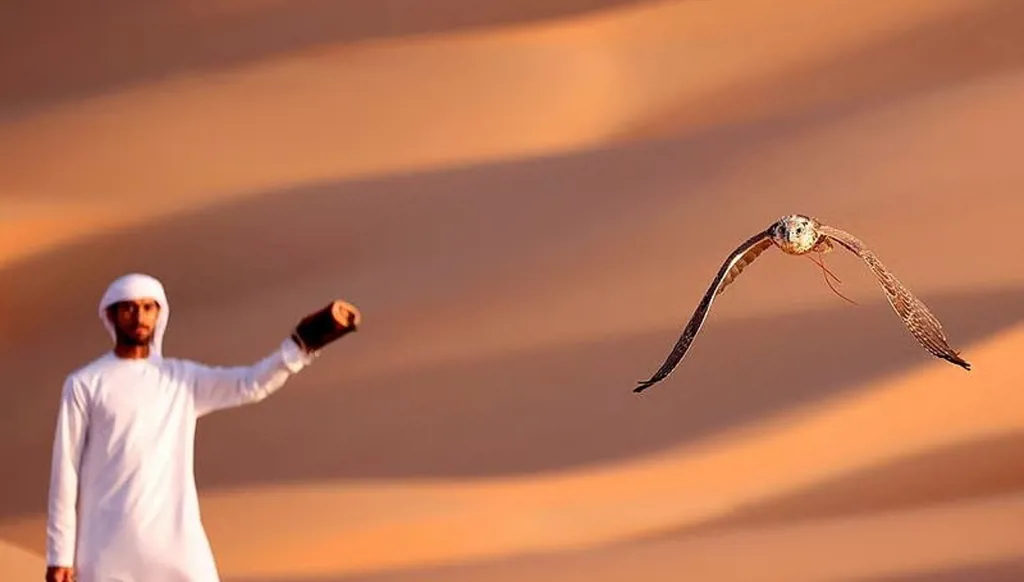
In the desert, where the land stretches as far as the eye can see and silence has a presence of its own, the falconer stands with his arm raised, holding a bird accustomed to soaring across vast distances. A single moment separates stillness from motion. The falcon takes off, cutting through the air with its wings outstretched, disappearing from sight before returning to the hand that released it. It is a scene repeated across generations, yet one that never loses its ability to amaze.
What is most striking about this relationship is that the falcon, unlike many animals that have grown accustomed to humans, retains its wild nature and independence. It can fly away and continue its journey, yet it learns to return. From this delicate balance between freedom and trust emerged one of the oldest relationships between humans and nature.
Arabs knew the falcon long before it became a symbol celebrated in poetry and society. It was a hunting partner and a means of adapting to an environment where resources were scarce. Over time, its presence became part of social life and collective memory. In the Gulf region, particularly in the United Arab Emirates, falconry has retained its status even as the way of life that gave rise to it has changed.
In its early days, falconry was neither a luxury nor a hobby. In desert environments, where nature dictated the conditions of human life, the falcon helped capture elusive prey that would otherwise have been difficult to hunt, including bustards and rabbits.
The practice required precise knowledge of bird behavior, migration seasons, wind directions, and the nature of the terrain. Falconers learned to observe the sky just as closely as they monitored their birds, developing their expertise through years of practice.
Over time, falconry became part of traditional gatherings in councils and hunting expeditions, with fathers passing down its secrets to their sons. Even as lifestyles changed, the skill endured, preserved through memory, customs, and social bonds.
Fouad Aitani, founder and president of the Bird Protection Society in Lebanon, believes that the continuation of falconry is rooted in meanings that extend beyond its original purpose.
Speaking to "Annahar," he said: "Falconry could have disappeared, but it did not, and the reason is that it was never merely a means of living, but an example of patience, discipline, and knowledge of nature, passed down from fathers to sons in councils and hunting trips. That's why it stayed alive, it carries the memory of the place and people."
In the United Arab Emirates, the falcon holds a special place in the national memory. Falconry features prominently in heritage events and cultural activities, as well as in practices maintained by families and institutions dedicated to preserving folk heritage.
This status is closely linked to the history of local communities and their relationship with the desert. The falcon evokes the lives of ancestors, their hunting skills, their knowledge of the land, and their ability to adapt to their surroundings.
Sheikh Zayed bin Sultan Al Nahyan placed particular importance on falconry and helped strengthen its place in efforts to preserve Emirati heritage, alongside initiatives to protect falcons and wildlife.
One manifestation of this commitment is the development of institutions specializing in falcon care, foremost among them the Abu Dhabi Falcon Hospital, established in 1999, which has become a center for veterinary care, research, and the conservation of these birds.
In the Emirati experience, efforts are being made to bring traditional practices together with modern scientific advances in the study and care of falcons, preserving inherited knowledge while addressing contemporary environmental requirements.
In the Arab imagination, the falcon is associated with courage, freedom, and pride. Yet observing it in the wild reveals other aspects of its behavior, ones that may be less apparent in pictures and poetry.
Aitani explains that the falcon is a powerful and precise hunter, but also more cautious than its reputation might suggest. Attacking prey requires considerable effort and may expose the bird to injury, making it careful to assess its chances of success before diving.
He also points out that falcons differ in their individual traits, even within the same species, in terms of temperament, boldness, and ability to learn.
When asked which trait he would choose to describe the falcon, his answer is striking: "wisdom," rather than "fierceness."
Perhaps this observation offers a different way of understanding the symbolism the falcon has acquired. The strength celebrated by Arabs is inseparable from precision, patience, and the ability to make the right decision at the right moment.
Among the species commonly found in Gulf falconry traditions are the Saker falcon, known for its ability to pursue prey across open terrain; the Peregrine falcon, renowned for its exceptional speed during a dive; and the Gyrfalcon, one of the largest falcon species. Today, hybrid falcons bred in specialized centers are also used.
The year 2010 marked a turning point in the history of falconry, when the United Nations Educational, Scientific and Cultural Organization (UNESCO) included it on its Representative List of the Intangible Cultural Heritage of Humanity through an international nomination file in which the UAE participated alongside ten other countries.
The recognition was expanded in subsequent stages to include 24 countries by 2021.
The significance of this recognition lies in the fact that falconry transcends geographical boundaries. Different communities share its knowledge and techniques, while each retains its own cultural identity and traditions.
The practice encompasses skills in training and caring for birds, crafting traditional tools, and understanding nature, as well as its presence in poetry, music, and social customs.
In this context, Aitani points out that UNESCO's recognition granted falconry international acknowledgment as a living body of knowledge passed down through generations.
However, in his view, preserving this heritage requires more than documenting its tools and rituals. It begins with teaching younger generations the fundamentals and ethics of falconry and connecting the practice with the principles of nature conservation.
As environmental changes accelerate, falconry faces a fundamental challenge: how can its traditions be preserved without harming wild birds or the species they hunt?
This question is particularly important as some falcon species face growing threats, including illegal hunting and captivity, habitat loss, declining prey populations, and poisoning.
Drawing on his experience in bird monitoring and field surveys, Aitani highlights another risk: electrocution and collisions with power lines, particularly in open areas where falcons use tall structures as perches and observation points.
Climate change may also affect migration routes, breeding seasons, and prey distribution, although understanding its effects requires long-term scientific monitoring.
In the UAE, the Sheikh Zayed Falcon Release Program, launched in 1995, stands as a prominent example of efforts to bring heritage preservation together with wildlife conservation.
According to official Emirati data released in August 2026, the program has returned more than 2,400 Saker and Peregrine falcons to their natural habitats through veterinary rehabilitation, scientific follow-up, and the tracking of migration routes.
Aitani believes that the success of these efforts should also be measured by the condition of falcons in the wild and the extent to which pressures on their natural populations can be reduced.
This underscores the importance of relying on captive-bred falcons from legal and documented sources, as well as organizing hunting practices according to scientific studies that take prey populations, seasonal patterns, and the condition of wild species into account.
After many years of observing birds and studying their behavior, Fouad Aitani is still amazed by the sight of a falcon swooping down. What strikes him most is its exceptional ability to combine strength with precision and make decisions in a fraction of a second.
Yet what he considers most worthy of attention goes beyond the bird's hunting abilities to its role in nature and the relationship humans have built with it throughout history.
The falcon, once known in the Arabian desert as a partner in securing food and a symbol of strength and freedom in the Gulf imagination, now carries an additional meaning: the responsibility to protect it.
Perhaps the most beautiful aspect of this story is that the hand that learned, centuries ago, how to call the falcon back must now learn when to let it fly.