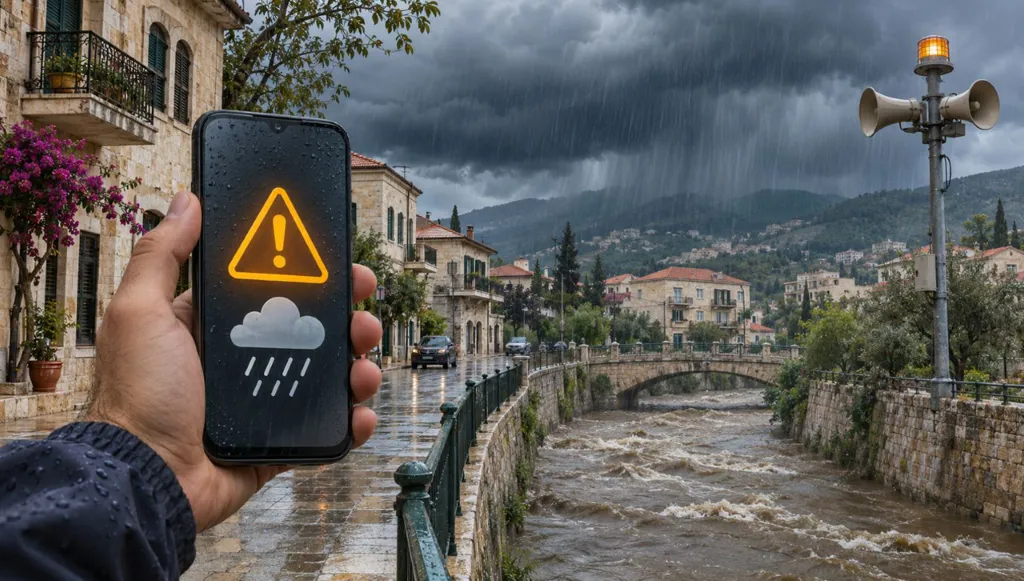
A storm forecast may be accurate, and the resulting disaster may still be devastating. Information that remains on an expert’s screen does nothing to protect a home near a riverbed, and a warning that arrives too late gives people no time to move their children to safety or close their shops. That is why evaluating early warning systems begins with a question that goes beyond the accuracy of the weather forecast: What happened between the issuance of the warning and the moment residents took action to protect themselves?
Why this matters: Climate change is increasing the need to prepare for weather-related hazards. However, the scale of losses is also affected by where buildings are located, the condition of drainage systems, poverty, and the ability of institutions to intervene. Not every flood should be considered standalone evidence of global warming. Attributing a specific event to climate change requires scientific research, while preparedness can be improved immediately, regardless of the number of factors behind it.
The United Nations Environment Programme identifies four pillars of early warning systems: disaster risk knowledge and management, monitoring and forecasting, warning dissemination and communication, and preparedness to respond. The point is that purchasing new monitoring equipment is not enough if vulnerable neighborhoods have not been identified, or if it is unclear who is responsible for contacting residents and who has the authority to order the evacuation of a high-risk area.
UN estimates indicate that providing notice approximately 24 hours before a hazardous event can reduce damage by up to 30 percent. This is an estimate of the benefits of early warning under suitable conditions, not a guarantee for every storm. Flash floods, for example, may leave much less time to react, and some residents have no means of transportation even when they understand the warning.
It is essential to clearly communicate the level of risk and update messages whenever forecasts change. After every incident, authorities should disclose what worked and what failed, rather than reducing the assessment to finding someone to blame or simply praising the efforts made.
In October 2026, the agenda of the Second Arab Forum on Early Warning and Disaster Preparedness placed coordination, funding, communication, and access to communities at the center of the discussion. These challenges become even more difficult in environments affected by conflict, displacement, and weak public services, where communication channels may be disrupted and residents' places of residence may change constantly.
A useful warning needs to provide specific answers: Which area is at risk? When will the danger begin? What action should people take? And where can they find help? A general statement urging people to "exercise caution" leaves considerable room for interpretation. By contrast, clear instructions about avoiding a low-lying road or crossing a watercourse link information to a concrete decision, provided they come from a competent authority and are based on reliable data.
In Lebanon, the entire chain can be tested within a single municipality before drawing conclusions about the country as a whole. The assessment begins with the authority receiving the alert, moves through the list of officials and communication channels, and ends with the location where people can seek shelter if they are forced to leave their homes. This is an assessment of preparedness, not a preconceived assumption that the system is either working or failing.
The test should also include people who may have difficulty receiving messages: older adults, people with disabilities, those without reliable internet access, and workers who do not understand the language used in the announcement. Multiple communication channels can be used, while avoiding the circulation of conflicting instructions. Ensuring that warnings are accessible is part of service design, not the sole responsibility of individuals.
An effective response requires practical training. Can an emergency shelter be opened at night? Does the staff member on duty have the authority to take action? Is there a way to transport a patient or someone with limited mobility? A small-scale drill can expose these gaps before they become emergencies and allow procedures to be adjusted to available resources, rather than relying on a plan that is difficult to implement.
Trust is also built through explanation and review. A warning reflects a possibility that may not fully materialize; it is not a promise that a disaster will certainly occur. It is essential to clearly communicate the level of risk and update messages whenever forecasts change. After every incident, authorities should disclose what worked and what failed, rather than reducing the assessment to finding someone to blame or simply praising the efforts made.
The time it takes for a warning to reach people should also be measured against the time it was issued. An official authority may publish an alert well in advance, but it could take too long to circulate between departments or reach residents only after the danger has begun. This is why recording the time taken at each stage, conducting test calls, and checking that contact numbers and the names of staff on duty are up to date are all useful measures. This approach makes service improvements measurable and directs resources towards the stage where delays actually occur, rather than purchasing equipment before identifying the source of the problem.
The Early Warnings for All initiative aims to protect everyone through such systems by 2027. But the value of this commitment must be measured at the local level: How many people received and understood the warning? How long did it take to make a decision? And did assistance reach those most at risk? Saving lives requires linking science to public services, so that every minute gained through better forecasting translates into real time that allows people to reach safety.