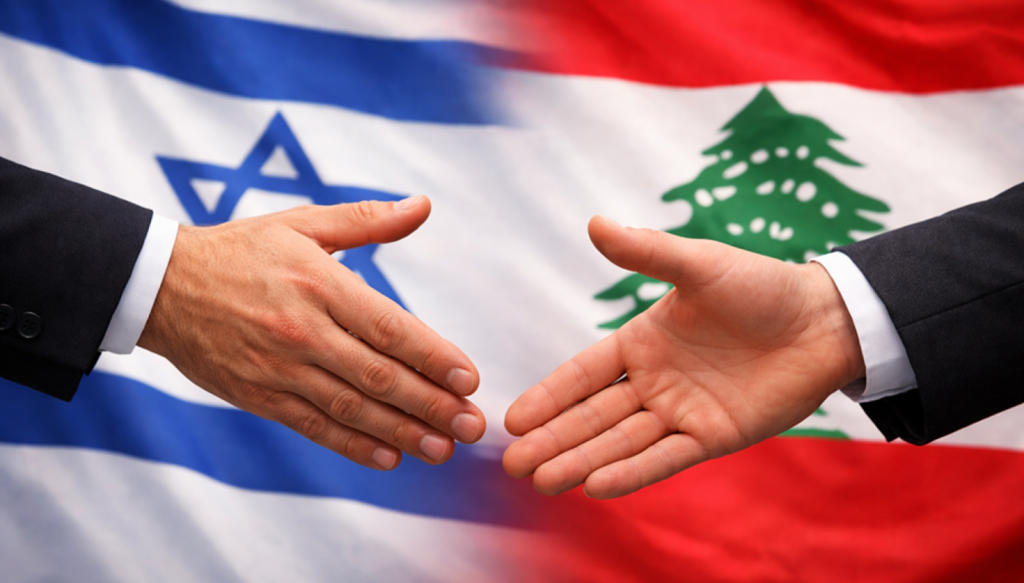
The call for peace with Israel, during a moment of crisis in Lebanon, seems to some like a discovery of salvation.
Lebanese groups are enthusiastically promoting this slogan, defending it with arguments ranging from the desire to end wars, to economic openness, cultural interaction, and even the wish for Lebanon to become part of a region with natural relations after decades of conflict.
But the issue is not with the idea of peace. Peace itself is a legitimate, noble political and humanitarian goal. The problem begins when peace turns from a comprehensive political project into a psychological reaction to past tragedies.
Here, we are talking about a phenomenon that could be called “emotional peace.”
Peace is not about where we drink beer, which beach we visit, which religious site we aim for, or which company we trade with. These are all natural manifestations that could, and perhaps should, come in the context of a stable relationship between two nations. But they are not the essence of peace.
The essence of peace is the state, sovereignty, borders, security, guarantees, agreements, the ability to implement them, and the regional environment that protects them.
Lebanon, before raising the question of peace with Israel, needs to answer a more fundamental question: How does it build a state capable of making peace? And this is not a theoretical matter.
Lebanon signed an armistice agreement with Israel in 1949 under the auspices of the United Nations, while its history since then has witnessed a series of wars, interventions, occupations, and conflicts related to the Arab-Israeli conflict. The Taif Agreement also stipulated extending state authority over all Lebanese territory and disarming militias.
However, Lebanese history has repeatedly shown that the problem was not only how to interact with Israel, but also how Lebanon itself became a battleground for the conflicts of others.
It began with the Palestine Liberation Organization. Then came the long Syrian tutelage. After that, the Iran-“Hezbollah” equation was entrenched. Thus, at every stage, Lebanon was paying the price of a conflict larger than its capacity to control.
More importantly, this experience created, for some Lebanese, an opposing conviction: if the slogan of hostility toward Israel was used to justify violating Lebanon’s sovereignty, why not make peace with Israel as the opposite path to restoring this sovereignty?
The question is understandable... but the conclusion is not so simple.
There is a fundamental paradox in the Lebanese discussion. Some want peace with Israel to be a means to rebuild the state, while Lebanon actually needs a degree of state rebuilding to be able to create sustainable peace.
Peace between two nations assumes the existence of two nations capable of making decisions and implementing them.
And if the Lebanese state is unable to monopolize decisions of war and peace, is internally divided on defining its national interest, faces a deep economic and social crisis, or is still unable to secure internal consensus on weapons and sovereignty, then signing an agreement does not necessarily solve the problems that caused the wars.
The conflict might then shift from a cause of war to a cause of disaster. Here lies the gap between desire and project.
Lebanon needs peace with Israel, if it decides so according to its national interests, not as an emotional response to defeats experienced under “resistance” slogans.
As a prelude to that, it needs peace with itself: one state, one sovereign decision, one army, capable institutions, clear borders, an economy capable of absorbing openness, and internal consensus on the rules of the game.
Without this, peace might become another source of division. Just as Israel was previously used as an excuse to paralyze the state, the peace slogan with it might turn into a new excuse to bypass fundamental Lebanese questions.
The problem, then, is not that a Lebanese person dreams of crossing the border one day without war, trading with Israelis, visiting Israel, or hosting Israelis in Lebanon.
These are all possible results of real peace, but they are not a definition of peace.
Peace is not about life becoming normal after signing the agreement; peace is about having the conditions that make this normal life sustainable.
Here, the Lebanese discussion must shift from desire to politics, and from the emotional question, “Why don’t we make peace?” to the more difficult political question: “What kind of peace, under what conditions, who protects it, and who holds the decision of war if it collapses?”
This is the difference between emotional peace and political peace.
Disclaimer: The opinions expressed by the writers are their own and do not necessarily represent the views of Annahar.
Thank you for subscribing to our newsletter