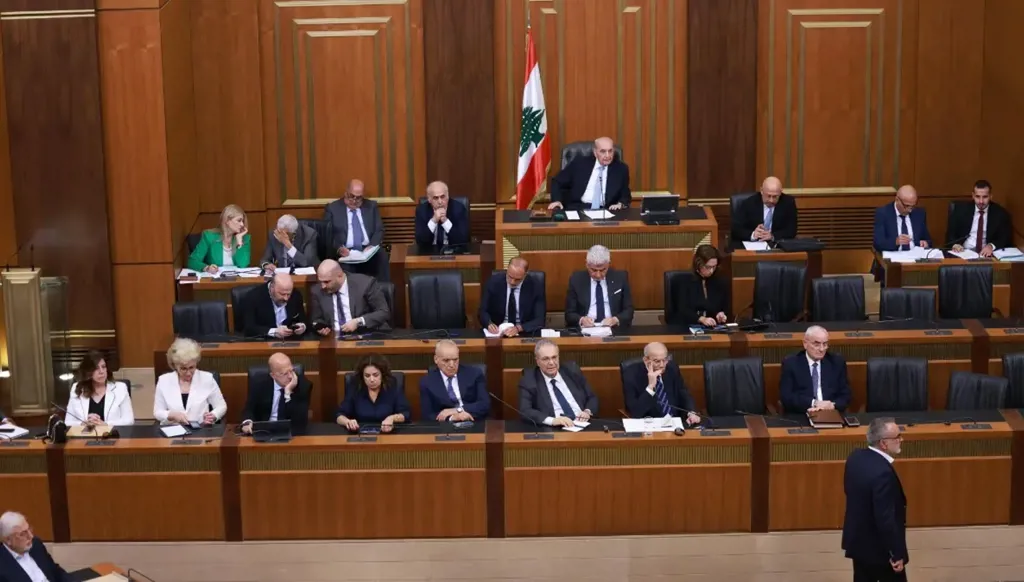
A two-day parliamentary questioning session exposed the tensions surrounding Lebanon’s political system, from government accountability to Hezbollah’s place within the state.
If most Lebanese, as is likely, did not dedicate any time to following two days of speeches and televised addresses directly from Parliament, it is reasonable to doubt that similar sessions would attract viewers in the Arab world, for instance. This does not in any way undermine the democratic parliamentary fundamentals that distinctly characterize the Lebanese system, with its long-standing and unique place in Lebanon’s history and reality. In particular, this facet of Lebanon’s pluralistic formation and democratic system has been, and remains, at the core of its distinction in its surroundings and the world, despite all the distortions the original system has faced over the past five or six decades.
Indeed, raising the issue of democratic fundamentals comes to the forefront during every test of the state of Lebanese democracy. A recent example was the parliamentary session questioning the government of Prime Minister Nawaf Salam, which ended with a vote of confidence granted by the parliamentary majority, marking the third such vote since this government was formed.
Perhaps the most notable paradox accompanying the two-day sessions was that a country groaning under an imposed and forced cruel war, alongside countless internal crises and issues, was expected to consider such governmental questioning far more significant than merely a rhetorical display for populist parliamentary bids. Yet indifference marked the reception of these sessions until everyone was surprised at the end by a confidence vote in the government initiated by the Aounist bloc.
This meant that the bloc, seeking to highlight its role as the sole opposition to the government, provided the government with a precious gift by giving it the opportunity to demonstrate that it continues to enjoy a parliamentary majority, also supported by ongoing Arab and Western backing.
This is not a trivial detail in the trajectory of a country undergoing a severe struggle between its authorities’ efforts to rid itself of the burdens of war, occupation, and regional overreach, and its endeavors to preserve the characteristics of its system, which has been explicitly and implicitly subjected, since the post-Taif Accord era, to attempts to hollow out and undermine its features for regional objectives pursued by what was termed the “Resistance” faction.
Despite the catastrophic decline in the Lebanese people’s trust in their system, due to the state’s excessive displays of weakness and failure to fulfill significant commitments it repeatedly makes, especially regarding the exclusive possession of arms and the disarmament of all illegal weapons, notably Hezbollah’s arsenal, the depth of the facts proves that attempts to undermine the Lebanese system have utterly failed.
This includes previous experiences during the Syrian regime’s past tutelage over Lebanon and its partnership with the Iranian regime, as well as current attempts to intimidate the state and sovereign forces with remnants of armories or remnants of the “deep state.”
None of this appeared directly in the parliamentary scrutiny sessions, but it lay in the background of the broader political reality shadowing any internal political movement in Lebanon.
Indications sharply show that the Lebanese constitutional and parliamentary system, although failing in many Lebanese dilemmas, remains stronger than those who seek to overthrow it and turn Lebanon into something far more dangerous than it is. Specifically, the Hezbollah bloc, while framing verbal confrontations with most blocs opposing the party’s arms and its allegiance to Iran, abstained from voting confidence for the third time, exiting Parliament before the vote because it does not wish to resign its ministers from a government it describes as the American-Israeli custodianship government over Lebanon.
Hezbollah’s duality in remaining within the government of its “enemies” reveals a lingering strength in a system that compels the party to cling to its last “protection” card; without it, the last fig leaf over its legitimacy would fall.
Disclaimer: The opinions expressed by the writers are their own and do not necessarily represent the views of Annahar.
Thank you for subscribing to our newsletter

