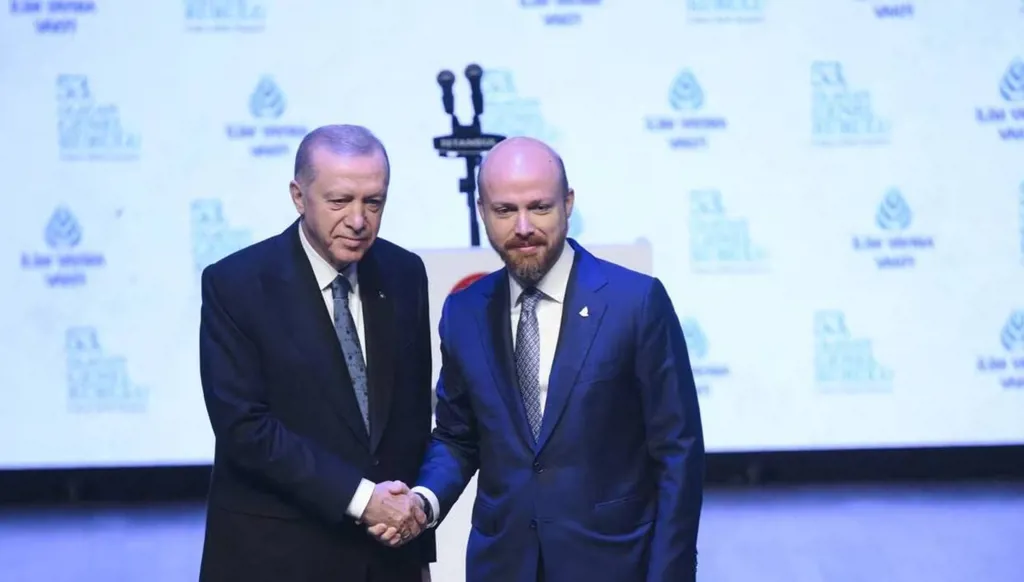
Welcome to the country to the esteemed Ottoman governor, Bilal Recep Tayyip Erdoğan, who is making the rounds of political and religious shrines before holding public meetings, particularly in certain predominantly Sunni areas. Welcome to Bilal Erdoğan, who seems almost like the new conqueror of a country lost in questions of its own fate, identity, and allegiance. A fertile land for every occupier, guardian, and patron, to the point that he is even checking on the descendants of the Ottoman sultan after conducting a comprehensive survey of what remains in the Land of the Cedars.
Erdoğan is being greeted with considerable warmth and enthusiasm, particularly within the Sunni community, which lacks leadership and feels orphaned in the absence of its leader, former Prime Minister Saad Hariri, following the assassination of his father, former Prime Minister Rafik Hariri, in an attempt to turn the page on one of the most influential chapters in modern Lebanese history.
Bilal Erdoğan is neither a head of state, nor a prime minister, nor an official presidential envoy. Yet he has managed to make significant inroads across all circles, beginning with the official establishment and extending to the public. In doing so, he may well be taking a step forward towards political succession in his own country, using Lebanon as his gateway.
Bilal Erdoğan is much like Khalil, the son of President Joseph Aoun, or Mustafa, Abdallah, and Bassel, the sons of Parliament Speaker Nabih Berri, or the son of Prime Minister Nawaf Salam. I wonder whether any of these sons would receive a welcome at the presidential palace, or at any other high-level public or private venue, were they to visit Turkey. Would any celebration be held in their honour beyond a lunch or dinner hosted by friends, who would most likely not be Turkish?
With the advent of the new Syrian era, there was talk of a different approach to relations between the two countries and of turning a new page after years of tutelage and occupation. What actually happened, however, was a Lebanese rush to secure Syrian approval, with various parties seeking to win favour in Damascus. These were parties that had regularly travelled that road, with Anjar being their most prominent stop. They sought to revive past practices. These attempts, coupled with the lack of serious and clear official engagement with the new regime, prompted the Syrian leadership to adopt a condescending attitude and deal with Lebanon cautiously, perhaps even with a degree of superiority. After all, Syria's need for the wider world, the Gulf states, and others is greater than its pressing need for Lebanon. The Syrian president, who has travelled the world and visited both near and distant countries, is still perhaps waiting for the Lebanese president to visit Damascus, rather than the other way around.
Lebanon's treatment of all foreign envoys is marked by a sense of inferiority that falls short of the standards expected of a state confident in its sovereignty, independence, and ability to engage with other countries on an equal footing. This, in turn, encourages those countries to adopt a somewhat condescending attitude towards it. What we witnessed in the various stages of Bilal Erdoğan's reception confirms this reality and diminishes Lebanon's standing, not that of the guest, with whom we have no particular concern. He may not even have asked for such an enthusiastic welcome or expected it, although he will certainly be pleased with it.