Wars are not measured only by the military installations their missiles destroy, but by their ability to disrupt the infrastructure on which economies and states depend. Iran’s threat to target undersea internet cables carries strategic weight because it opens a new front in the conflict, one in which the confrontation shifts from controlling land and sea lanes to influencing the flow of information and data.
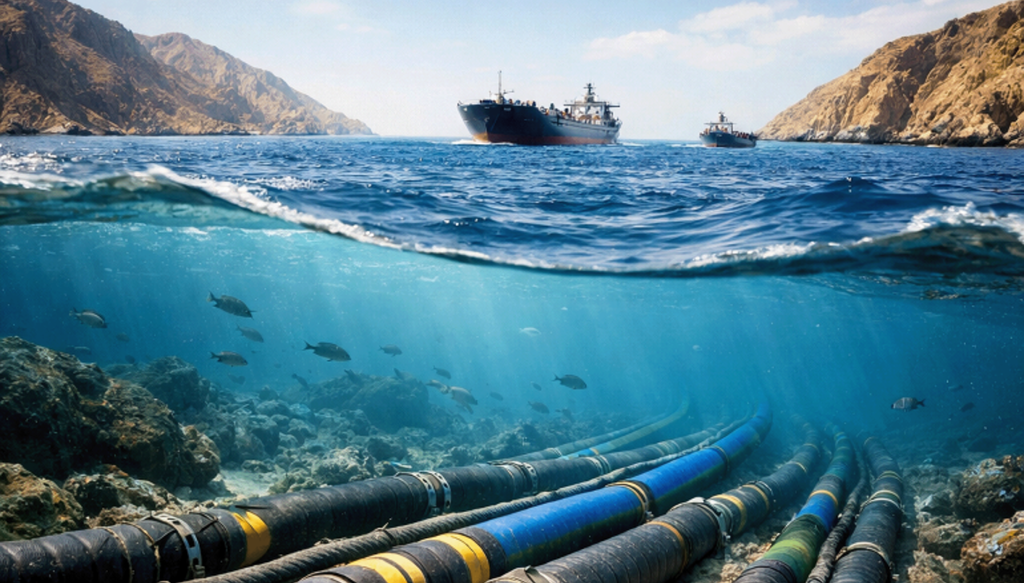
The significance of this threat stems from the geography of the Strait of Hormuz and its surroundings, where maritime communication routes link the Gulf states to international networks. Broad sectors, from banking and e-commerce to government services and cloud computing, rely on this digital infrastructure, which has become a core part of economic security.
Yet the seriousness of the threat does not mean that targeting the region’s cables would cut off the internet worldwide. The impact depends on how many cables are damaged, how heavily countries rely on them, and how well networks can reroute data traffic through alternative paths. The damage could therefore be severe for some countries without paralyzing international communications entirely.
How does the equation of war change?
The first shift is the widening of economic pressure. Disrupting undersea communications could slow financial and commercial transactions, raise the cost of digital services, and affect institutions that depend on constant connection to data centers and foreign markets. Civilian infrastructure thus becomes part of the pressure equation in war, even without directly targeting military forces.The second shift concerns deterrence. The mere threat of damaging communication networks may push an adversary to recalculate the cost of escalation, especially if the economic and technological interests of allied states are at stake. Here, cables turn from invisible technical infrastructure into a strategic bargaining chip that can influence political and military decisions before it is ever actually used.
The third shift lies in the nature of the damage and the time needed to recover. Repairing undersea cables requires specialized ships, technical teams, and security conditions that allow the work to proceed. In a volatile military environment, repairs may be delayed, so losses extend beyond the initial outage and become a mounting economic burden.
Does Iran possess a weapon capable of deciding the confrontation?Despite the importance of this card, its power is not absolute. International internet networks rely on a vast system of cables and alternative routes, and cutting a single cable does not mean the collapse of the network it serves. Rerouting data can limit the extent of the damage, although it does not guarantee avoiding congestion or a decline in connection quality.
Moreover, using this threat may carry risks for the party that resorts to it, as it could trigger broader military or economic responses and harm regional interests beyond the targeted party. The value of the threat is therefore measured not only by the scale of damage it can cause, but also by the cost that carrying it out may entail.
In conclusion, the Iranian threat to internet cables reveals a fundamental shift in the concept of power in modern warfare. Strategic corridors are no longer limited to oil and trade routes; they also include the pathways that carry data and keep the digital economy running.
Still, the issue is not the ability to cut the world off from the internet, but the ability to disrupt vital systems and raise the cost of confrontation for the adversary. In today’s wars, disrupting a digital artery may not be enough to win the battle, but it can become a decisive factor in determining its cost, its duration, and the options available for ending it.
Disclaimer: The opinions expressed by the writers are their own and do not necessarily represent the views of Annahar