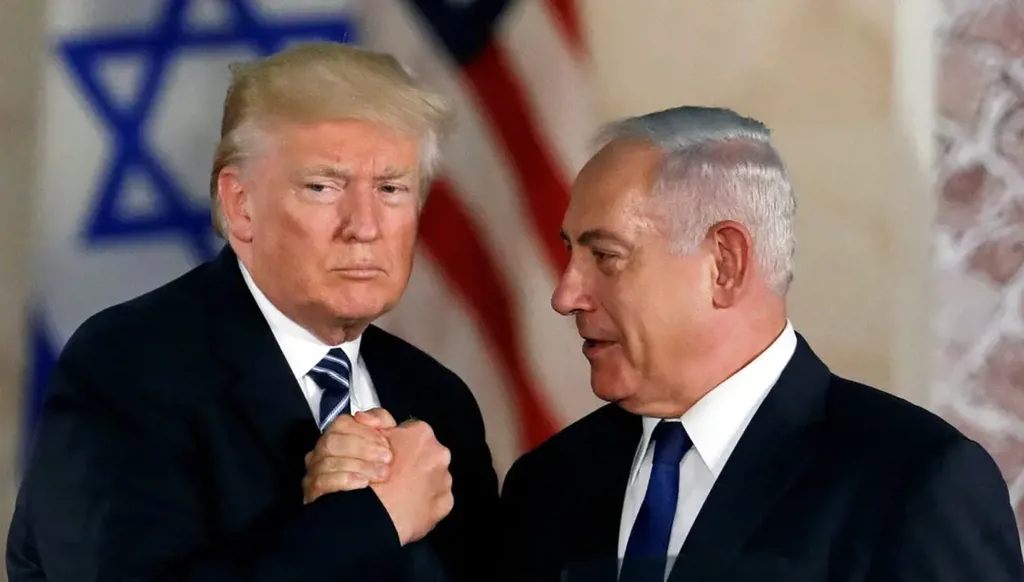
The announcement by U.S. President Donald Trump supporting Benjamin Netanyahu to win the upcoming Israeli elections (on October 27 of this month) did not come as a surprise to most interested parties and observers, both inside Israel and internationally. This is due to the similarities between the two men in their populist tendencies, their vision for governance, which includes a quest to seize power, a disregard for legislative and judicial authorities, and their belief that power is the basis of international relations.
In turn, Netanyahu quickly capitalized on this announcement as part of his election campaign, describing Trump as "the greatest friend Israel has ever had," using it to fend off internal accusations that blame him for tensions with the American administration and for damaging Israel's status and isolating it internationally due to his stubborn positions on numerous regional issues, from the Palestinian issue to the war against Iran and the fractured relations with European countries.
In any case, Trump, through this move, has revived the policies he adopted in his first term (2017-2021), which revealed an absolute bias in favor of Israel by closing the PLO office in Washington, cutting ties with the peace process, legitimizing settlement in the occupied Palestinian territories, opposing any move to support the establishment of an independent Palestinian state, and halting support for UNRWA as part of liquidating the refugee issue. Additionally, he supported Israel politically, militarily, and financially in the ongoing war against the Palestinians and sought to separate Gaza from the Palestinian entity.
It becomes clear that the betting by some Palestinians and Arabs on disagreements between the American and Israeli administrations was misplaced, stemming instead from a wishful spirit and a lack of understanding by this group of the true nature of the strong American-Israeli relations from all perspectives. This aligns with the famous saying: "The West has no better ally in the East than the West itself, meaning Israel." This indicates that any disagreement between the two parties is merely about form, method, or priorities, not about the essence or the objectives pursued between America and Israel.
The important point here is that Trump's announcement provides Netanyahu with election support that will undoubtedly make a significant difference in the upcoming elections, enhancing his position by increasing the vote share in his favor and improving his chances of forming a government coalition, at the expense of other opposition and rival candidates.
In fact, opinion polls in Israel indicated optimism for the opposing figures, especially for General Gadi Eisenkot, former Chief of Staff of the Israeli army. However, the "vote" from America might tip the scales in Netanyahu's favor in this historic Israeli election race. With a Prime Minister who has fought the largest, most dangerous, and longest war in Israel's history, and one who is attempting to consolidate executive, legislative, and judicial powers in his hands, while striving to transform Israel from being a Jewish and democratic state (for its Jewish citizens) to a national and religious state for Jews. It is noteworthy that he has become the longest-serving Prime Minister in this position (1996–1999 then from 2009 to the present), surpassing even Ben Gurion himself.
This means that Israel, under the extremist government of national and religious right-wingers (Netanyahu, Smotrich, Ben Gvir), is facing a new phase in its history regarding its nature, status, and self-vision. It is no longer the state that presents itself as a victim, nor as a state that pleads for the world's sympathy, nor as a haven of democracy in the Arab world, nor as an extension of liberal democratic values in the West. Rather, it is striving to establish itself as a Jewish and religious state, attempting to impose its status in the Middle East and enforce the peace it desires through power, legitimizing the use of its extensive military arm, from Lebanon to Iran.
Extreme right-wing currents, both national and religious, find current international and regional conditions, including the American stance (under Trump's administration), conducive to imposing their vision. They exploit the "Al-Aqsa Deluge" operation in the worst ways to impose their priorities and interests, even enforcing their vision of what the new Israel should be, a vision other secular and liberal currents see as a departure from the first Israel. This means that today's Israeli extremism has a dual face, against Palestinians and against other Jews.
Due to all this, Trump's announcement serves as a vote for his partner Benjamin Netanyahu, and it may be the "tipping point" that decides in his favor in elections that rely on the vote percentage for one list or another, as well as on the person most capable of forming a government coalition.
Disclaimer: The opinions expressed by the writers are their own and do not necessarily represent the views of Annahar.