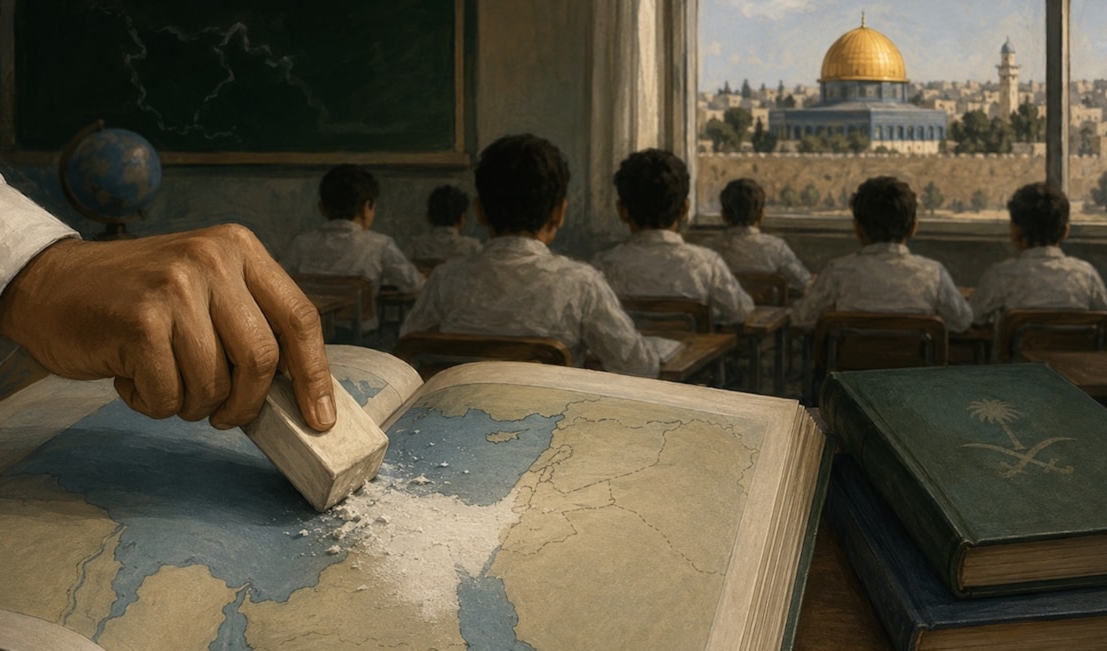
“The Muslims will not give up Jerusalem,” is among a number of references that Saudi Arabia has removed from its school curriculum. Since the start of the month, social media users have circulated reports of a Saudi effort to soften hostile language toward Israel, alongside the removal of “Palestine” from most maps and practical examples in several textbooks. A broad backlash followed, with Saudi activists dismissing the reports as attempts to undermine the country’s standing. But Israeli NGO IMPACT-se, which monitors school curricula across the Middle East, has documented what it describes as a new direction in Saudi education policy. Saudi Arabia has been under scrutiny since the Abraham Accords process began in 2020. While its possible entry into the accords appeared more difficult after Israel’s actions in Gaza, changes to its curriculum suggest the process began earlier. Riyadh started revising school materials in 2024 and has continued making changes that reduce the presence of Palestine in the collective consciousness of future generations. Where there is smoke, there is fire When reports of the changes first emerged, most Saudi activists rejected them as rumors. Despite decades of media campaigns aimed at changing perceptions of the enemy, the widespread reaction reflected disbelief that the Saudi leadership could take such steps. The reports began with the Israeli newspaper Maariv, which highlighted changes to Saudi textbooks as evidence of continued “softening” toward Israel. Other digital platforms followed with additional material. IMPACT-se’s recent report went further, examining changes grade by grade and documenting what it described as significant systematic revisions. The Israeli institute monitors “peace and cultural tolerance in school education in the Middle East,” although Israel’s own educational materials have been criticized for promoting racist and genocidal ideas. The latest reports suggest Saudi Arabia is preparing the cultural ground for younger generations to accept Israel as a state and detach Palestine from its moral and religious significance. Normalizing the occupation IMPACT-se reviewed Saudi textbook revisions between 2024 and 2026. It found that references linking Muslims to Palestine were removed. One prominent example appeared in an 11th-grade Arabic textbook in the 2024-25 academic year, where the sentence “The Muslims will not give up Jerusalem” was deleted. It disappeared from editions published from the following school year onward. Another example appeared in an 11th-grade history textbook. A passage on Saudi assistance to Egypt and Syria during the 1973 war referred to Israel as “the Zionist enemy.” By the following academic year, the term had been replaced with “Israeli occupation.” While the new wording still carries a political judgment that rejects recognition of the occupation, IMPACT-se described the change as one that “reduces hostility toward Israel”. More politically significant changes affected references to Palestinian territory. According to the review, the word “Palestine” was removed from occupied territories in Saudi textbooks. Some maps now leave the territories unnamed. The Israeli institute also welcomed Saudi Arabia’s removal of some Quranic and hadith passages, describing it as a positive development. Preparing future generations for normalization US President Donald Trump’s administration sought during his first term to advance the “Deal of the Century.” Since 2020, four Arab states have entered the normalization process, beginning with the UAE and Bahrain, followed by Morocco later that year. Saudi Arabia appeared likely to follow, but the political moment was disrupted by the Gaza war. Riyadh has said it will not pursue “peace” with Israel without an independent Palestinian state. The latest reports suggest Saudi Arabia is preparing the cultural ground for younger generations to accept Israel as a state and detach Palestine from its moral and religious significance. Nelson Mandela described education as a fundamental tool for changing what societies accept as normal. Systematic change begins with what people learn to regard as ordinary. The illustrations in today’s textbooks can become the social realities of tomorrow. This is an edited translation for an article published in Arabic.