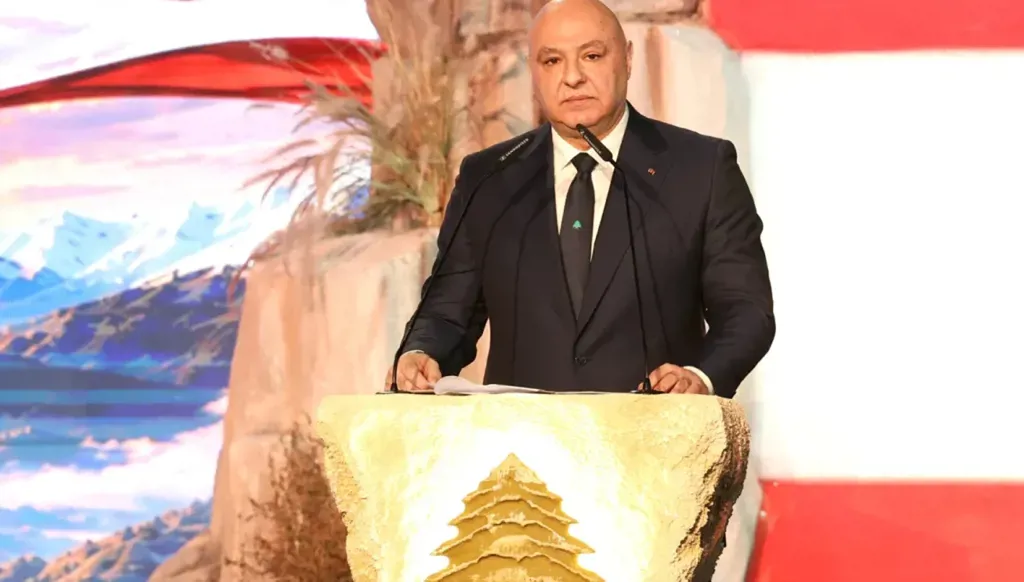
President of the Republic General Joseph Aoun has taken a significant step towards identifying the nature of the obstacles standing in the way of Lebanon’s independence and development. For the first time, he publicly identified “certain influential parties in Iran” as responsible for arming Hezbollah, placing them alongside Israel and its occupation of southern Lebanon as two major obstacles.
While this reality has long been known and widely discussed, publicly acknowledging it in such candid terms marks a shift in the confrontation with Hezbollah towards its actual scope: openly denouncing Iran’s role, which makes no secret of its support for and intervention in the party’s affairs, rather than resorting to diplomatic innuendo.
Equating Iranian intervention with Israeli occupation as two obstacles to Lebanon’s independence marks a development that places the country at a pivotal stage on several fronts. The question is whether President Aoun can shield Lebanon from the consequences of Iran’s efforts to seize control of its national decision-making, amid external disappointments with official positions that neither confront the facts nor attempt to accommodate them excessively.
These concerns are compounded by fears of possible repercussions, including a tougher Israeli stance on withdrawing its forces from Lebanon, even if its government changes, and resistance from Hezbollah or Iran to handing over the party’s weapons to the legitimate authorities under the pretext of the continued Israeli occupation.
There are fears that extremists on both sides could trade mutual interests to serve one another, entrenching a long-term status quo in Lebanon. Such a scenario threatens multiple collapses across the economic, political and social spheres, potentially making the 2019 collapse seem like a minor rupture compared with what could unfold in the coming months.
Some politicians believe that one of the most pressing domestic factors behind President Joseph Aoun’s decision to move beyond diplomatic innuendo in his Independence Day speech, after previously avoiding explicitly naming Iran as an obstacle to Lebanon’s independence alongside Israel, was the revelation of Hezbollah cell movements in northern Lebanon.
These developments have reached the point of raising questions about the presence of leaders responsible for armoured weapons and recruitment in areas far removed from the southern front, which the party claims as the arena of its “resistance” and which has no connection to these northern areas. This constitutes a dangerous indicator, threatening the security and sense of reassurance of Lebanon’s various sects and raising the prospect of internal strife.
The central responsibility of the current presidency is to protect all Lebanese, ensure their security and prevent the party from managing the country according to its own terms and interests. This responsibility has become even more pressing as Hezbollah expands its activities and movements beyond the supposed arena of battle or war.
One of the most significant external pressures now facing Lebanon is the comparison that is likely to emerge, and which foreign officials may invoke in their positions and demands towards the country. It concerns the firmness demonstrated by Iraqi Prime Minister Ali Al-Zaidi in seeking to end the mini-state established by the “Hezbollah Brigade” in Jurf Al-Sakhar, Iraq, compared with Lebanon’s continued insistence on dialogue that seeks to impose the party’s conditions on the state.
Lebanon had previously faced criticism through comparisons between the firmness demonstrated by Syrian President Ahmad Al-Sharaa and what was perceived as Lebanon’s flexibility, or lack of firmness, in addressing Hezbollah’s weapons.
Furthermore, U.S. President Donald Trump, in his congratulatory message to President Aoun on Independence Day, urged Lebanon to seize an opportunity that remains available but is rapidly closing. Similar invitations have been extended over the past months, spanning at least a year, yet Lebanon has failed to make progress because of a renewed war in which Hezbollah has embroiled the country.
This has resulted in an Israeli occupation that Israel makes conditional on Hezbollah’s disarmament, while the party, in turn, insists that the occupation must end before it hands over its weapons. In this way, both sides continue to exchange interests and serve one another at the expense of the state and its ability to establish its authority.
Faced with the dual exploitation of Lebanon by Israel and Iran, which many acknowledge is necessarily linked to considerations beyond the country’s will and capabilities, as well as to a complex and fierce international and regional conflict, these politicians believe that domestic initiatives and the political leadership’s growing awareness of this reality cannot be overlooked. Nor, they argue, can the responsibility for the lack of progress be dismissed, as also reflected in the presidential assessment.
These observers have no illusions that the coming weeks could bring further political escalation and confrontation. Some Hezbollah supporters believe that Lebanon’s official public stance against Iran will not make Israel more lenient or understanding. On the contrary, they fear it could encourage Israel to adopt an even tougher position, unless guarantees or expectations surrounding the success of U.S. negotiations with Iran lead to a moderation of its stance in light of the weakening it is facing.
Disclaimer: The opinions expressed by the writers are their own and do not necessarily represent the views of Annahar.