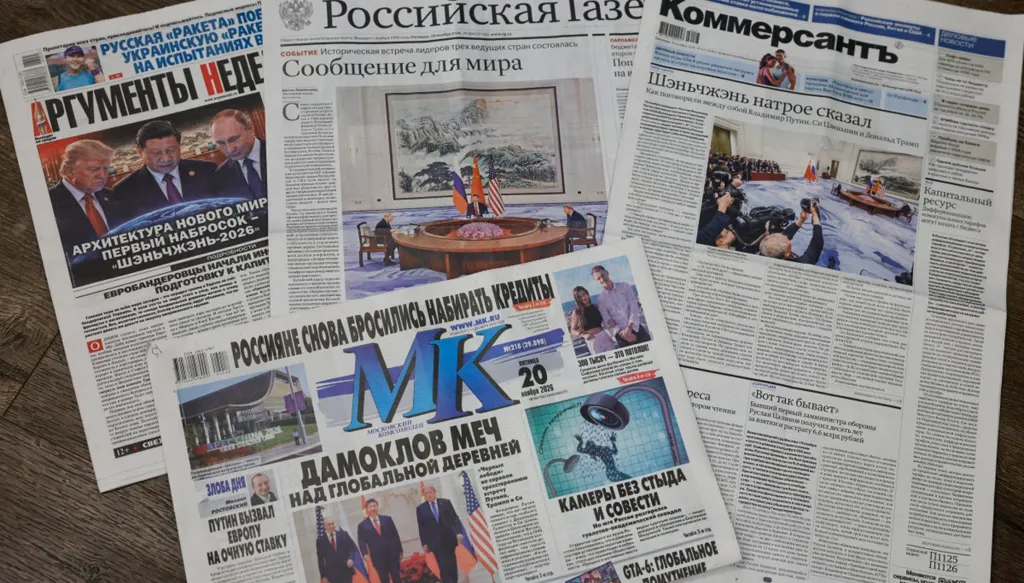
It was good for the world that U.S. President Donald Trump, Chinese President Xi Jinping, and Russian President Vladimir Putin sat at the same table in Shenzhen. It is not easy for the leaders of three nuclear powers to discuss reducing the risk of confrontation among them while their interests diverge in ongoing wars.
This was a summit marked by cordiality and mutual praise. Xi was its star, having hosted a precedent-setting meeting and remained determined to obscure any disagreements. Putin emerged as a winner because Xi and Trump restored his status among the major powers and lifted him out of isolation. Trump conducted his meetings with an unusual degree of accommodation toward his counterparts, treating China and Russia on an equal footing with the United States. No substantive decisions were made, nor were any breakthroughs achieved at the trilateral summit. The bilateral meetings, which could have addressed what the trilateral format could not, demonstrated why those desired achievements remain elusive.
The most apparent political gift to Putin was that the three leaders discussed the immunity of state officials and the limits of the International Criminal Court's jurisdiction. This is the court that issued an arrest warrant for the Russian president. The warrant remains valid, and sanctions on Russia remain in place. What changed in Shenzhen is that Putin was able to sit with the American and Chinese presidents and question the court's powers without offering any concessions.
The Trump-Putin meeting set a course to explore the possibility of ending the war in Ukraine, but it did not bring a settlement as close as the U.S. president had hoped. Any formula involving territories that Moscow sees as consolidating its gains may be viewed by Kyiv as a compromise over what it cannot relinquish. A winter ceasefire protecting energy installations could be an achievement in itself, but it would not resolve the territorial dispute or determine the future of Ukraine's relationship with NATO.
Ukraine remains the elusive achievement for Donald Trump. It continues to pursue him because ending a major war would allow him to tell Americans that he had fulfilled his promise and enable him to postpone some of the decisions he faces in the war he could not end in Iran. However, neither Moscow nor Kyiv is ready to offer him this way out on terms that do not serve their interests.
In Xi and Putin's meeting, the energy issue alone was enough to demonstrate the limits of what the warm reception could achieve. The European Union will halt its remaining imports of Russian liquefied natural gas by early 2027 and Russian gas through pipelines in the fall of the same year. Moscow is looking to China to compensate for these losses. Perhaps the "Power of Siberia 2" project was discussed at the meeting, but Shenzhen did not witness the announcement of a new agreement.
Even if the project moves forward, it will not bridge the gap within the timelines set by Europe. Xi is aware that Moscow's need for another buyer strengthens his position in negotiations with Putin, particularly over prices. Both understand that marginalizing Europe has its limits.
The Shenzhen Summit placed Europe in the back seat, as the three presidents discussed U.N. reform as though Britain and France were not also permanent members of the Security Council, with veto power like the United States, China, and Russia.
Xi preferred to separate economic ties with countries such as Germany from any acknowledgment of Europe's collective political role, while Trump wanted to retain the initiative in negotiations. Putin wanted to discuss European security with Washington without the Europeans being present.
But a European decision made outside the summit changed Russia's calculations on energy, and the three leaders cannot determine Europe's role in ensuring any settlement in Ukraine.
The Trump-Xi meeting left room for understanding on trade, where each side can offer something without changing its policy on more contentious issues. Buying more American products will not resolve tariff disputes, lift restrictions on semiconductors, or end competition in artificial intelligence.
The same distinction applies to nuclear weapons. A willingness to discuss reducing nuclear risks is more than mere talk, but it is not what Trump wanted from Beijing. Calling for a ban on nuclear weapons and their elimination does not mean Xi agreed to negotiate China's arsenal alongside those of the United States and Russia.
The Shenzhen Summit did not produce a framework for these negotiations or set a date for them. It was not a new Yalta. The three leaders could discuss how to manage their disagreements, but they could not act as though they had overcome them.
On Iran, what drew attention was Trump's insistence that he did not need Xi or Putin to help him end the war. He wanted to keep the decision in American hands rather than publicly ask for something the two presidents could publicly refuse.
The issue he was supposed to confront them with was not about mediation at all. What will China change in its dealings that allow Tehran to receive funds? And what will Russia change in its military and intelligence cooperation with Iran? These are the questions Trump spared Xi and Putin from answering.
The blockade and economic strangulation will remain riddled with dangerous gaps as long as the two countries help Iran endure and circumvent them. It makes little sense for the U.S. president to declare that he can do without their services while his country continues to bear the consequences of their policies.
It is not new that Beijing and Moscow oppose Iran acquiring a nuclear weapon, contrary to what President Trump implied. The new requirement is for them to demand Iran's commitment regarding the fate of its enriched uranium stockpile at the beginning of negotiations, rather than after it meets the seven conditions. There is no evidence that they intend to do so.
This is the core issue Trump relieved Xi and Putin of addressing. China can demand that Tehran end its intransigence, which calls for greater U.S. use of force, while Russia can prevent the unrestricted delivery of weapons to Tehran through the Caspian Sea if it wants to avert a major U.S.-Israeli strike on Iran.
Trump did not need to ask Xi and Putin to abandon their strategic agreements with Iran to test their seriousness. He should have called on them to use their influence on this specific nonproliferation issue and state what they were prepared to do about it.
But Donald Trump opted to absolve his Chinese and Russian counterparts of responsibility. He did so to avoid the embarrassment of rejection, knowing full well that he must be firm in demanding a fundamental shift in their rhetoric toward the Islamic Republic of Iran. In doing so, the U.S. president betrayed his administration's core policy.
Gulf Arab states are bearing the repercussions of this American rhetoric, which reflects policy volatility. Iranian attacks on Bahrain and Kuwait, alongside ongoing Houthi assaults on Saudi Arabia, mean that the decision not to expand the war so far does not imply that it is over for these states.
While the United States launches strikes and urges Israel to expand its operations, Tehran is betting that fear of retaliation will prompt its neighbors to pressure Washington and voice their opposition to the operations.
The Gulf states may be right to seek to avoid a wider war, but the burden should not fall on them, nor should they fall into the trap of Iranian blackmail. It is time, and in their interest, to establish a common policy: to specify to Washington what they expect when decisions affecting their security are made; to clarify to Beijing and Moscow what their support for Tehran means for their relations with the Gulf; and to tell Iran that de-escalation begins with halting attacks, not by demanding concessions from those under attack.
Waiting on the threshold of a decision leaves them bearing the cost while their role in shaping the outcome diminishes.
Donald Trump believes he has enough time, and continuing the blockade may now cost him less than expanding the war. But the time he buys does not come at the same cost to everyone.
Extending the blockade will not be enough if Beijing and Moscow continue helping Iran withstand it. After Shenzhen, Trump does not need new mediation on Iran as much as he needs to extract changes in the behavior of the two countries he declared he does not need.
In Ukraine, he does not need another picture with Putin, but conditions that Kyiv can accept and that Europeans can help ensure.
By these measures, it will become clear whether the amicable summit marked the beginning of serious work or was merely another stop in the pursuit of elusive achievements, all while others bear the cost of the story called the endless wait for Donald Trump.
Disclaimer: The opinions expressed by the writers are their own and do not necessarily represent the views of Annahar.