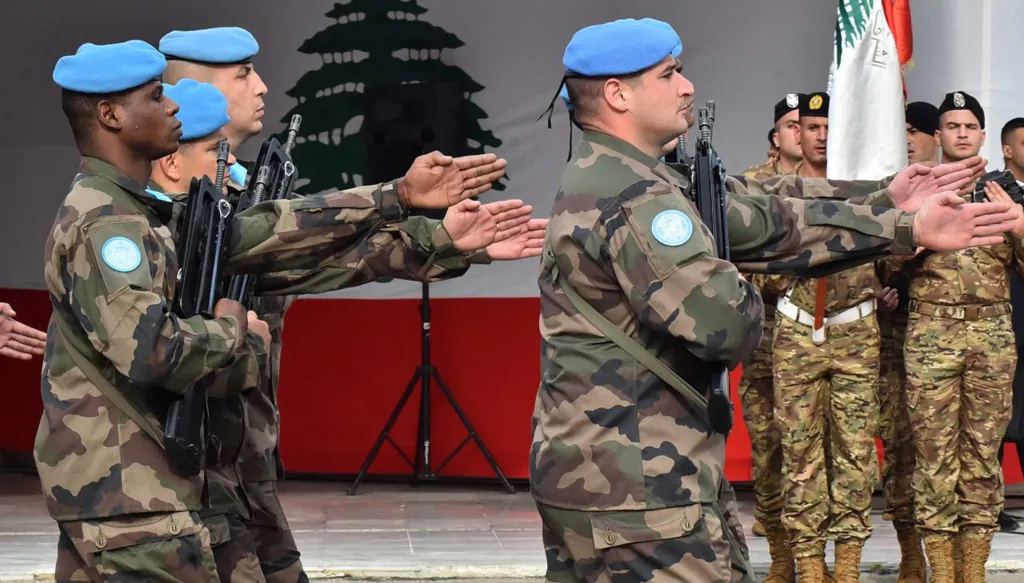
The controversy that erupted during the latest Cabinet session over the fifth item on the agenda, concerning the Foreign Affairs and Expatriates Ministry’s proposal to establish a European civilian and military mission in Lebanon, has this time opened an official and public debate over the future of the international presence in Lebanon once UNIFIL’s mandate comes to an end.
Within what security and political framework will the next phase in the south be managed, amid Washington’s firm opposition to all Lebanese and European efforts to renew the force’s mandate in an effort to avert the security vacuum its departure would leave in a highly sensitive and volatile border area?
The proposal submitted by the Foreign Ministry calls for the establishment of a European mission for three years, with the aim of “contributing to the full implementation of Resolution 1701 and helping the government strengthen state institutions and its authority and consolidate its monopoly on weapons by supporting the Lebanese Armed Forces and Internal Security Forces in enforcing their control over all Lebanese territory.”
However, consideration of the item was postponed pending further answers from the relevant ministries. Information Minister Paul Morcos explained that some of what had been circulated about the mission contained “misconceptions,” stressing that it is a technical mission with a logistical purpose, part of an existing European Union programme, and has no connection to UNIFIL or any intention of replacing it.
The ambiguity surrounding the document is understandable, particularly given its timing, as discussions are underway over alternatives to replace UNIFIL, while France and Italy are seeking to fill the vacuum by forming a force whose designation varies between a multinational force and a European body, as in the Foreign Ministry’s proposal.
The proposal refers to a three year European civilian and military mission aimed at supporting state institutions, the army and security forces, strengthening their capabilities, and contributing to the implementation of Resolution 1701. It is worth noting that references to this resolution have disappeared from Lebanese and international political discourse.
This raises the question: Can this mission really be separated from the arrangements that will follow UNIFIL, even if it is not legally or operationally a replacement for it?
According to political sources, the answer is yes, at least in terms of the nature of the mission. The proposed European mission is not a peacekeeping force with a UN mandate like UNIFIL, nor does its current formulation envisage it deploying as a combat force in the south. Its primary role is training, technical and advisory support, including assistance to the army and security agencies, as well as developing border control, monitoring, surveillance and maritime security capabilities.
Politically, however, it is difficult to overlook the timing of the two tracks. The international community is effectively looking for ways to prevent a security vacuum in Lebanon at the same time as discussions are taking place over UNIFIL’s future. Meanwhile, Paris hosted yesterday an international preparatory conference in support of the army, which also addressed the future of the international force in the south.
The issue is not the mission’s name, but the role it could eventually evolve into. Will it remain a mission supporting state institutions? Or could it become part of the security arrangements that will fill some of the vacuum left by UNIFIL? According to the sources, this may explain the reservations within the Cabinet.
Lebanon does not want to appear to be giving advance approval to an alternative international formula before the identity of the force that will succeed UNIFIL, its mandate, its chain of authority, its relationship with Resolution 1701 and any other security arrangements become clear.
At the same time, any government position on the matter would put Lebanon in a difficult position with regard to its relationship with the United States, which is directly sponsoring the negotiations with Israel and opposes any force to replace UNIFIL unless its establishment, personnel, participating countries and objectives are under direct U.S. supervision.
This predicament also extends to Lebanon’s relations with the European countries seeking to end Washington’s exclusive role and have a say in decision making in the south.
It is worth noting that the Foreign Ministry’s letter was based on a memorandum received by Prime Minister Nawaf Salam from the European Union delegation, conveying the position of the EU High Representative, who expressed readiness to establish a European mission within the framework of the EU’s Common Security and Defence Policy.
Accordingly, this issue is expected to fuel debate and discussion at any Cabinet session in which it is decided to resume consideration of the fifth item. This will open up a broader debate over an increasingly complex issue that is no longer simply about replacing UNIFIL with a European mission, but about determining what kind of Lebanon and what international authority over the south will emerge after UNIFIL.
Disclaimer: The opinions expressed by the writers are their own and do not necessarily represent the views of Annahar.
Thank you for subscribing to our newsletter