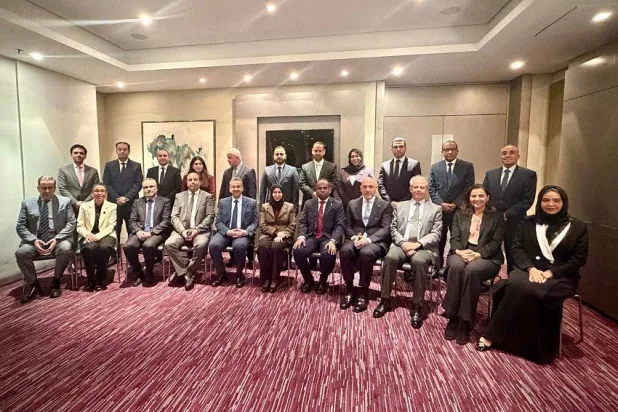
The Yemeni government has intensified its diplomatic efforts in Berlin to mobilize European political and economic support for confronting Houthi escalation and restoring state institutions. The diplomatic push comes amid warnings that the threat posed by the Iran-backed group could extend to international maritime security and global trade interests, alongside calls to correct what the government describes as misleading narratives about the Yemeni crisis. During a series of meetings with German officials and lawmakers, Arab diplomats, experts and representatives of research centers, Foreign Minister and Minister of Expatriates Dr. Afrah Al-Zouba said continued international tolerance of Houthi violations had emboldened the group to expand its destabilizing activities and extend its threats beyond Yemen to vital regional shipping routes. At a roundtable organized by Germany's Körber Foundation as part of the Berlin Political Breakfast, Al-Zouba outlined the roots of Yemen's crisis, beginning with the Houthi coup against the national consensus and internationally recognized government in September 2014. She recalled the group's armed takeover of the capital, Sanaa, and its undermining of the outcomes of the National Dialogue Conference, leading to the latest military escalation and attempts to target international shipping in the Bab Al-Mandab Strait. Al-Zouba said the group's escalating actions posed a direct threat to regional and international peace and security, warning that international silence and tolerance of its violations gave the Houthis greater room to continue threatening global trade. Expanding Houthi Threat As part of the same diplomatic efforts, Al-Zouba warned during another roundtable organized by Germany's Konrad Adenauer Foundation that the Houthi threat was expanding to regional security and international shipping. She pointed to attacks on shipping routes and coordination with terrorist groups in the Horn of Africa, including Somalia's Al-Shabaab. Al-Zouba linked the Houthis' rejection of peace efforts and attempts to establish control over the Bab Al-Mandab Strait to the launch of Operation Fajr Yemen. She said the operation aimed to restore state institutions and protect maritime routes against threats to international shipping and trade. The minister urged participating officials, experts and members of Germany's governing party to convey an accurate picture of developments in Yemen to their institutions and policymakers and to correct misleading narratives about the crisis. She stressed the need to ensure that Yemenis' voices were heard and that the military escalation's humanitarian consequences received appropriate attention. Al-Zouba emphasized that political, economic and humanitarian support for the Yemeni government was essential to strengthening its ability to fulfill its responsibilities, consolidate stability and restore state institutions. Siege of Taiz and Collective Punishment The humanitarian situation in the city of Taiz featured prominently in the minister's discussions. She highlighted the continuing Houthi siege and its consequences, including restrictions on the entry of food, medicine and essential supplies, the closure of healthcare facilities and obstruction of efforts to evacuate patients and wounded civilians through safe corridors. Al-Zouba described these practices as collective punishment against civilians, saying they had intensified the suffering of the most vulnerable groups, particularly women and children. She added that the siege had caused civilian deaths because people were unable to obtain necessary medical care and supplies. During a meeting with Armin Laschet, chairman of the German Bundestag's Foreign Affairs Committee, Al-Zouba discussed developments in Yemen and their regional repercussions. She stressed that threats to freedom of navigation and global trade represented an extension of the Houthis' destabilizing activities since the group seized control of state institutions. Al-Zouba also outlined the internationally recognized government's efforts, operating from the temporary capital Aden, to fulfill its public service and development responsibilities. She emphasized that stabilizing state institutions and securing their own revenue sources were essential to addressing the humanitarian crisis sustainably. The foreign minister called on Germany and European partners to provide urgent political and economic support to the government, with particular emphasis on strengthening national capabilities. These include the coast guard and maritime border surveillance, which would improve Yemen's ability to combat the smuggling of Iranian weapons and military technology to the Houthis. According to Yemen's official media, Laschet expressed concern over Houthi human rights violations, particularly the recruitment of children and deteriorating living conditions among civilians. He stressed that attacks on shipping in the Red Sea threatened the economic security of European Union countries and the wider world. The German official also emphasized the need for Germany's parliament and government, in coordination with the European Union, to develop a new strategy for addressing the Yemeni crisis, one that keeps pace with rapidly evolving developments and protects regional and international security.