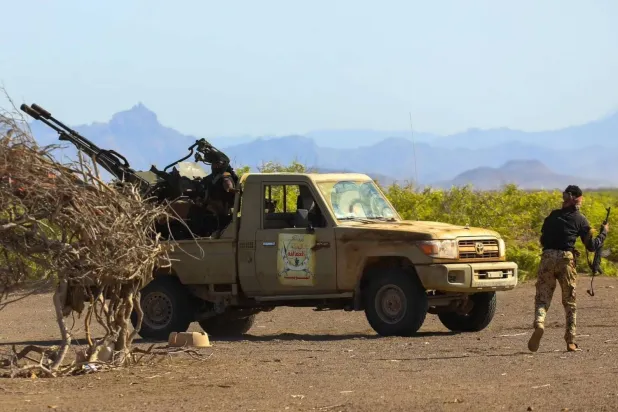
Violent clashes broke out anew on Tuesday across the battlefronts of the Yemeni city of Taiz, where Houthi militants launched fresh assaults on the Al-Shaqab front. The offensive coincided with intense shelling targeting surrounding villages in the Mount Saber region, even as government forces and the Popular Resistance continued to repel the attacks and block any hostile advance. The developments unfolded alongside ongoing military maneuvers under Operation Dawn of Yemen, which entered its 16th day. These new developments come in the wake of escalating airstrikes and drone attacks targeting Houthi positions in Taiz, Marib, and Al-Jawf. The Giants Brigades announced that they repelled a large-scale assault by the group in the Kahbub Mountains, west of Lahj. On the political level, the Yemeni leadership has intensified its efforts to demand the designation of the Houthis as a terrorist organization and to tighten international restrictions on their sources of armament and funding. On the ground, Yemeni field sources said army forces and the local resistance repelled Houthi attacks on the Al-Shaqab front, south of Taiz, preventing the attackers from making any progress. In the Al-Misrakh district south of Taiz, government forces, backed by the Popular Resistance, continued their offensive against Houthi positions amid violent battles in the village of Sanamat. Government forces had announced on Monday that they achieved advances in the Sanamat and Al-Sarari areas following clashes with the Houthis that attempted to infiltrate towards the region's villages, reach the summit of Mount Al-Arous, and cut off roads through the villages of Saber. Field sources reported a lull in Houthi attacks on the outskirts of the city over the past 24 hours, amid assessments that the group is attempting to regroup its forces in preparation for launching heavier assaults. In the past 24 hours, spokesperson for the Yemeni Armed Forces Majed Al-Nuzaili announced the execution of 1,164 operations, which neutralized 558 Houthis, including field commanders. The operations also destroyed and disabled 135 military vehicles and equipment. He added that forces seized new positions in Taiz with aerial and artillery support, while the Shabwa fronts continued to press the group's positions, hindering their movements and reinforcements. In Marib and Al-Jawf, government forces announced the targeting of Houthi armored vehicles, machinery, and fortifications using drones, coinciding with a new missile attack on the city of Marib. The Media Center of the Armed Forces published footage showing the targeting of Houthi vehicles in Al-Jawf and fortifications and positions in Marib. On the political level, Chairman of the Yemeni Presidential Leadership Council Dr. Rashad Al-Alimi, said Operation Dawn of Yemen will continue until its objectives are achieved. The operation "is not limited to military action, but rather includes protecting the population, restoring services, preparing conditions for recovery and reconstruction, and ensuring the regular functioning of state institutions," he stressed during a meeting with Chargé d'Affaires of the US Embassy to Yemen Neil Hop. The officials discussed bilateral relations and military and security developments, in light of the continuous Houthi attacks inside Yemen and across the border with Saudi Arabia. Al-Alimi stressed the need to support efforts aimed at delivering water, food, and medicine, facilitating the movement of civilians, and opening vital roads for humanitarian supplies. He renewed his thanks to Saudi Arabia for its political, economic, and humanitarian support to the Yemeni government and people. Al-Alimi officially requested United Nations Secretary-General Antonio Guterres to support international action through the Security Council to designate the Houthi group as a terrorist organization, ensure the enforcement of the arms embargo against it, dry up its sources of funding and armament, and hold accountable its backers and those responsible for its violations. During a phone call with Guterres, Al-Alimi briefed the Secretary-General on the missile and drone attacks targeting state institutions and civilian facilities, as well as the expanding assaults on cities and villages, coinciding with the siege of Taiz and the shelling of its residential neighborhoods. He also noted the continued detention of more than 70 United Nations staff members and the abduction of thousands of citizens.