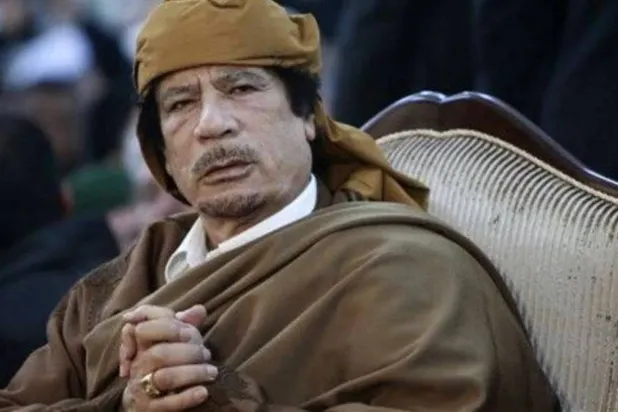
Fifteen years after the killing of Libyan leader Muammar al-Gaddafi, his supporters are still searching for a political heir, with the assassination of his son Saif al-Islam last February extinguishing hopes of a comeback that had grown since his ill-fated presidential bid in 2021. Gaddafi was captured by opposition fighters in the city of Misrata on Oct. 20, 2011, before being killed as his rule of more than four decades came to an end. His downfall left a political vacuum among loyalists who later rallied around Saif al-Islam as the most prominent face of the former regime. Hopes of a political revival gained momentum when Saif al-Islam announced his presidential candidacy in November 2021. But the elections never took place, and his assassination in Zintan in February reopened the question of succession, leaving the movement without a figure capable of uniting its supporters. Political analyst Hossam Fenaish told Asharq Al-Awsat that Gaddafi loyalists were searching for a successor, with attention turning to his surviving children Aisha, Al-Saadi and Mohammed. Hannibal, he said, appeared to have the weakest prospects. Two other sons, Khamis and Saif al-Arab, were killed during the 2011 uprising. Saif al-Islam Gaddafi in November 2011. (Reuters) The most notable shift came in September, when supporters of the former regime began promoting Aisha Gaddafi on social media as a possible contender. Their campaign drew on an open online poll that reportedly put her more than 30,000 votes ahead of her nearest rival. But there was no verified information on the number of participants or whether the results reflected wider public opinion. Aqila Dalhoum, head of the media and human rights team at the National Truth Committee investigating Saif al-Islam's killing, backed the idea. He said the poll reflected both the Gaddafi family's enduring symbolic appeal among some Libyans and frustration over the country's political, economic and living crises. Aisha, however, has largely stayed out of public politics. She lives in Oman with her brother Mohammed and has turned to visual art, exhibiting works depicting her father and brother Mutassim at Moscow's State Museum of Oriental Art in 2024, followed by an exhibition in Muscat this year. Yet enthusiasm for her possible candidacy is far from unanimous. Two prominent former regime figures declined to comment on calls for her to run. One questioned whether such discussions were premature. "Where are the presidential elections at this point, given the stalled political process in Libya?" he told Asharq Al-Awsat. A former Libyan army spokesman also played down the campaign, saying it reflected individual initiatives rather than a collective decision by Gaddafi loyalists. No candidate had secured a consensus, he told Asharq Al-Awsat. "Aisha is a Libyan citizen who has the right to run for office like anyone else," he said. "Choosing a representative of the former regime's supporters begins with a family decision, followed by consultations within the movement. The final say then rests with voters." Hannibal Gaddafi. (Reuters file) Aisha is not the only Gaddafi family member whose name has surfaced. Supporters have also floated Al-Saadi Gaddafi, who lives in Türkiye, as a possible contender. But he publicly ruled out a political role in June, saying in a post on X that he had no intention of entering politics, contesting elections or backing any faction. Instead, he said he wanted to live an ordinary life devoted to learning and wished success to whoever Libyans chose to lead the country. Al-Saadi was freed from a Tripoli prison in 2021 after spending years in detention following his extradition from Niger in March 2014 over allegations linked to the crackdown on the 2011 uprising. Attention has also turned to Mohammed Gaddafi, the former leader's eldest son from his first wife, Fathia Nuri Khalid. Mohammed resurfaced on social media after Saif al-Islam's assassination, pressing for the findings of the murder investigation to be made public. Last month, he raised questions about a suspected sabotage cell apprehended in Tripoli and its possible links to the assassination, urging relevant international organizations to investigate and uncover the circumstances of the killing. Pages aligned with the former regime have since touted Mohammed as another potential successor. One page, "Gaddafi Speaks," portrayed him as a man suited to a time when Libyans are seeking a strong, independent state. Blogger Ahmed Faraj also voiced support for him as a future candidate. But activist Rania Gaddafi dismissed suggestions that Mohammed was preparing to enter politics as rumors. Al-Saadi Gaddafi. (Al-Saadi Gaddafi on Facebook) She said he had no interest in running for election or holding office, and was concerned only with seeing Libya regain security, stability and national unity. Born in 1970, Mohammed previously headed the Libyan Olympic Committee and chaired the board of the General Posts and Telecommunications Company. Hannibal Gaddafi, meanwhile, remains entangled in one of the family's most complicated chapters, far from Libya's political stage. He spent about a decade in detention in Lebanon in connection with the 1978 disappearance of Lebanese cleric and politician Musa al-Sadr and his two companions before his release. Feneish said Hannibal appeared to be out f the running for now. But beyond the competing names, some Gaddafi loyalists reject the idea that his political legacy belongs to any single family member. They argue that the former leader left behind not a conventional political inheritance but a set of national and pan-Arab values and principles. Libyan writer and researcher Mustafa al-Fetouri, a supporter of the former regime, told Asharq Al-Awsat that the question of succession went beyond the Gaddafi family. "Anyone who believes in those principles can be his heir, beyond his family and children," he said.