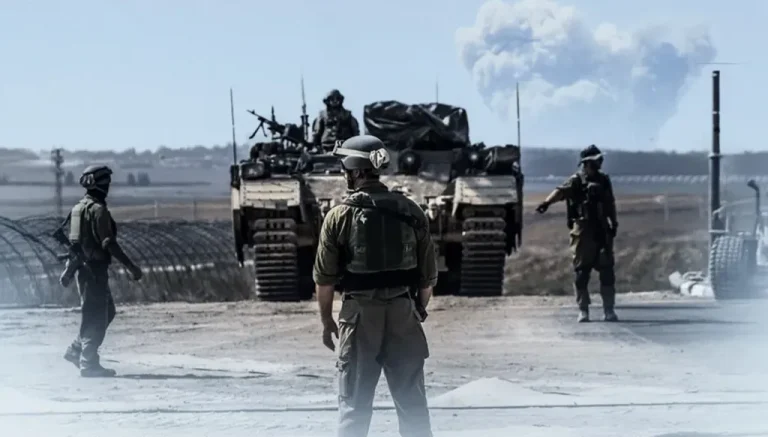
Israel did not forget Lebanon's Independence Day. Its Foreign Ministry wished the Lebanese a "true independence," while Captain Ella made an appearance at Debl's public school. In the interest of accuracy, which sometimes gets in the way of denunciations, the Israeli army chose the time of entry and filming, then left some Lebanese to investigate who appeared in the picture. These children did not open the front, buy missiles, or promise anyone they would change the face of the region. They were at their school, in a town living under occupation.
This scene has precedents in Lebanon's historical album. Shimon Peres imposed himself on Walid Jumblatt when the latter was effectively under house arrest at the Al-Mukhtara Palace during the 1982 invasion, and the press documented that meeting at the time. During the 2006 war, the images of "Marjaayoun tea" emerged from the barracks raided by the Israeli army. The circumstances differ, but the image of Lebanese people standing before an occupier can easily be extracted from a context of unequal power and turned into a public trial. We focus on who served the tea while allowing the question of how the tank arrived to grow cold.
Yesterday, the Palestine Liberation Organization was Israel's justification; today, it is Hezbollah. Names change, but Lebanon remains the place where wars are fought and accounts settled. What these experiences have in common is that the Lebanese, through their state, lack the decision-making power that determines their fate. Those who possess the weapons control the country, while those who command airpower decide the scale of punishment, leaving citizens to search for another home.
On Independence Day, President Joseph Aoun placed the Israeli occupation and Iranian intervention on equal footing as major obstacles to completing Lebanese sovereignty. He referred not only to political interference but also named its instruments: "weapons and decisions beyond the authority of the Lebanese state." Here, Hezbollah becomes an essential part of an equation that cannot be ignored: Israel occupies Lebanese land with its army, while Iran interferes in Lebanese decisions through weapons operating outside state institutions. Most importantly, Aoun described these crises as interconnected, with each invoking the other and providing justification for it. This is precisely the link that must be broken: the occupation cannot be ended by consolidating illegal weapons, just as illegal weapons cannot be justified by the continued occupation. Otherwise, this amounts to collusion in every sense of the word.
On October 8, 2023, Hezbollah supported Gaza and led Lebanon down a path to hell. On March 2, 2026, the party supported Iran and dragged the country into another war, handing Lebanon the bill. In this strategic school, solidarity is measured by how much the Lebanese can lose.
Even the Nawaf Salam government, which is presumably the decision-maker, found itself reacting to decisions made outside its authority. Declaring a ban on the party's military and security activities and demanding its disarmament are insufficient to pinpoint the source of the problem: the state only asserts its authority after the party has already exercised it.
We hope there will not be a third war following these consecutive conflicts. Between them, the promise that surplus strength guarantees protection has collapsed. The standard by which any weapon should be judged is the security of the people and the freedom of their land. Southern villages are once again under occupation, and their residents are caught between displacement and siege, while Israel enjoys the luxury of filming greetings in a Lebanese school. What remains of the promise of protection embraced by the "resistance" when the occupation itself offers a lesson in independence?
The 2000 withdrawal could have marked the beginning of embedding liberation within the state, but the party treated its record of resistance as a perpetual mandate to determine the country's fate. Today, that achievement is invoked to justify the weapons, while the very land those weapons were supposed to protect is being reoccupied.
Israel is responsible for its aggression and occupation, as well as for turning a school and its children into a propaganda platform. Hezbollah's deadly mistakes do not give Israel rights over Lebanese land or immunity from accountability. Conversely, Israel's crimes do not absolve Hezbollah of its own wrongdoing. Whoever understands the nature of their enemy yet still decides to expose an entire country to war outside the authority of its state bears political responsibility for the consequences. The disgrace is that it learned nothing from the words, "If I had known!"
Therefore, the anger over the Debl scene should be directed at the leadership that misled people with promises of protection, monopolized the decision of war, and left them exposed to the occupying army and its cameras. Accountability begins with ending a party's alleged right to gamble with Lebanese lives. The sovereignty we demand that Israel respect must first be respected by Hezbollah. It sowed the wind, and the Lebanese reaped the storm. Before asking a child in Debl why they did not expel Ella from their classroom, ask Hezbollah why her entry was made possible in the first place!
Disclaimer: The opinions expressed by the writers are their own and do not necessarily represent the views of Annahar.