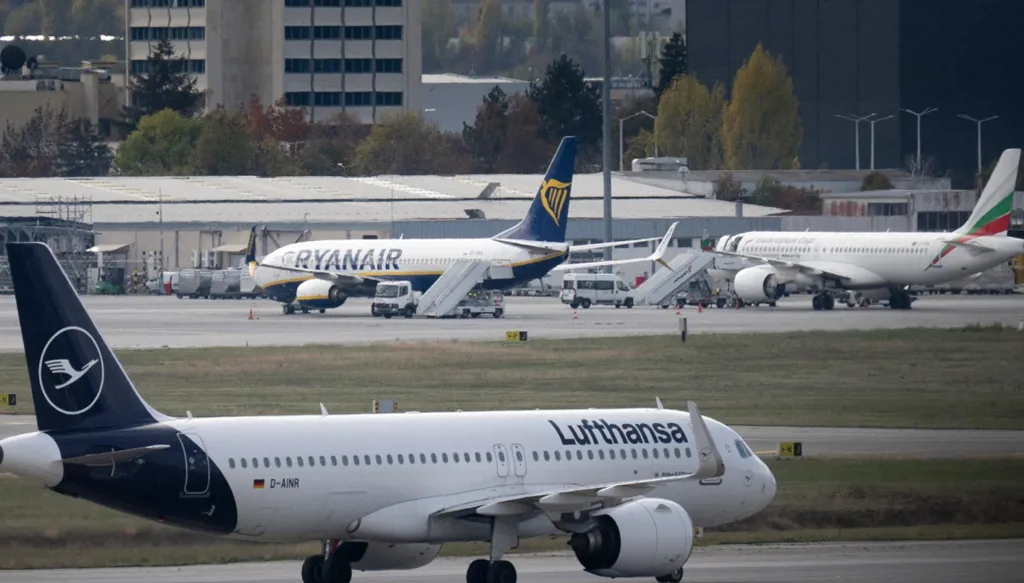
The entities behind the bomb threats disrupting air travel across Europe did not need to blow up an aircraft to throw air traffic into disarray and put security agencies on high alert. Threatening messages, several of which proved to be false, were enough to prompt aircraft searches, flight diversions and fighter jet escorts. As the alerts continue and spread, concerns are extending beyond flight safety, raising questions about who is behind the warnings and what their possible objectives might be.
Over the past few days, bomb threats targeting aircraft have swept across European airspace. From the Czech Republic and Bulgaria to France, Ireland and other countries, what exactly has been happening in Europe?
The Financial Times quoted intelligence officials as saying that the reports bear “the hallmarks of Russian hybrid warfare intimidation campaigns.” However, European Transport Commissioner Apostolos Tzitzikostas said it was too early to establish whether the incidents were connected.
Geopolitical analyst Michel Fayyad told Annahar that the alerts expose structural vulnerabilities in Europe's civil aviation system when faced with simple, low-cost threats. A single email is enough to trigger complex procedures, including aircraft searches, flight diversions and fighter jet escorts, in addition to causing operational losses and leaving passengers feeling unsafe.
Fayyad describes this as an imbalance between the virtually zero cost to the attacker and the high cost imposed on the targeted society. Security protocols designed to deal with credible threats can be disrupted and stretched by repeated false reports.
Fayyad considers the possibility that these incidents are part of hybrid warfare a serious hypothesis. However, proving this would require identifying signs of technical coordination, such as threats occurring simultaneously, similarities in the channels used and recurring patterns across several countries, or uncovering digital and human links to government entities or proxy groups.
The investigation should also examine whether the incidents are connected to a broader series of acts of sabotage, cyberattacks and drone activity that have been taking place in Europe since the outbreak of the war in Ukraine. Within this framework, the possible objectives could include exhausting security systems, exposing the vulnerability of European airspace, spreading fear and testing the limits of the response without escalating to open confrontation.
However, he stresses that there is no publicly available evidence attributing these operations to any particular state. The fact that some messages were signed by the “Male State Fighters,” a name associated with a far-right Russian nationalist movement, does not establish a connection to the group. It could instead be an attempt to mislead or impersonate the movement.
For his part, geopolitical expert Dr. Rami Khattar Abou Diab told Annahar that the main problem with false alerts and cyber activities lies in the extreme difficulty of identifying those responsible and determining their motives.
He links understanding these incidents to an examination of the broader European context, which is marked by tensions, cyberattacks and drone activity. He points out that the European Parliament, in a report it adopted, identified Russia as the most serious state actor behind the hybrid threats facing the European Union. This, however, does not establish Russia's responsibility for the current alerts.
According to Abou Diab, these activities aim to destabilize, deriving their effectiveness from remaining below the threshold of direct conflict while still being capable of causing significant disruption when they target critical infrastructure.
However, he cautions against reducing them to terms such as “hybrid warfare” and “cyberattack,” as doing so could obscure their political essence behind their technical dimension. He favors the concept of “political warfare,” highlighted by researchers Kevin Limonier and Jonathan Guiffard, which refers to a state's decision to seek to undermine its adversary's political and ideological system.
Between the possibility of a coordinated campaign of attrition and that of isolated or copycat incidents, investigations remain essential to establishing responsibility. For Europe, Fayyad says, the challenge lies in improving threat assessment, strengthening cross-border coordination and ensuring operational continuity without lowering its guard against a threat that could prove real.