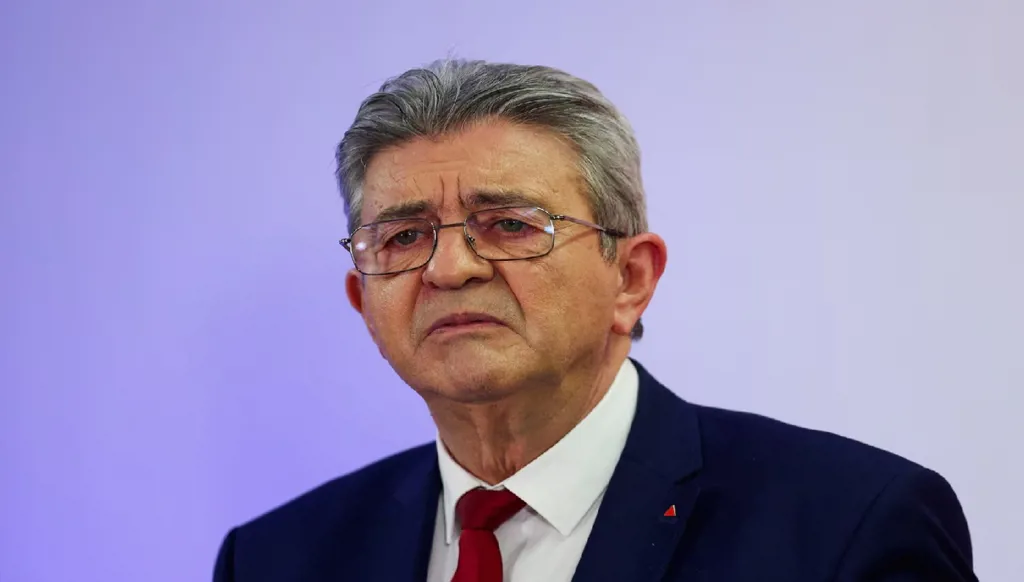
The radical-left candidate Jean-Luc Mélenchon told a crowd of his supporters on Saturday that "everything must change," months ahead of the French presidential elections, in which he is one of the prominent candidates.
Opinion polls predict that the leader of the France Insoumise party could reach the second round of the elections for the first time, where he would face the far-right candidate Marine Le Pen. However, expectations suggest that he could suffer a crushing defeat in that decisive round.
Despite this, Mélenchon, 75, affirmed at a massive rally in Le Bourget, a suburb of Paris, attended by around 20,000 supporters, that he is determined to succeed the current president, Emmanuel Macron.
"I will propose one viable solution to you. It is actually a moderate proposal. (...) Everything must change," he said, adding: "We are paving the way for a significant political transformation in France."
Mélenchon renewed his attack on the centrist Macron, saying: "We are witnessing a strange moment. The death throes of Macronism are manifest in brutal practices, violent police actions, and unexpected outbursts of violence at the end of demonstrations."
French authorities accuse the France Insoumise party of inciting violence during demonstrations.
France has been witnessing protests for weeks by high school students over deteriorating educational conditions and the university guidance system, alongside widespread demonstrations over the cost of living and inequality. These protests peaked on October 17 with the worst riots France has seen in years.
Mélenchon accused Macron of overseeing "a dark end to his tenure," pointing out that the far right, led by Le Pen, "has nothing to offer except racism."
While many in France's traditional left-wing circles oppose Mélenchon's positions, he pledged not to soften them, asserting: "We will fight until the last second, and in the end, we will win."
The leader of France Insoumise also addressed the Ukrainian issue in his speech, pledging to actively work to end the conflict if he wins and stressing the need for Europe to play an active role in any peace talks.
He raised the issue of the Donbas region in eastern Ukraine, which Russia largely controls and over which it demands sovereignty.
"The idea of any peace that includes territorial concessions in Ukraine cannot even be considered without asking the affected populations whether they agree to be on this side of the border or that," he said, emphasizing that "only the people decide what they want."