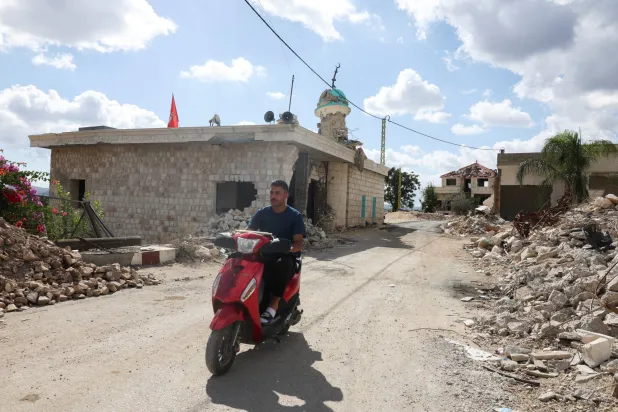
A state of uncertainty hangs over the political and security situation in southern Lebanon following the postponement of a US-sponsored Lebanese-Israeli military meeting until after Israel's Knesset elections and the US midterm elections. The delay has prompted the development of a preemptive plan to address the possibility that Israeli Prime Minister Benjamin Netanyahu may seek to expand the security zone by targeting the highlands and hills stretching between Iqlim al-Tuffah and Jabal al-Rihan. Bridging the period until the Israeli elections on October 27 remains a central concern for Lebanese President Joseph Aoun, who is seeking to contain the repercussions should Netanyahu insist on expanding the security zone. Asharq Al-Awsat has learned from a political source directly involved in the Lebanese-Israeli negotiations that Aoun is in contact with senior US administration officials, urging them to pressure Netanyahu and prevent him from expanding the security zone if he concludes that such a move is necessary to boost his political standing and secure his return as prime minister. US Assurances Against Escalation The political source confirmed that Aoun had received US assurances that Washington would not give Netanyahu the green light to expand the security zone, provided he is given no pretext to justify targeting the highlands between Iqlim al-Tuffah and Jabal al-Rihan. The source said Hezbollah was the party concerned. With dialogue between Aoun and the group suspended, the president has instead been consulting Parliament Speaker Nabih Berri to convey a message to his ally, Hezbollah, which has continued to observe the ceasefire and has not responded to Israeli attacks and violations. The source revealed that the decision to convey the message to Hezbollah was prompted by information obtained by security and military officials indicating that the group had taken a series of precautionary measures to prepare for the possibility of Netanyahu expanding the security zone by targeting the highlands between Iqlim al-Tuffah and Jabal al-Rihan. The source ruled out Hezbollah initiating a ceasefire violation, saying the group would have no choice but to defend itself if its positions came under attack. Residents of the area, however, are concerned that the confrontation could spread from north of the Litani River to their communities, particularly after Hezbollah built fortifications near residential areas. The source argued that Hezbollah would be forced into an existential battle if it came under attack, considering the area its first, and possibly last, line of defense in the south after Israel established control through firepower over towns near Beaufort Castle, north of the Litani River, which overlooks the area to its south. The source added that the Internal Security Forces' seizure of a shipment of explosives in Dahr al-Baidar, while it was being transported to Beirut's southern suburbs, had unsettled Hezbollah. The group was consequently compelled to launch media campaigns against President Joseph Aoun and Prime Minister Nawaf Salam to justify why the truck was being sent to it. Hezbollah Fails to Recover Explosives Shipment Meanwhile, a parliamentary source close to the Shiite duo said Hezbollah had attempted to recover the truck without having its cargo of explosives confiscated. The source told Asharq Al-Awsat that Hussein Abdullah, head of Hezbollah's Liaison and Coordination Unit, who succeeded Wafiq Safa, promptly contacted security and military officials in an effort to secure the truck's release, but was unsuccessful. The source noted that Hezbollah had not expected its request to be rejected. The group argued that the explosives were intended to be transported south for use in confronting the Israeli military should it decide to expand the security zone. According to the source, Hezbollah's intervention was itself an acknowledgment that the cargo belonged to the group. However, its efforts were met with refusal, along with a firm stance from Prime Minister Nawaf Salam, who called for an expanded investigation. Salam's position supported a request by Government Commissioner to the Military Court Judge Claude Ghanem to involve the Internal Security Forces' Information Branch in the investigation. A New Political Phase The parliamentary source said the refusal to comply with Hezbollah's request sends a message domestically and internationally that Lebanon has entered a new political phase, distinct from the period preceding Aoun's election as president and the formation of Salam's government. The government has adopted decisions aimed at establishing the state's exclusive control over weapons, beginning south of the Litani River, with the process subsequently extending north of the river to the Lebanese-Syrian border. The source said these decisions were behind the seizure of the explosives shipment, alongside the government's commitment to enforcing Cabinet decisions prohibiting the carrying, transportation and use of weapons. Asked about the implications, the source explained that allowing Hezbollah to recover the explosives would, in the eyes of domestic and international observers, effectively signal the collapse of the project to strengthen state authority. It would also risk prompting the international community to abandon its commitments to helping Lebanon recover, which are conditional on the state exercising exclusive control over weapons. Lebanon would consequently risk falling off the international community's list of priorities if the explosives were returned to Hezbollah. The source stressed that the seizure of the explosives would increase international attention to Lebanon and strengthen its negotiating position, particularly in light of admissions by the truck driver and his companion that the cargo was to be delivered to an individual in Beirut's southern suburbs known as Zulfiqar. The source also addressed the campaign launched by Hezbollah's official television outlet, Al-Manar, against Salam over his position on the seizure of the shipment and his insistence on establishing responsibility and revealing Zulfiqar's real identity. The campaign also targeted Aoun following the European Union member states' approval of a military mission to Lebanon to support and train the Lebanese Armed Forces and Internal Security Forces, helping them extend state authority across the country's entire territory. According to the source, the campaign against Aoun primarily stems from Hezbollah's belief that the European mission's mandate to support Lebanon's security and military institutions would contribute to placing all weapons under state control. The mission is not intended to replace the United Nations Interim Force in Lebanon (UNIFIL). Rather, its activities would extend across Lebanese territory. The source said this prospect is a source of concern for Hezbollah, particularly if it becomes clear that bringing the group's weapons under exclusive state control is part of the European mission's program to help Lebanon extend its authority throughout the country.