Trump is betting on a swift military campaign to extract concessions from Iran, while Israel pushes for a broader offensive. Could three days of strikes change Tehran’s position, or trigger a wider conflict that proves difficult to contain?
When U.S. President Donald Trump speaks about "things that will happen soon" regarding Iran, he does not specify what these things are. However, it does not take much effort for observers to figure out what he means. There is a firm belief that America and Israel are preparing to launch what has been described as an ‘intensive and short’ three-day operation against Iranian sites after the U.S. midterm elections on November 3.
The scope for speculation remains wide open about the objectives of this new military operations. Trump believes that after sustaining a large-scale military strike, Iran will be more willing to make concessions in negotiations, particularly regarding the Iranian nuclear program. He has Pickaxe Mountain, near Natanz, in mind, amid suspicions of nuclear activities at the site . He is reluctant to target Iranian oil fields for fear of sending oil prices skyrocketing. This is a point of disagreement with Israeli Prime Minister Benjamin Netanyahu, who is pushing for simultaneous strikes on oil fields, refineries, electricity infrastructure, bridges, and facilities producing missiles and drones, in a move that would pave the way for the regime's downfall.
It is no secret that Netanyahu wants to exploit a new war to pressure opposition parties into joining a coalition government with him, at a time when opinion polls indicate that the right-wing coalition he leads is unlikely to secure the 61 seats needed to form a new government.
Further reinforcing the likelihood that a return to the military option is the most probable course of action, reports continue to emerge of joint U.S.-Israeli air drills over Iraq extending to the Iranian border, as well as a growing U.S. naval buildup expected by the end of this month. The number of U.S. vessels is set to rise from 20 to 24, including three aircraft carriers, with a naval force comprising around 20,000 sailors and Marines, in addition to special forces personnel. Washington has withdrawn some of its diplomats from Saudi Arabia, amid reports of arrangements to evacuate the families of personnel from other Gulf missions in anticipation of an escalation in hostilities.
The New York Times quoted U.S. officials as saying that they believe intensive strikes could push the Iranian economy to the brink of collapse, although previous predictions of such a collapse did not materialize. On the contrary, the regime has tended to become more hardline after each war.
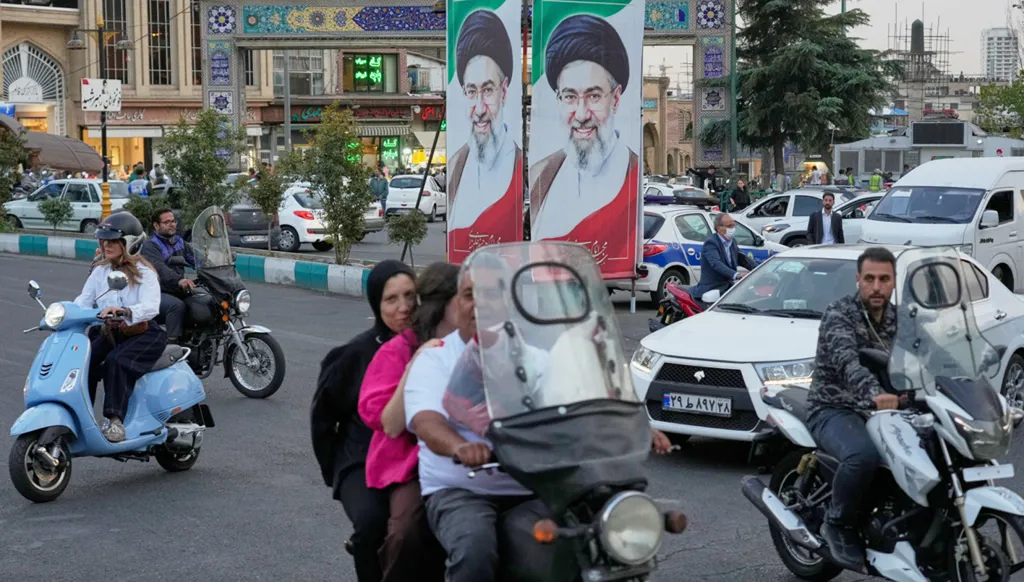
Iranians looking at a billboard depicting an actor portraying U.S. President Donald Trump behind the bars of a mock prison cell in Tehran’s Tajrish Square on Wednesday, October 21, 2026. (AP)
Intermediaries who visited Iran in recent days proposed accepting Trump’s offer to change the order in which contentious issues are addressed, starting with the nuclear issue, with the aim of de-escalating tensions and avoiding a new war. However, Iran’s response was negative, particularly regarding its rejection of transferring nuclear material enriched to 60 percent from Iran to a third country, or allowing the return of inspectors from the International Atomic Energy Agency (IAEA), before Washington agrees to Iran’s seven demands.
Iranian President Masoud Pezeshkian, who received Pakistani Army Chief Field Marshal Asim Munir on Tuesday, stated that the United States cannot expect dialogue while maintaining the blockade imposed on Iran and issuing threats. Iranian Foreign Minister Abbas Araghchi reiterated that his country is fully prepared to defend itself.
Iranian officials warn that their response to any military action would be extensive and would include the destruction of infrastructure in the Gulf, including the cutting of internet cables beneath the Strait of Hormuz. Notably, Iran’s regime is pairing its warnings with escalation on the ground. The Islamic Revolutionary Guard Corps announced today that four tankers involved in the illegal transport of oil in the northern Gulf had been struck simultaneously, setting them on fire, after being spotted by Guard forces the previous day, Wednesday. It added that three other vessels had struck mines west of the Strait of Hormuz.
Even if Trump is planning a few days of fighting to persuade Iran to return to negotiations on flexible terms, these estimates may not necessarily hold once war breaks out. On February 28, President Trump announced that the war would last only two weeks, but it is now approaching its ninth month.
Disclaimer: The opinions expressed by the writers are their own and do not necessarily represent the views of Annahar.
Thank you for subscribing to our newsletter