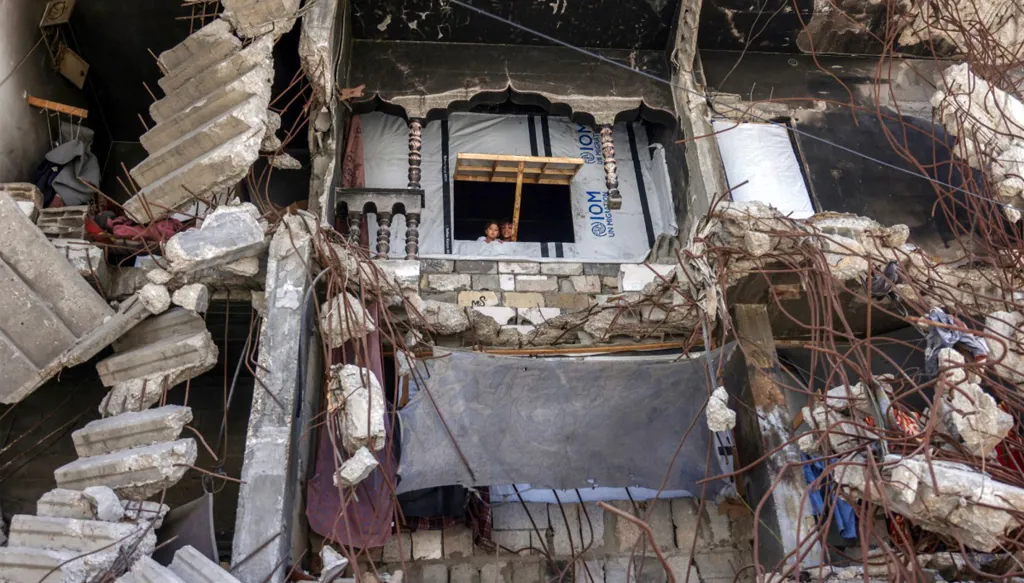
The “Deluge” changed the reality for Palestinians, the course of their national cause, and the state of their political entities, meaning that what came after the “Deluge” was unlike what came before on all fronts. It placed them before a new catastrophe in every sense of the word, one that might not be less significant or impactful than the foundational catastrophe of 1948, if not harsher and more bitter.
It is not enough here to say that Israel is responsible, as it launched a brutal genocide against the Palestinians, especially in the Gaza Strip. This is a colonial, settler, racist, and genocidal state, as it has been recently defined, and it found in the “Deluge” operation, initiated by Hamas, a perfect opportunity to implement the plans of the extremist right-wing nationalist and religious stream, to oppress the Palestinian people, undermine their national project, crush their dream of an independent state, and exclude them from political equations.
This means that Hamas bears responsibility for allowing, or indirectly facilitating, Israel’s brutal war against the Palestinian people, which exceeded their limit of endurance, along with its responsibility for choosing the option of decisive warfare, as an army against an army, an option unrelated to the concepts of a long-term popular war or gradual resistance, which wins by points and avoids confronting the might of the enemy’s army, thus avoiding the draining of its people.
Now, three years after the “Deluge” operation, there have been massive changes, the most significant of which is that Israel has positioned itself as the superpower in the Middle East, with a long reach extending to Lebanon, Syria, and even Yemen and Tehran. It is also trying to establish itself as a domestic player in shaping the policies of regional countries.
For Palestinians, the separation of the Palestinian entity between the West Bank and the Gaza Strip has been cemented, with the Strip coming under a form of international guardianship with special administration, according to Trump’s plan. Meanwhile, around two million Palestinians are living on foreign aid, facilitated by Israel, after it turned the Strip into an unlivable area, making it the largest wasteland, cemetery, and the most crowded and miserable region in the world, with its military and direct control over 70 percent of Gaza’s land.
As for the West Bank, Israel dominates all aspects of life there, keeping the Palestinian Authority merely as a formality, with a president, government, embassies, and security apparatuses, but with no authority over the ground, borders, resources, or even the population.
Moreover, Israel has worked to impose everything that would prevent Palestinians from establishing any political entity by fragmenting the West Bank with settlements, military checkpoints, and bypass roads, and by creating a militia for settlers that contributes to making Palestinian lives more difficult, sabotaging their livelihoods, and displacing them into confined areas.
Ultimately, the “Deluge” operation, which was supposed to be the peak of Palestinian military action against Israel, represented the peak of the collapse of this way of confronting Israel. It came as a disaster for everything known as the “resistance and defiance” axis, from Hezbollah in Lebanon, through Hamas in Palestine, to Iran. It was even a disaster for the Palestinian national movement and its project of a Palestinian state in the West Bank and Gaza, after Trump’s initiative pulled Gaza out of the Palestinian cart and after Israel started controlling everything in the West Bank.
Nothing conceals this catastrophe: the unprecedented international sympathy with Palestinians, especially in Western countries and among Jewish circles in those countries, does not cover, nor does it match, the horrors that the Palestinian people have experienced over the past three years. This sympathy came as an ethical response to the brutal genocide waged by Israel against Palestinians, not as support for the “Deluge,” contrary to how Hamas tries to portray it to downplay its responsibility for that disaster.
Three years after October 7, the shockwaves continue to reshape Gaza, Israel and the wider Middle East. This dossier examines the changing narratives, human cost, security debates and political and economic consequences of a conflict that continues to redefine the region. Read our special dossier:
Thank you for subscribing to our newsletter

