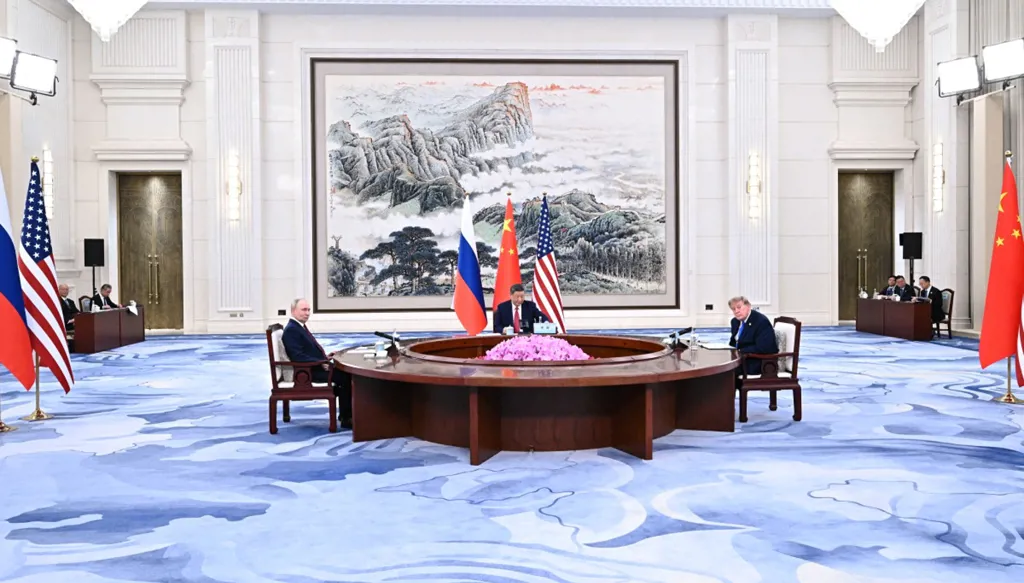
The world had set its geopolitical clock to the Shenzhen Summit, anticipating the deliberations of the leaders of three major powers: China's Xi Jinping, America's Donald Trump, and Russia's Vladimir Putin. The wait ended with a final statement titled the "Declaration of Peace," comprising four clauses. The first calls for reforms to the United Nations to maintain international peace and security. The second emphasizes the importance of stabilizing energy flows, followed by a commitment not to misuse the International Criminal Court. The fourth clause calls for efforts to reduce the proliferation of nuclear weapons.
However, none of these clauses resulted in a binding agreement among the parties involved. Nor did the summit achieve any significant breakthrough regarding the wars in Ukraine and Iran, which affect nations and their economies. It also failed to deliver any progress on the "Cold Cyber War" as the world enters the age of artificial intelligence.
The summit's host, Chinese President Xi Jinping, directed several messages to the parties concerned, both to the leaders gathered around the table and to those awaiting the outcome. Among his remarks, he stated: "As long as dialogue continues and the door remains open, there is hope for achieving peace," urging all parties to "take the legitimate security concerns of each country seriously." He described the summit as a "historic precedent at the highest level," while stressing that "unregulated competition and clash of interests open the door to chaos and disturbances."
Commenting on these messages, China-affairs specialist Zhou Xuan offered a three-dimensional analysis.
First, on the political and security front, the summit emphasized the importance of dialogue among major powers and "avoiding confrontation and strategic misjudgment."
Second, on the economic front, the joint statement focused on the importance of stabilizing energy flows, which is "particularly crucial for Gulf countries due to their pivotal role in global energy markets, and the linkage of market stability to economic growth and international trade."
The third dimension concerns global governance, UN reform and strengthening its capacity, alongside reducing nuclear risks and preventing proliferation. However, the Chinese researcher believes that "the real challenge after this summit is not only to reach political understandings but to translate them into practical actions and tangible results beneficial to the international community."
On the American side, former member of President Donald Trump's advisory council, Dr. Gabriel Soma, outlines three political dimensions of the summit, highlighting the need to distinguish between "formal agreements issued by the summit and the political understandings among leaders and their potential international implications."
He explains to "An-Nahar" that the American president "sought to open direct channels with China and Russia and achieve diplomatic results on security, energy, and international stability files." Meanwhile, his Chinese counterpart "enhanced China's status as a center for international diplomacy and hosted a meeting that brought together American and Russian powers on Chinese soil." President Putin, in turn, seized "an opportunity to demonstrate that Russia remains a stakeholder in international issues and is prepared for direct dialogue with Washington."
On the Russian front, the summit's significance lies in conveying a message to the world that "the three countries seek constructive engagement for peace, stability, and development and finding solutions to conflicts," according to Russian Ambassador and diplomat Alexander Zaspkin. He added that his country "looks forward to a better future for humanity, especially considering the onset of a new technological phase and the urgent need for purifying international atmospheres."
In his conversation with "An-Nahar," he emphasized that Russia would continue its efforts "to expand the circle of understanding and cooperation globally, based on principles of equality, justice, respect for sovereignty, and balance of interests."
The summit of the major powers in Shenzhen brought back echoes of World War II. The host president reminded his counterparts that the three countries had fought side by side and, as "main victors," must defend the outcomes of that victory and abandon a "Cold War mentality."
The summit also revisited the Yalta Conference, held before the end of the war in 1945. Shenzhen was dubbed a "New Yalta," carrying a historical irony: the city of Yalta itself is located in Crimea, annexed by Russia in 2014, an event some consider the actual beginning of the war in Ukraine. During the summit, Trump described that war as "the bloodiest conflict in Europe since World War II," which must be stopped.
Meanwhile, Russian President Vladimir Putin, heir to the Soviet Union, defended Yalta, pointing out that it "merely formalized and recognized the facts on the ground." Drawing parallels with the current situation, he asked: "Isn't it right to formalize the victory over the new Nazis?" referring to Ukraine.
Despite official denials of the idea of a "New Yalta," Europe's absence from broader international discussions has raised concerns among its leaders. While talks were taking place in China, the German capital hosted a summit of the "coalition of the willing" to support Ukraine in its war.
The historical irony also extends to Berlin, which knows all too well the division of the world by the Allies following the 1945 Yalta Conference, an arrangement that embodied the concept of the Cold War.
European affairs specialist Dr. Hussein Al-Waeli firmly asserts that the Berlin summit was a response to the Shenzhen summit, "to break the sheen and media pattern concentrated in China," adding that "Europe is united and has the economic and military capacity to be an international player, in case new international blocks are established, or there is a new partition of what is called a new Yalta or otherwise."
However, the same researcher notes that the broader international scene views Europe as "being marginalized" in its role, prompting it to defend its geography, although "it will not have much room for maneuver globally." This is particularly true as Europe still relies on American technology and buys gas from the United States, making it a "hostage to the United States of America."
In his dialogue with "Annahar," he continued: "But at the regional level, it has the power to act with the British," and may "hinder" any breakthrough in the Ukrainian crisis, as it still holds a "set of winning cards." The first is President Volodymyr Zelensky, "whom it can dictate what it wants," alongside its financial and economic capacity to fund the war, particularly as it now has significant financial spending on military industrialization.
Addressing Europe's divisions over several issues, including negotiations with Russia, Dr. Al-Waeli, who resides in Brussels, points to a "fear of the cost of war and the consequences of settlement, and of a loophole or trap from the United States in the end." These concerns are driving Europeans to go further in becoming a "single bloc," particularly regarding their hostility toward Russia.
Veteran Russian diplomat Zasypkin denies that the summit signals a new division of global influence, describing it instead as "affirming principles of interaction according to each country's interests." Meanwhile, European Union leaders "seek to thwart any attempt to prevent progress of their expansion plans. This matter is entirely clear to Russia, which fights a vital battle against them on the Ukrainian field and will continue to struggle until victory."
He considers it difficult to speak about the summit's direct impact on upcoming conflicts, "because the summit concerns principles rather than specified agreements." Nevertheless, he expressed hope that an international security system would be established, including in the Euro-Atlantic region and the Middle East, assuring that his country would do everything it could to achieve these objectives.
In Washington, Dr. Soma highlights three significant signals emerging from Shenzhen. China is seeking to strengthen its role in shaping international decisions and "not leaving global leadership to the United States alone." Russia, meanwhile, wants to "relieve its international isolation and regain negotiating space with Washington."
As for President Trump's administration, it aims to compete with China and Russia "through direct negotiation rather than relying solely on confrontation." Therefore, there is no evidence that the three leaders agreed to "divide spheres of influence or form a common political and military alliance."
Soma's observations intersect with those of Chinese researcher Zhou Xuan, who identifies three fundamental paths forward. The first involves "turning political understandings into continuous diplomatic, security, and economic mechanisms among the three countries," which could help build trust between them.
The second is to begin cooperation in areas where "common interests" exist, most notably energy security, reducing nuclear risks and reforming the global governance system. The third involves linking the summit's outcomes "to the needs of the international community, especially developing countries."
In light of these paths, Xuan stresses that "it is crucial to emphasize that dialogue among major powers should not turn into a means to share spheres of influence or determine the fate of other countries, but should be a tool to promote peace, cooperation, and international responsibility."
For Arab countries, the key measure of the summit's success is "its contribution to enhancing regional stability, ensuring energy supply security, and supporting political solutions to crises while respecting the sovereignty and independent choices of the region's nations."