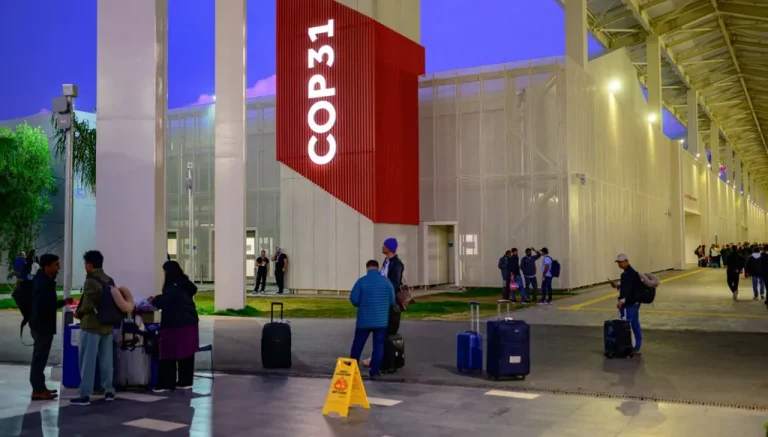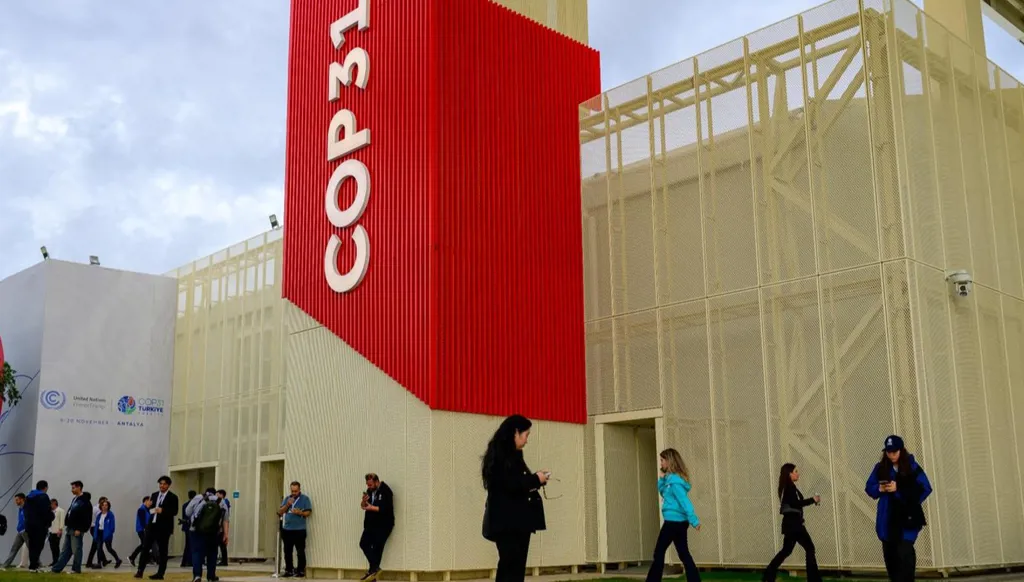
The COP31 climate conference in the Turkish city of Antalya ended on Sunday without reaching a comprehensive final political agreement, after the Turkish-Australian co-presidency failed to secure consensus on the latest draft, following negotiations that extended more than two days beyond the official closing date. With disagreements over fossil fuels and climate adaptation financing remaining the two main obstacles, participating countries failed to adopt the text that was supposed to represent the summit’s main political outcome.
Conference President Murat Kurum acknowledged during the closing session that no consensus had been reached on the document, confirming that the decisions it contained had not been adopted. The presidency thus avoided imposing a text rejected by key parties, but failed to broker a compromise that would secure the unanimity required to adopt the comprehensive decision.
The main dispute centered on the absence of any direct reference to fossil fuels in the latest draft, which contained no mention of oil, gas or coal and did not explicitly call for a transition away from these sources, despite their being the main drivers of greenhouse gas emissions.
Earlier drafts had included calls to accelerate the transition away from fossil fuels, but these references were removed in subsequent stages of negotiations amid objections from energy-producing countries, including Saudi Arabia and Russia.
The European Union, the United Kingdom and other countries refused to adopt the text in its latest form, arguing that ignoring fossil fuels represented a retreat from the understandings reached at the 2023 Dubai conference, where countries agreed to transition away from these sources in a just and orderly manner.
Panama, island nations and groups of developing countries also objected to the proposed wording, warning that an agreement that fails to address the root causes of global warming does not match the scale of the climate crisis. Saudi Arabia, meanwhile, defended keeping all technological solutions on the table, including carbon capture and storage, as part of the tools for tackling climate change.
The disagreement over fossil fuels was not the only reason the negotiations stalled. Financing for developing countries to address the impacts of climate change remained a major point of contention, as the most vulnerable countries called for clear and guaranteed financial resources rather than general pledges or deferred negotiation processes.
The latest draft did not include a specific annual target of $120 billion in adaptation financing by 2035, nor did it provide sufficient implementation guarantees for increasing the resources available to developing countries. This prompted objections from countries facing the mounting costs of droughts, floods, rising temperatures and the degradation of agricultural land.
While developing-country delegations stressed that financing must match the scale of the damage and needs, disagreements persisted over the responsibility of wealthy countries, the sources of funding and the mechanisms for providing it. As a result, Antalya failed to turn climate pledges into a clear financing framework on which the countries most exposed to climate risks could rely.
The conference's outcome highlights the difficulty of speaking of unified Arab gains. On the one hand, oil- and gas-producing countries avoided the inclusion of new, explicit language on transitioning away from fossil fuels, easing the negotiating pressure on them. On the other hand, the Arab countries most vulnerable to climate change secured no new financial guarantees commensurate with their adaptation needs in the face of drought, water scarcity, desertification and rising sea levels.
This divide is particularly significant in the Middle East and North Africa, a region facing rapidly rising temperatures and mounting pressure on water resources and food security. Delegations' positions also showed that divisions are not confined to Arab countries, as developing, island and European nations objected to the text over concerns related to climate ambition, financing and justice.
The failure to adopt a comprehensive political decision did not lead to the cancellation of the Paris Agreement or commitments previously approved at climate conferences. Separate decisions were also adopted during the conference on individual negotiating tracks. However, the absence of a final decision deprived the summit of a unified political signal that was supposed to set the direction for climate action in the coming period.
As Ethiopia prepares to host the next climate conference in Addis Ababa in 2027, it will inherit the issues left unresolved in Antalya: the future of fossil fuels, adaptation financing, mechanisms for implementing commitments and the sharing of the burden of addressing a crisis whose impacts intensify year after year.
COP31's failure was therefore not merely a disagreement over wording in a negotiating document, but a reflection of deeper divisions over who bears the cost of the climate transition, who has the right to determine its course and who pays the price for delays in tackling global warming.