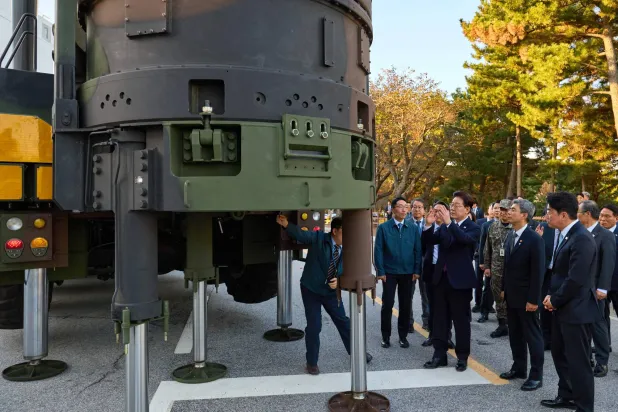
South Korean President Lee Jae Myung oversaw the country's first test-firing of a domestically developed hypersonic missile, the presidential office said in a statement on Thursday. The rare public showcasing of a missile test by a South Korean president took place amid heightened tensions on the Korean Peninsula and a race to develop weapons capable of evading missile defenses. Seoul's test of a hypersonic glide vehicle, a maneuverable weapon that can change course during flight, came days after North Korea said its leader Kim Jong Un had also overseen his own test of an intermediate-range, hypersonic missile. "Today, the first test launch of a hypersonic missile we are developing with our own technology was a success. I am truly proud," Lee wrote in a Facebook post, according to Reuters. Calling it progress in "self-reliant defense", Lee said South Korea will "keep investing steadily in advanced defense technologies, including hypersonic propulsion, AI and high-powered lasers". The South Korean missile is a "strategic asset" for the country, the presidential office said, adding that it was capable of striking a target by surprise with its unpredictable flight paths and overwhelming speed. After being briefed on the test, his office said Lee called on missile researchers at a state-run institute to swiftly develop and deploy the missile. He also inspected the military's Hyunmoo-5 bunker-buster missile. Lee's decision to publicize the test appeared aimed at sending a warning to Pyongyang after a mine blast on the border wounded South Korean soldiers last month, while avoiding escalation, local media reports said. The South Korean president has repeatedly called for a resumption of dialogue with the North, but his overtures have been repeatedly rebuffed. Tensions between the Koreas have risen since the landmines exploded on September 21 south of the Military Demarcation Line in the western sector of the Demilitarized Zone (DMZ), wounding three South Korean soldiers. South Korea's military said a joint investigation with the United Nations Command concluded that the blast was caused by mines planted by North Korean troops. Seoul has called the blast a violation of the 1953 armistice and demanded an apology. North Korea has denied responsibility, with Kim Yo Jong, the powerful sister of leader Kim Jong Un, dismissing Seoul's findings and warning of retaliation if South Korean troops open fire on North Korean soldiers working along the border. South Korean presidents rarely publicize missile tests they attend in person. In June 2015, then-President Park Geun-hye watched a ballistic missile launch at the Agency for Defense Development's Anheung test site, the first public visit by a sitting president to the site in decades, according to media reports. Her successor, Moon Jae-in, observed missile tests in 2017 and 2021. Hypersonic weapons typically travel at more than five times the speed of sound, often at relatively low altitudes, with analysts noting their main feature as maneuverability to hit targets. Lee's government is seeking to take back wartime operational control of South Korean forces from the United States. Under the current arrangement, designated US and South Korean forces would operate under Combined Forces Command led by a US general if war broke out. The government wants to complete the transfer before Lee's five-year term ends in 2030.