"Success is not measured by the number of agreements we sign or conferences we hold, but by the projects that begin, the investments that arrive, the partnerships that expand and the jobs that are created."
That standard, set by the chairman of the Investment Development Authority of Lebanon (IDAL) Majed Mneimneh, captures much of what was said at the Lebanese-Syrian Investment Forum. It should also have been the forum’s guiding principle. Yet the sessions suggested otherwise.
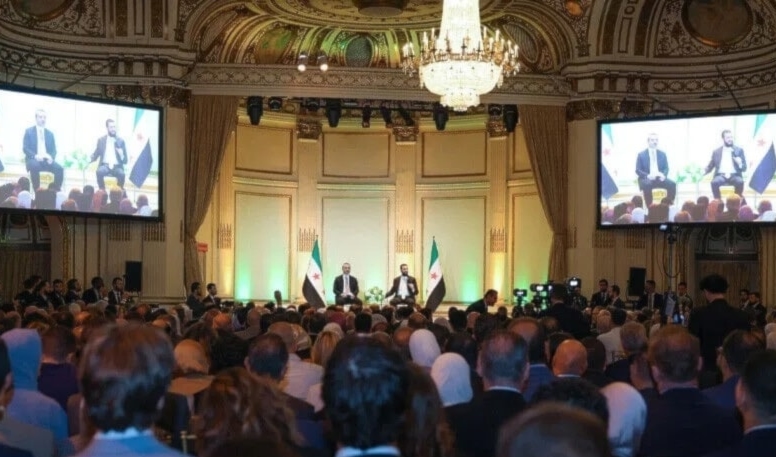
Instead of concrete projects, ready investments and clear implementation plans, there were many photo opportunities, including with what Syrian Economy and Industry Minister Mohammad Nidal Al-Shaar described as "the largest Syrian government delegation to visit Lebanon since liberation." Familiar problems in Lebanese-Syrian economic ties were also revisited, from political and security issues to border crossings, transit, trade restrictions, financing, guarantees and the legal framework.
The forum often appeared more like a series of speeches than a meeting built around a clear vision for the relationship. It remained unclear what Lebanon economically wants from Syria, what Syria wants from Lebanon, and what interests could make "integration" beneficial to both sides. The broader message seemed to be that Syria needs investment and Lebanese businesses should seek their share of the market.
The gap between those opportunities and projects ready to receive investment remained wide.
After an opening ceremony filled with ambitious speeches, the sessions moved into broad discussions about "integration," value chains and opportunities across different sectors. The gap between those opportunities and projects ready to receive investment remained wide.
The clearest message was perhaps that the private sector should move ahead of both governments. More than 40 agreements and protocols are still under review, while border crossings, trucks, transit, standards, inspections, trade restrictions and the movement of businesspeople all remain unresolved.
The contradiction was evident in the remarks of Economy Minister Amer Bisat himself. He described the governments’ role as "opening the way for economic activity," removing obstacles and providing a clear and stable legal framework. He then called on Lebanese investors to study opportunities, identify projects and inform both governments of the "obstacles, guarantees and procedures" they require so they can be addressed through the official mechanisms that "we have begun establishing." In other words, investors are being asked to take the road first, identify its obstacles and then wait for the state to clear them.
Lebanon is hardly in a position to treat investment as an experiment. It has emerged from a war after years of financial and banking collapse, while its own reconstruction, investment and financing needs remain substantial. Those who still have capital to invest are not sitting on excess funds looking for a market. Protecting their money and ensuring its return have become central to any investment decision.
Yet much of the forum’s rhetoric presented Lebanon mainly as a source of capital, expertise, services and business networks for Syria. There was little discussion of what the relationship could contribute to Lebanon’s economy beyond individual investor profits.
Once an investor takes money to Syria and earns a return, what does the promised "integration" bring back to Lebanon, its economy and its citizens?
The contradiction also emerged over Syrian customs duties and trade procedures. The response was that these measures were not directed against Lebanon but formed part of a broader policy to protect Syrian industry. That is understandable from Syria’s perspective, but it exposes the limits of the integration rhetoric.
Lebanon is simply expected to wait until Syria recovers, as though Lebanon itself were in good shape.
When it comes to attracting capital, Lebanon is portrayed as a close partner expected to be among the first to enter. When it comes to tariffs, restrictions and market protection, there is no special treatment reflecting that relationship. Lebanon is simply expected to wait until Syria recovers, as though Lebanon itself were in good shape.
Integration does not mean that Syria should abandon industrial protection for Lebanon’s benefit. Nor does it mean Lebanon should send its capital to Syria simply because the two countries are neighbors. Each side has its own interests. A special relationship is measured not by the warmth of investment invitations but by what it actually delivers to both economies.
Al-Shaar himself acknowledged that geography alone cannot create integration. What is needed are clear rules, trusted institutions, functioning border crossings and banks capable of financing trade. Syria is still working to develop its legislative and institutional environment and reform its financial and banking sectors.
That makes the repeated talk of "opportunities" less important than the absence of ready projects. Investors do not need a conference to tell them that a country emerging from war needs energy, factories, transport, hospitals and infrastructure. They need an economic reason to put their money there, particularly when their own economy needs that capital too.
This is an edited translation for a report published in Arabic.