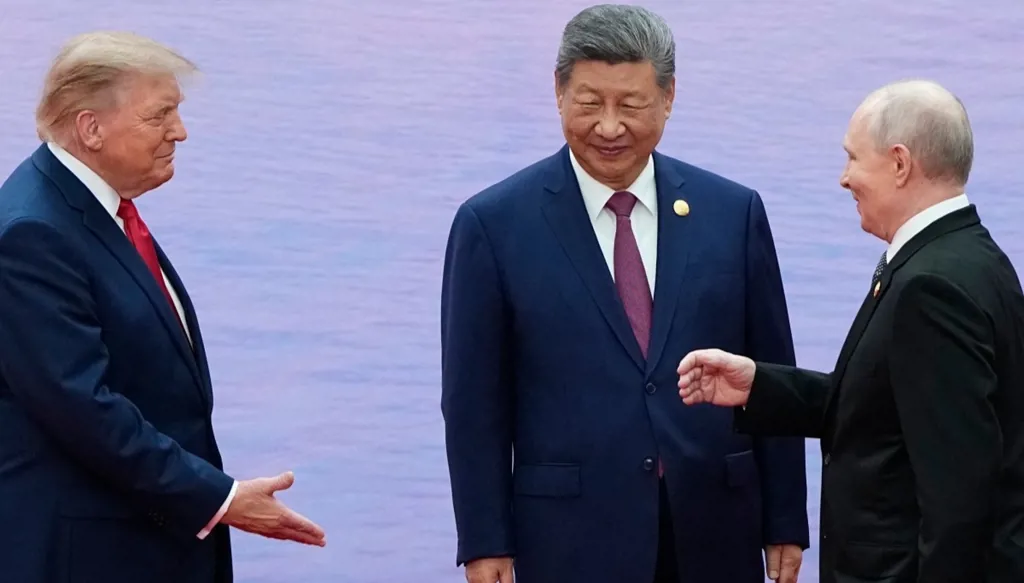
The leaders of the world's three most powerful countries, U.S. President Donald Trump, Russian President Vladimir Putin, and Chinese President Xi Jinping, are set to meet on Thursday in an unprecedented gathering, despite their differences over issues including artificial intelligence, nuclear weapons, technology, trade, and international influence.
The meeting will take place on the sidelines of the Asia-Pacific Economic Cooperation (APEC) summit in the Chinese city of Shenzhen, in discussions reminiscent of the "Big Three" summit in Yalta in February 1945, which brought together the United States, Britain, and the Soviet Union.
At that meeting, held months before the end of World War II, the leaders of Britain, the Soviet Union, and the United States agreed on the post-war distribution of influence in Europe.
Europe is absent from the upcoming meeting, raising concerns, as is Ukraine, after nearly five years of war with Russia, and Taiwan, which China considers part of its territory and has vowed to bring under its control.
However, analysts dismiss the possibility of a breakthrough on major issues such as Ukraine, nuclear disarmament, and artificial intelligence, despite the significance of the summit itself.
The following is an overview of what the three presidents hope to achieve during the meeting.
In theory, Putin will be the weaker party, leading a country with a population far smaller than those of the United States and China, not to mention its economy's size compared with those of Washington and Beijing.
However, the war that erupted following Moscow's invasion of Ukraine could feature prominently in the talks as the conflict approaches its fifth year.
Putin could use Ukraine's and its European allies' absence from the negotiating table to present his conditions for ending the war.
Frederic Wehrey, a researcher at the European Council on Foreign Relations, said Putin "wants Russia, the United States, and China to decide the geopolitical fate of everyone. But ultimately, it's impossible to determine the foundations of European security without the Europeans."
The image projected by the meeting, which will be broadcast by Russian state-controlled media, is also of great importance to Putin, who has long sought to reinforce Moscow's status as a global superpower, even after the collapse of the Soviet Union.
Tsipora Fried, a researcher at the Hudson Institute, said, "Sitting alongside the American and Chinese presidents will confirm Russia's status as a global power, even though its economic position is much weaker" than that of the other two parties.
She added, "Political recognition would be a gain even without concessions regarding land, sanctions, or Ukraine's future directions."
Trump: Nuclear Issues and Elections
Trump and the White House have presented the summit as an opportunity to make progress on limiting nuclear weapons, although the U.S. president acknowledged before leaving Washington that "the issue is difficult."
The image projected by the meeting is also important for Trump, who, at 80, is preparing to spend the final two years of his term facing constraints from Democratic control of Congress, following his Republican Party's defeat in the midterm elections earlier this month.
Edgard Kagan, a senior advisor at the Center for Strategic and International Studies, said, "This is typically a way for presidents to regain initiative after poor midterm election results, and to remind other leaders that they still control foreign policy."
Trump will also be keen to avoid signaling any easing of export restrictions on technologies reliant on artificial intelligence to China, particularly as the summit follows the resignation of NVIDIA CEO Jensen Huang amid a relationship with a woman accused by U.S. intelligence of spying for China.
Matilde Villiers, a researcher at the French Institute of International Relations, said, "The Americans' room for maneuver is limited because of the NVIDIA scandal," noting that it has led to "a hardening" of the U.S. stance.
China: Position and Taiwan and Stability
Fried said Chinese President Xi Jinping is aware that, as the summit's host, "the meeting could place China at the heart of global diplomacy and enhance its stature alongside the United States."
However, she believes that "Beijing has reasons to avoid setting an ambitious agenda."
Beijing has maintained a cautious stance throughout the war in Ukraine, remaining neutral and dismissing accusations of directly supporting Russia, including through the export of technology that could be used for both civilian and military purposes.
Chinese Foreign Ministry spokesperson Mao Ning said the meeting would feature "in-depth dialogue on safeguarding global peace and enhancing strategic stability in relations between major powers," describing it as an event of "historical significance."
On the nuclear issue, Tong Zhao, a senior researcher at the Carnegie Endowment, said that "China prefers bilateral nuclear talks with the United States over a tripartite format involving Russia."
He explained that this would allow Beijing to exert pressure on issues it considers of "greater priority," such as U.S. arms sales to Taiwan.