Former U.S. diplomat Ryan Crocker tells "Annahar" that the region’s reshaping is far from over, with Iran’s standoff with Washington, renewed fighting in Yemen, Iraq’s armed factions and Syria’s uncertain future all shaping a new Middle Eastern order.
On the eve of the third anniversary of October 7, and looking at the impact that the events of that historic day have had on the Middle East, it appears that the region’s political landscape, maps, and geography have undergone radical changes. Amid the rapidly unfolding events, however, it seems that the changes have not yet reached their conclusion, and the process of reshaping the Middle East is still at its peak.
"Annahar" hosted former U.S. diplomat Ryan Crocker, who has extensive experience in the Middle East and served as his country’s ambassador to Lebanon, Syria, Iraq, and Afghanistan, to hear his views on the war with Iran, which remains deadlocked with no decisive solutions in sight; on Yemen, where the rising smoke signals a difficult war; on Syria, which is trying to emerge from the repercussions of war; and on Iraq, which is facing major challenges.
The starting point was the changes that took place after October 7, which will have long-term consequences and appear likely to erase the borders of the "Sykes-Picot" order and establish new ones. Israel is seeking to build new security zones. In this context, Crocker says that what happened "shook Israel’s sense of security, and the sense of vulnerability and lack of protection grew. From this perspective, the Israeli reaction can be understood."
A state of deadlock dominates the U.S.-Iranian conflict. There are expectations that escalation could return after the midterm elections, but there is also a prevailing belief that U.S. pressure on Iran to force it to make concessions will rely on an economic campaign, through a blockade and sanctions, because this is the means most capable of actually influencing the regime and posing an existential threat to it. War, meanwhile, may weaken its military capabilities but strengthen it ideologically.
Ambassador Ryan Crocker during an interview with 'Annahar.'
Crocker expects the blockade and efforts to allow ships to pass through the Strait of Hormuz to continue. In his view, this is the most effective way to bring Iran back to the negotiating table on "reasonable" terms. Crocker believes that the leaders of the Islamic Revolutionary Guard Corps know how to deal with war and that it "serves them." Most of them are veterans who fought against Iraq, but they cannot deal with the problems of governance.
Israeli leaders, foremost among them Prime Minister Benjamin Netanyahu, have expressed their efforts to bring down the Iranian regime. In Crocker’s view, "regime change cannot be imposed from outside," and in the presence of ongoing military action or the threat of it, it is "unlikely" that we will see mass protests. For this reason, he again calls for maintaining "a calm military situation, applying economic pressure, and giving Iranians the opportunity to realize the scale of the suffering they are enduring because of their government’s policies."
A fighter in Iran during a maneuver amid escalating tensions with the United States. (AFP)
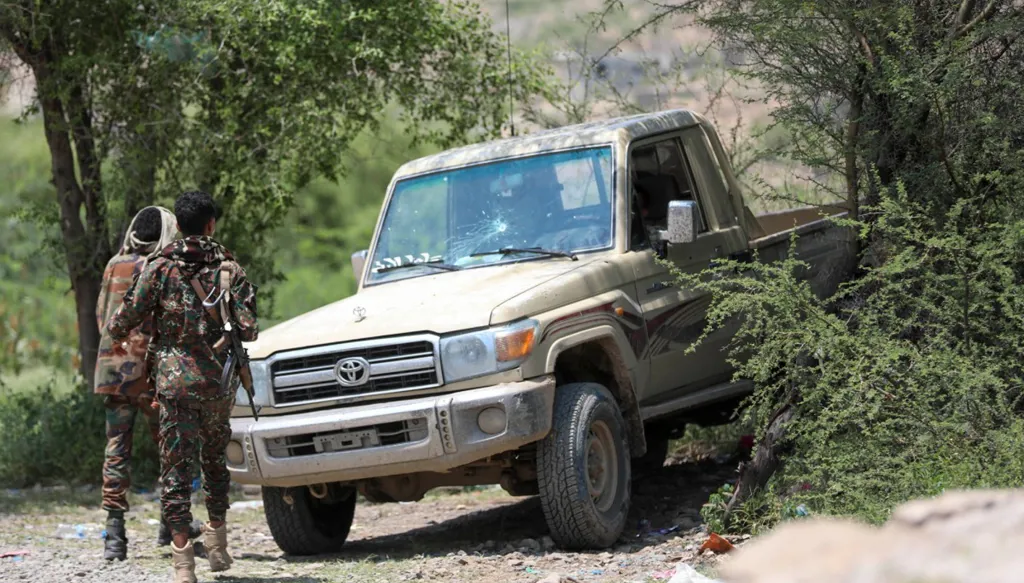
Clashes in Yemen are escalating violently, and the scope of Houthi targeting against Saudi Arabia is expanding. There are many questions about the role of the "Mecca Coalition" and the possibility of an expansion of Saudi operations in Yemen. Crocker does not expect Turkey and Pakistan to become involved in the war, but rather foresees Saudi air support for the Yemeni government forces, while ruling out a Saudi ground intervention.
Fighters in Yemen siding with the government against the Houthis. (AFP)
Iraq failed the test of bringing weapons under state control and dismantling the Iran-aligned factions, and has extended the deadline until early next summer. Crocker expects the activities of armed groups in Iraq to end in the coming months "one way or another," because they were not genuinely part of the Iraqi political scene. In his assessment, Iran will not be able to prevent this because it is preoccupied with its own worsening internal problems. The same applies to his assessment of "Hezbollah."
Syria stands at a crossroads, between energy projects linking the Gulf to Europe and projects involving partition and sectarian wars. In Crocker’s assessment, Syria needs to revive its economy and create an environment conducive to foreign investment, not only in terms of security and stability, but also by establishing a legal framework that welcomes foreign investment and guarantees investors a legally secure economic environment in which to conduct their business.
As for partition projects, he believes that the unity of Syrian territory is "extremely important to its stability and to regional stability," and that moves by parties such as Israel and Turkey that run counter to this approach are "extremely harmful." In his view, this is an opportunity for both countries, Turkey and Israel, to see Syria develop and transform into a state that does not pose a threat to them as it did in the past.
Given his experience in Lebanon and Syria and his knowledge of U.S. policy, Crocker had to be asked about the possibility of Syria intervening to dismantle Hezbollah’s weapons, an idea hinted at by U.S. President Donald Trump. In his assessment, there will be no Syrian intervention in Lebanon. Rather, Syria’s role in dismantling the weapons would consist of ensuring that weapons and money do not reach Hezbollah from Iran through Syria.