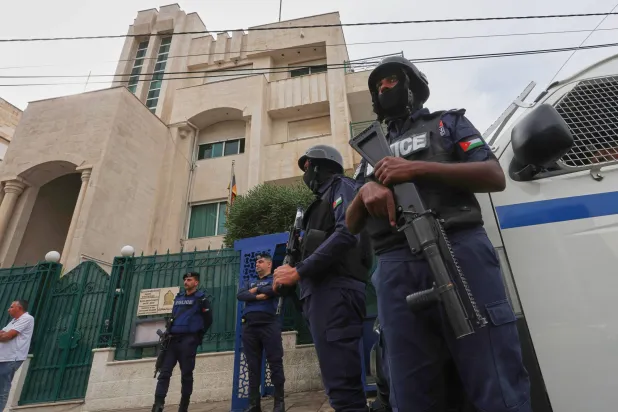
Just days after the deadly attack on Saint George Church in Hamoud village in southern Jordan and retaliatory airstrikes against ISIS in southern Syria, another attack struck the capital, Amman, on Thursday, killing one security officer and wounding another. The assailant, described as a “terrorist,” had recently been released from prison after serving a sentence in a 2020 terrorism case involving plans to carry out attacks. Attacks on security personnel guarding ministries, embassies and government institutions are not new. But Thursday’s assault has revived concerns about the threat posed by lone-wolf attackers and their possible links to ISIS. Observers say the attack may have appeared isolated, but that does not rule out instructions being delivered through online accounts linked to the militant group. ISIS makes no secret of its hostility toward Jordan. Communications between the group and the cell behind the Hamoud Church attack revealed a list of potential targets. Civilians and members of the security forces stand outside the Sri Lankan embassy after a stabbing attack that killed one Jordanian security officer and wounded another, in Amman, Jordan, November 5, 2026. REUTERS/Jehad Shelbak Retired security experts warn that bladed weapons are easy to conceal and use, particularly when attackers strike without warning. The threat is compounded by the nature of police work, which requires Public Security Directorate personnel to maintain close, direct contact with civilians. Jordanian security under attack on multiple fronts Jordan's efforts to combat terrorism and extremism have made it a target for militant groups. A string of attacks in recent years has claimed the lives of civilians and security personnel and struck sovereign state institutions, raising questions about the methods used to monitor and pursue militants at home and abroad. ISIS's targets extend well beyond security forces. Civilians and members of the security forces stand outside the Sri Lankan embassy after a stabbing attack that killed one Jordanian security officer and wounded another, in Amman, Jordan, November 5, 2026. REUTERS/Jehad Shelbak The Hamoud Church attack in Karak killed nine people and wounded 40. More troubling, however, was what appeared to be an attempt to sow sectarian discord between Muslims and Christians in a governorate widely regarded by Jordanians as a symbol of religious coexistence. The challenge for security agencies lies partly in the unpredictable nature of lone-wolf attacks. Even suspects under surveillance may develop plans suddenly, driven by revenge or extremist religious edicts urging the killing of security personnel. Experts argue that surveillance alone cannot contain the threat. They say rehabilitation must become a priority, particularly through open dialogue between terrorism convicts and moderate religious leaders. One figure involved in such efforts is Bassam al-Amoush, a former Muslim Brotherhood leader and former member of the Islamic Action Front who is now affiliated with the Umma Party. Al-Amoush won parliamentary seats on the Islamic Action Front ticket in several elections before leaving the party over internal disagreements. He has since engaged imprisoned ISIS members in discussions aimed at exposing the religious violations committed by terrorist and takfiri groups. The concern is not theoretical. Several perpetrators of terrorist attacks in Jordan had previously been convicted of terrorism offenses, served their sentences and returned to civilian life. Image taken from a video of militants during their attack on the church in the Jordanian village of Hamoud Human rights reports indicate that terrorism convicts are held in shared prison wards, while years behind bars have failed to dislodge the extremist beliefs that underpin their ideology. Those beliefs remain deeply rooted among militants, whether they operate in organized cells or as lone wolves living within their communities. The latest attack has brought those concerns into sharper focus. The assailant who targeted a security guard outside the Sri Lankan Embassy on a major road in western Amman had previously pledged allegiance to the ISIS leader in 2019. He was arrested in 2020 and sentenced to nine years in prison in 2022, raising questions about the gap between his sentence and the time he actually served. A similar pattern emerged among those involved in the Hamoud Church attack in Karak, with former terrorism convicts featuring prominently among perpetrators of attacks in Jordan. The threat has also been fueled by years of cross-border recruitment. Since the outbreak of the Syrian conflict, terrorist organizations in Syria and Iraq have used social media to recruit young Jordanians, while militant cells spread along Jordan's northern border. Some of those areas remain outside the control of Syria's new government, providing potential bases for threats to Jordanian national security. Sleeper cells and fears of coordinated attacks Security experts say the pattern points to possible links between militants inside Jordan and organizations abroad, as well as the presence of sleeper cells within the kingdom. After years of relative dormancy, ISIS has reassessed its operations, plans and the distribution of its cells among communities in southern Syria, exploiting weak security and vast areas beyond effective state control. Security assessments suggest the group has adapted its deployment and methods to changing conditions, taking advantage of Jordanian security forces' focus on countering Iranian attacks against Jordan and Gulf states since late February. A bloodstain at Saint George’s Greek Orthodox Church, where gunmen opened fire during a funeral the previous day, in the village of Hamoud, Karak, Jordan, October 24, 2026. REUTERS/Alaa Al Sukhni The threats come from more than one direction. ISIS remains active to Jordan's north, while Tehran-backed Shiite militias operate along its eastern border with Iraq. Despite their differences, the groups share an interest in targeting Jordanian security. Such threats also have roots in areas once supported by Syria's former government, including territory that housed drug-manufacturing facilities and cross-border smuggling networks used to threaten Jordan through various means. Informed sources say Jordanian security officials are increasingly concerned about renewed, intensive communications between sleeper cells inside the kingdom and terrorist organizations abroad. The concern has fueled calls to widen surveillance using databases of Jordanians affiliated with terrorist groups, including those still in prison and those who have been released. The priority, according to the sources, is to close potential security gaps before militant groups can exploit them. One question remains particularly pressing. Some perpetrators of the Hamoud Church attack had been released from prison only shortly before the assault. The attacker behind Thursday's operation had also recently completed his sentence. Could they have received instructions from convicted militants with whom they had shared prison cells? Fears that security gaps could complicate intelligence gathering and investigations prompted Jordanian security agencies to launch a sweeping series of raids across the kingdom as the case unfolded. The operations began Thursday night and continued into early Friday, reaching northern, central and southern Jordan. Security forces raided areas including Southern Mazar in Karak governorate and Irbid in the north, as well as Marka, Al-Rajm al-Shami and Jubeiha in and around northern Amman. The raids also extended to Russeifa in Zarqa governorate.