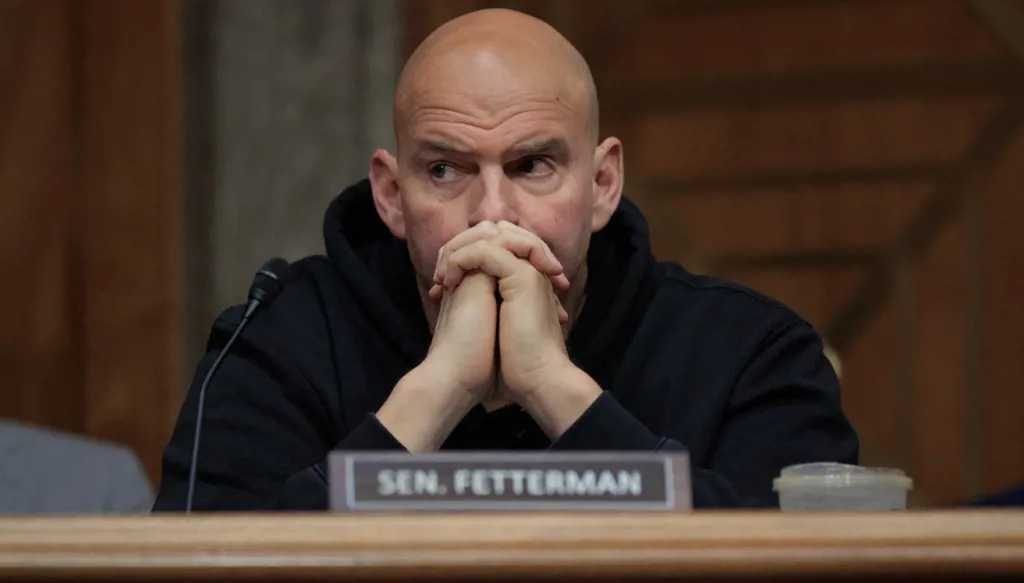
John Fetterman is not happy. The towering Pennsylvania senator was once the quintessential working-class white American, fiercely defending his community against Donald Trump, the billionaire who burst onto the political scene in 2016. Although he lost the Democratic primary that year, he remained defiant and progressive, a supporter of Bernie Sanders, a staunch opponent of Trump, and a critic of the moderate wing of the party.
When he arrived in the Senate in 2023, progressives appeared to have gained a voice on their side, but not for long. Although his break with them began before October 7, 2023, Fetterman underwent a dramatic transformation after that date. He became a staunch defender of Israel's war on Gaza, Benjamin Netanyahu's government, and unconditional US arms supplies to Israel, allowing it to remain armed to the teeth without any restrictions.
Fetterman, of course, rejected describing the war as genocide. Instead, he argued that civilians had fallen victim to "collateral damage" in an urban war against a terrorist movement, in which Israel was doing everything possible to minimize civilian casualties.
As the war progressed, he drifted further away from his party and closer to his former adversary. After winning the 2024 election, Trump welcomed Fetterman as the first Democratic senator to visit him at Mar-a-Lago in early 2025. Fetterman went on to vote alongside Republicans to confirm Trump's nominees for senior positions, while siding against Democrats on resolutions seeking to restrict presidential war powers, including in relation to Iran. His shift culminated in a video appearance at the Republicans' midterm election convention in Dallas, where he pledged to work with Trump to defend the "steel way of life" in his state, which is considered the backbone of America's steel industry.
In the outgoing Senate, Fetterman was one of 47 members of the Democratic caucus, but his colleagues did not count on his vote in major, controversial decisions. As part of the minority, his vote was not particularly consequential anyway. But in the midterm elections, any closely divided outcome, whether the Democrats secured a one-seat majority or ended up tied with Republicans, would have turned John Fetterman into the most important man in America. Of course, that did not happen. And he is not happy.
Thanks to his party's sweeping victory, Fetterman no longer has any real significance in the Senate. He has effectively become a lame duck two years before his term expires, threatening to leave the party if it crosses his red line on Israel, if the left decides who will become majority leader, or over any number of other statements by a politician whose remarkable ability to fail to grasp the moment in American politics and its shifting dynamics has been astonishing.
He has remained a defender of Israel and the war against Iran, even as Republicans acknowledged that both were among the main reasons for their crushing defeat.
The Republicans are not the only ones who have recognized the shift. The Democratic Party itself has read the political landscape and responded with considerable pragmatism, allowing anti-war, left-wing rhetoric and opposition to unconditional support for Israel to dominate the campaign narrative. This has gone hand in hand with attacks on Trump over the economy and the cost of living, precisely the territory where Fetterman had chosen to meet Trump, presenting himself as a defender of Pennsylvania's working class.
"I haven't changed. The party is the one that has abandoned its principles!" This is a line the senator has been repeating lately. He faces a difficult two years of isolation before his term ends, which many expect will be his last in Pennsylvania. He went to Donald Trump while America was moving away from him.