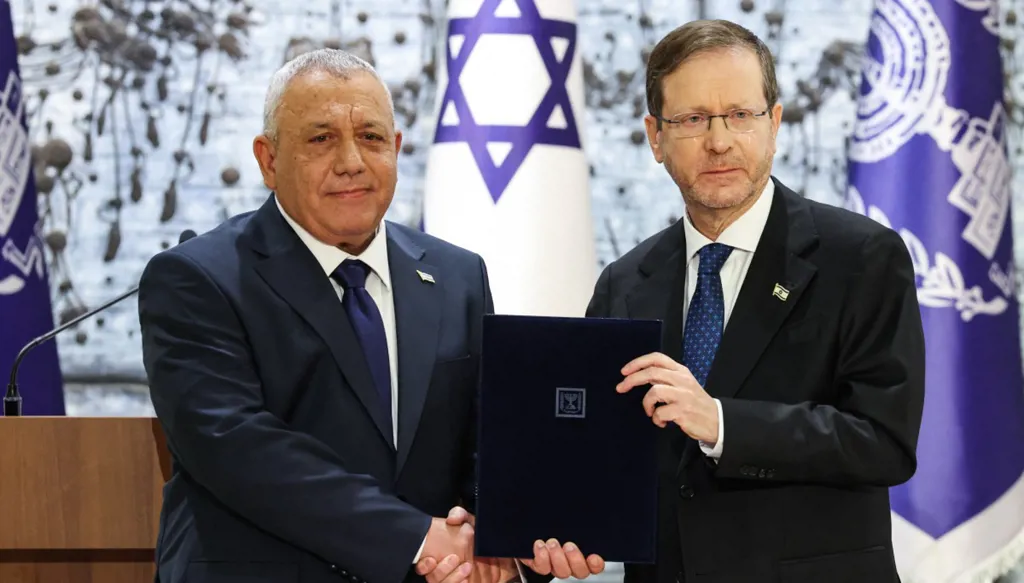
The Knesset elections have given Gadi Eisenkot an opportunity to form a government, but they have not brought Benjamin Netanyahu’s rule to an end. His bloc has lost its majority, but his opponents have failed to agree on an alternative coalition. Despite President Isaac Herzog’s decision to task an opposition candidate with forming a government, the transfer of power remains dependent on understandings between parties that disagree over the terms of joining the government.
Support from the two Arab lists helped tip the balance in Eisenkot’s favour during the consultations on forming a government. The United Arab List is showing a willingness to join the government, while the Joint List prefers to cooperate from outside the coalition. Some of Eisenkot’s allies are even opposed to relying on their votes in parliament. The results show that Arab representation, which has risen to 19 seats, gives Arab parties considerable parliamentary weight that cannot easily be ignored, without necessarily guaranteeing acceptance of their participation in power.
One alternative to relying on the Arab parties involves the two ultra-Orthodox parties, Shas and United Torah Judaism, but this option runs up against the issue of military conscription. Shas recommended Netanyahu, while United Torah Judaism refrained from endorsing any candidate. Both parties insist on exempting students at religious seminaries from military service, a demand the prime minister has sought to protect through legislation. Eisenkot, meanwhile, insists that everyone should perform military, national or civilian service. The ultra-Orthodox parties’ seats could give the opposition bloc a parliamentary majority, but meeting their demands could conflict with the commitments made to its partners.
Netanyahu stands to benefit from the continued divisions among his opponents, as he will remain head of the caretaker government until a new government is formed. He could stay in office for months if coalition negotiations stall. He has called for a national unity government to confront Iran, rejecting reliance on the Arab parties and insisting on the participation of his ultra-Orthodox allies and the hardline nationalist right. Eisenkot’s party, however, is calling on Likud to break its alliance with those it describes as extremists and join a new coalition.
The difficulty in reaching an agreement is also rooted in deeper divisions over domestic Israeli affairs. The investigation into the failures of October 7, relations between the government and the judiciary, and the influence of religious parties all reflect differences in the political forces’ orientations. Israeli parties may agree on major security priorities, yet disagree over holding officials accountable and the limits of government authority. Eisenkot’s ability to bring together the necessary votes therefore remains a test of the cohesion of any government he might form.
A change in Israel’s leadership does not necessarily mean a shift in its security policies. Eisenkot, a former chief of staff of the Israeli military, shares Netanyahu’s view that the Iranian regime, Hezbollah and Hamas pose threats that require deterrence and military action when necessary. However, the two differ in their assessment of the merits and timing of escalation, their strategies for confrontation, and their approach to coordination with Washington.
Netanyahu and Eisenkot both reject a two-state solution, but differ over settlement expansion and settler violence in the West Bank. Both support the general framework of Trump’s plan for Gaza, which provides for a transitional Palestinian administration under the supervision of a Board of Peace and the reconstruction of the territory. However, the prime minister has made Hamas’s disarmament a condition for a gradual withdrawal, while Yashar has criticised arrangements that it warned could allow the movement to remain in power.
The next Israeli leadership will face a more complicated relationship with the United States following the Democrats’ victories in both chambers of Congress. Netanyahu’s close ties with Trump have drawn criticism from his rivals, and Eisenkot has pledged to restore ties with both US parties. With the US president announcing his intention to halt annual military aid to Israel, the security partnership between Washington and Tel Aviv remains broader than the relationship between two leaders. The way the strategic alliance is managed may change without altering its foundations.
From a regional perspective, the continued state of neither war nor peace with Iran, alongside escalating tensions in Gaza and Lebanon, increases the risks of a wider confrontation and its repercussions. The absence of a just settlement to the Palestinian issue continues to fuel tensions. The elections may lead to a change in Israel’s prime minister, but regional stability will depend on the next government’s willingness to address conflicts politically rather than simply manage them through military means.
Disclaimer: The opinions expressed by the writers are their own and do not necessarily represent the views of Annahar