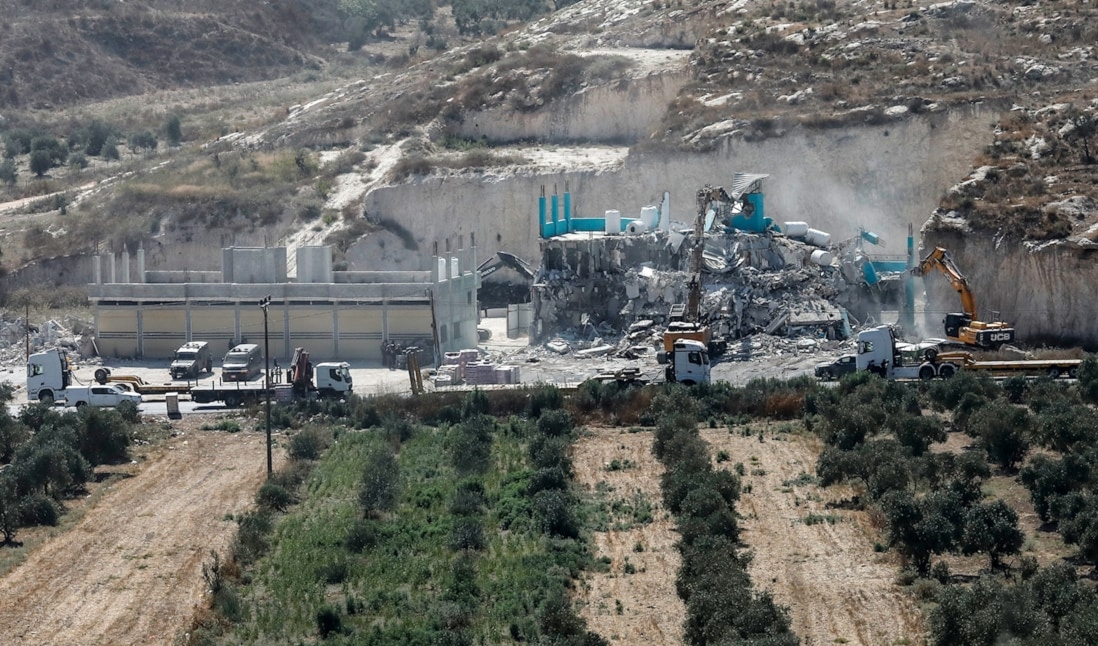
For weeks, Israeli military machinery has been relentlessly bulldozing land, uprooting trees and demolishing homes, businesses and other structures across Jenin governorate. The area has become one of the West Bank’s main targets for settlement plans. Dozens of projects are now under way as the Israeli occupation seeks to restore a settlement presence in Jenin more than two decades after its settlements were evacuated. Military measures are also paving the way for further land seizures, threatening major changes to the area’s geography and demographics.
In the latest escalation, villages across the governorate saw dozens of demolitions. Israeli Finance Minister Bezalel Smotrich announced the demolition of 26 Palestinian buildings in the former settlements of Ganim and Kadim, describing them as “illegal” and their removal as “necessary to strengthen settlement and security.” The Israeli government approved the re-establishment of Ganim and Kadim in late 2025, after they were evacuated in 2005, as part of a plan involving the creation or restoration of 19 settlements across the West Bank.
Jenin also hosted a settler ceremony near Arraba on Sunday, after Israeli ministers, Knesset members and officials laid the foundation stone for a new settlement called Emek Dotan on the town’s land. The event was attended by the head of the northern West Bank settlement council and about 22 settler families, highlighting official backing for the expansion. Israeli sources say more than 300 families have registered to move to 18 planned settlements in the governorate.
The settlement expansion is accompanied by military escalation around the new sites. Authorities have issued more land seizure orders, built and widened military roads, bulldozed fields, uprooted trees and established outposts. Arraba has faced near-daily raids. During its latest incursion, the Israeli military distributed leaflets warning residents: “A new Israeli town has been established near you and is guarded and protected by Israeli security forces. We will use all means to thwart and crush any attempt to carry out terrorist acts that threaten the security and stability of the area. Any attempt to harm Israeli civilians or Israeli security forces will expose you to live fire and arrest.”
The Palestinian Colonization and Wall Resistance Commission documented 3,488 attacks by settlers against Palestinians and their property during the first six months of 2026 in a report issued on July 6.
Emek Dotan, established about three months ago, occupies 72 dunams of privately owned land in Arraba and its plain, one of Jenin’s key agricultural areas. Its fertile fields are a major source of income for local residents. A settlement road is also planned from the Tersela settlement south of Jenin through the lands of Ajja, Sanur, Silat Al-Harithiya, Attara, Sebastia and Burqa, reaching Deir Sharaf in Nablus governorate. Such roads not only destroy farmland and vegetation. They isolate agricultural areas and restrict farmers’ access, threatening the livelihoods of thousands of Palestinians.
Villages west of Jenin are also facing mounting pressure, particularly near the separation wall. Israeli authorities have designated large areas as military zones before beginning to destroy agricultural land. On Wednesday, Israeli forces demolished several commercial structures along the road linking the Marj Ibn Amer roundabout with Aaba village and extending to the Haddad junction east of Jenin, after closing roads leading to the area.
In Zububa, west of Jenin, farmer Munir Abu Bakr lost about 50 dunams of land to the operations. The area contained olive trees and irrigated and rain-fed crops. A groundwater well was also destroyed. Abu Bakr is among about 50 farmers whose land and trees have been affected by the bulldozing.
The bloody settlement campaign is unfolding alongside a rise in settler attacks across the West Bank. Israeli security agencies recorded 660 incidents classified as “nationalist crime” during the first half of 2026, according to Israeli reports. Data cited by Israel’s Kan public broadcaster showed a sharp increase from 405 incidents in the second half of 2025 and 440 in the first half of that year. The figure represents a 63% increase from the final six months of 2025 and about 50% from the first half of that year.
Palestinian casualties also increased, from 82 injured and no deaths in the second half of 2025 to 140 injured and six deaths in the first half of 2026. The figures exclude July, when Israeli authorities recorded about 100 additional attacks, indicating that the trend continued into the second half of the year.
Israeli figures, however, do not capture the full scale of settler violence. The Palestinian Colonization and Wall Resistance Commission documented 3,488 attacks by settlers against Palestinians and their property during the first six months of 2026 in a report issued on July 6. That figure is far higher than the incidents classified by Israeli security agencies as “nationalist crime.”
This is an edited translation for a report published in Arabic.