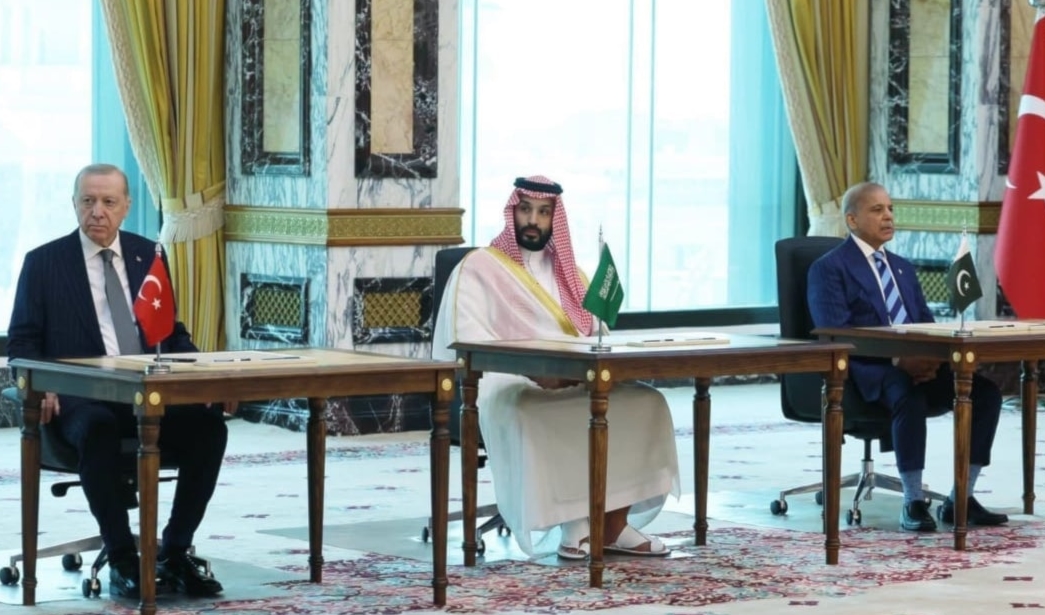
Israel does not view the Mecca Agreement between Saudi Arabia, Türkiye and Pakistan as a direct military threat. But it sees the pact as a consequence of the failure of the Israeli-US war on Iran, which was expected to “change the face of the Middle East.”
The war exposed the limits of the US defense umbrella in protecting Saudi Arabia and other Gulf states. It also highlighted the lack of security guarantees they had expected during such a crisis. That has prompted them to seek other partners that could provide an alternative or complementary security umbrella.
At the same time, Tel Aviv does not see the alliance as a bloc directed against Tehran. It instead believes Riyadh’s decision to turn to Ankara and Islamabad rather than seek Israeli assistance carries a message to Iran that the pact is defensive and not intended for direct confrontation. The agreement therefore reveals Saudi Arabia’s sense of vulnerability more than its strength. This is what concerns Israel and what it is monitoring for its indirect implications for Israeli security.
There is a growing Israeli assessment that Iran has emerged from the war more confident and determined to confront the US and its allies. Tehran is now using military pressure to assert its interests in the region, prompting Gulf states to seek additional partners for protection.
Iran has warned that any renewed US strikes would be met with attacks on energy and desalination facilities across the region. Riyadh is also concerned about “multiple coordinated attacks by Iraqi militias and Iran-backed Houthis” in Iraq and Yemen, with support from the Revolutionary Guard, according to a Saudi official cited by CNN.
Pakistan, in this context, represents one of the security umbrellas available from outside the region. But it has been careful not to portray the alliance as hostile to Iran, particularly because Islamabad does not have an adversarial relationship with Tehran. Türkiye’s motives are less ambiguous. Ankara is seeking greater regional influence, one that matches its military strength and capabilities, regardless of how the latest agreement ultimately develops.
The agreement has created additional distance between Arab states and Israel while highlighting their desire to avoid provoking Iran. That is precisely what is worrying Tel Aviv.
For Israel, the Mecca Agreement further weakens hopes of building a regional alliance in which it would serve as the main security and political partner against Iran. The decision by Arab states to pursue regional partnerships away from Tel Aviv suggests that they no longer see Israel as a source of protection, but rather as a problem from which they need to distance themselves.
That frustration is compounded by Turkish Foreign Minister Hakan Fidan’s expectation that Egypt could eventually join the Mecca Agreement as a natural partner. That prospect, combined with Israeli Prime Minister Benjamin Netanyahu’s presentation of maps of what he calls “Greater Israel” that include parts of Sinai, as well as previous Israeli calls to weaken the Egyptian military, reinforces the perception that Israel is becoming an additional source of concern for regional states rather than a potential security guarantor.
Yet Israel remains cautious in assessing the pact. Neither the government nor the Foreign Ministry has issued an official position rejecting the agreement or describing it as a threat. Diaspora Affairs Minister Amichai Chikli, who represents the far-right religious nationalist camp despite running and winning on the Likud ticket, has called for an alliance with the UAE, Cyprus, Greece and Somaliland in response to what he described as a “dangerous Sunni alliance.”
Some Israeli media analyses, which have closely followed the agreement, have argued that it could take defense cooperation among the three countries to a more consequential level. For Israel, however, the real test will be whether the Mecca alliance produces practical measures such as joint military exercises, operational integration and plans for implementing collective protection commitments.
If those measures remain on paper, the alliance will amount largely to a warning to both the US and Iran. It would have limited impact on broader strategic trends, though it would still make it harder to revive the security, political and military arrangement with Israel against Iran.
For now, Tel Aviv sees the agreement primarily as a declaration of strategic positioning and a warning to Washington, rather than as the creation of an alternative security umbrella capable of replacing the US. It also carries an implicit message to Iran and its allies to reconsider their calculations and avoid initiating hostile action against Saudi Arabia.
For Israel, meanwhile, Saudi Arabia’s effort to build multiple partnerships means Riyadh will enter any future negotiations with Israel with greater demands and stronger leverage. It is unlikely to accept arrangements that were previously under consideration before securing this three-way security umbrella.
The Mecca Agreement has yet to be tested in practice. But one point is already clear. The agreement has created additional distance between Arab states and Israel while highlighting their desire to avoid provoking Iran. That is precisely what is worrying Tel Aviv.
This is an edited translation for an article published in Arabic.