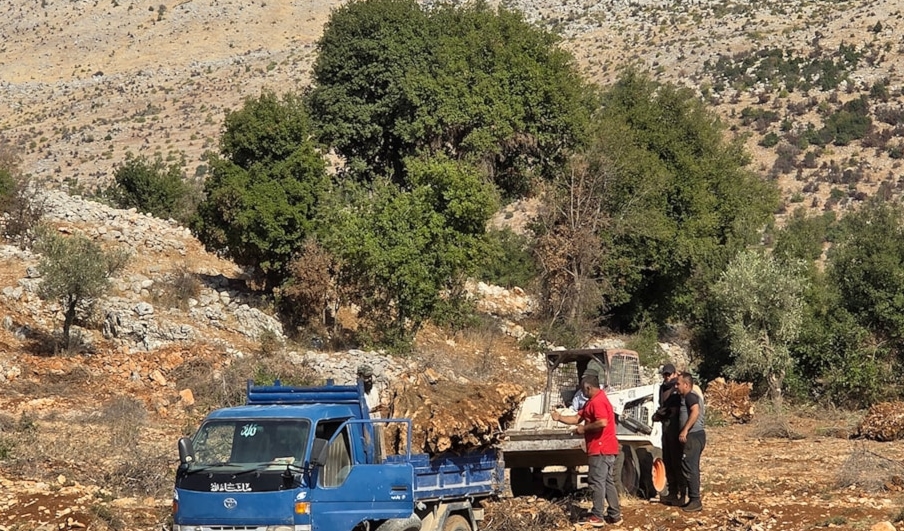
After preventing farmers in Kfar Shouba and other villages in Lebanon’s Arqoub region from harvesting their olives last week, Israel has agreed to allow them conditional access through the ceasefire monitoring mechanism. Permission comes under conditions that “fall short of even the minimum standards of seriousness and logic,” Kfar Shouba Mayor Qassem Al-Qadri told Al-Akhbar. Israel would allow a maximum of 100 people and 25 vehicles to harvest olives for just one day, effectively limiting access to 25 landowners in a village with tens of thousands of trees. Residents and the municipality have rejected the arrangement, which treats landowners as though they were begging for access to their own property. Kfar Shouba alone has around 85,000 olive trees, owned by most of the village’s residents. Their harvest is a primary source of annual income. “How can 25 owners harvest this crop in a single day?” Al-Qadri asked, questioning why the municipality was being asked to select a limited list of eligible farmers, a process that risks creating tensions within the community. The neighboring village of Shebaa has been excluded from the proposed arrangement, while vast agricultural areas, including Bastara, Majidieh and the Jebta road, remain completely off-limits. These areas contain olive groves on which Arqoub residents depend for their livelihoods. Israeli forces have recently bulldozed large areas of mature olive trees, established positions there and installed surveillance equipment and earthen barriers to impose new facts on the ground. Another major concern is the absence of security guarantees. The proposed plan offers no effective escort by the Lebanese army or the United Nations Interim Force in Lebanon (UNIFIL). Farmers would have to enter their lands alone and surrender their phones and identity documents at border checkpoints for Israeli forces to inspect. Al-Qadri said the measures “carry malicious intentions and treat residents as though they are going to foreign territory, rather than their own property.” The restrictions coincide with escalating Israeli attacks. Israeli forces have recently bulldozed large areas of mature olive trees, established positions there and installed surveillance equipment and earthen barriers to impose new facts on the ground. The situation is causing an unprecedented economic and social crisis, one Kfar Shouba farmer said, recalling the suffering of neighboring villages. Al-Qadri said Arqoub’s municipalities and local representatives were preparing a joint press conference and a broader media and diplomatic campaign. They also plan to appeal to the Lebanese government, the Agriculture Ministry and international organizations to intervene on behalf of a region with no armed presence, whose residents are being denied their basic right to their land and livelihoods. This is an edited translation of a report originally published in Arabic.