According to what was announced about the visit to Tehran by Pakistani Army Chief Field Marshal Asim Munir, Iranian officials once again told him that there would be no return to dialogue with the United States unless Washington implemented the seven demands that Iran had previously submitted to the mediators. This stance reflects an extremely hard-line position and deep mistrust of US President Donald Trump.
Iranian President Masoud Pezeshkian receives Pakistani army chief Marshal Asim Munir in Tehran, October 20, 2026. (AFP/Iranian Presidency)
Iranian officials are betting that the November 3 midterm elections will end in a resounding political defeat for Trump if the Republican Party loses control of Congress to the Democratic Party, as opinion polls suggest. Based on this calculation, Iran will not give the US president a “victory image” by returning to dialogue in the run-up to the elections. In other words, Iranian officials believe Trump will be in a weaker position after the elections, making it easier to extract concessions from him.
While these are Iran's calculations, Trump has his own plans for the post-election period. He has threatened to “finish the job soon unless Tehran changes course.” This warning leaves Iran facing a choice between war and an agreement, reflecting Washington's growing frustration with the state of neither war nor peace, which prolongs its entanglement in the Iranian quagmire.
This assessment is reinforced by revelations from the British newspaper The Financial Times that Trump intervened to prevent Israeli Prime Minister Benjamin Netanyahu from launching a bombing campaign against Iranian infrastructure on October 10. The US president wants to avoid the repercussions of a new war in the Middle East on oil supplies and the resulting surge in prices to even higher levels. Such an increase would further fuel American voters' discontent over inflation and push them to vote for the Democratic Party.
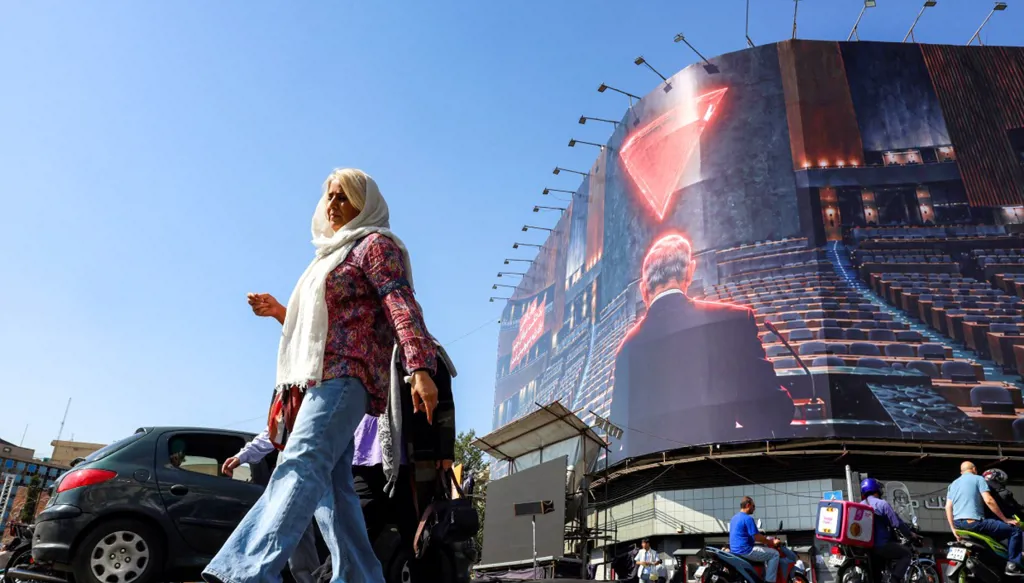
An Iranian actor wearing a mask depicting U.S. President Donald Trump inside a symbolic cell set up on a billboard in Tajrish Square in Tehran, October 21, 2026. (AFP)
Netanyahu has been evoking the atmosphere that preceded the war of February 28, repeatedly saying that he discussed with Trump the “necessity of toppling the Iranian regime,” arguing that as long as the regime remains in power, it will continue trying to acquire nuclear weapons. The US president, meanwhile, is careful to avoid discussing regime change, limiting himself to saying that his goal is to prevent Iran from obtaining nuclear weapons. He considers the issue of the Strait of Hormuz no longer a priority, given that commercial shipping through the strait has returned to 80% of its previous levels.
This recovery is mainly due to the successful operation of a temporary maritime transport system under US protection, which has helped oil tankers adapt to the risks and keep supplies moving.
In an implicit Iranian acknowledgment of this reality, the Islamic Revolutionary Guard Corps has expanded its attacks on oil tankers beyond the strait, targeting vessels south of Hormuz and as far as the Gulf of Oman. According to ship-tracking company Kpler, at least 18 attacks were reported over a two-week period. This drove Brent crude prices above $110 a barrel during Tuesday's trading. The Revolutionary Guard warned shipowners and crews that “crossing unauthorized routes or violating Iranian regulations exposes them to being burned and makes them fully responsible for their own safety.” This warning was followed by another threat from Guard spokesman Hossein Mohebi, who reiterated the threat to target internet cables in the Strait of Hormuz.
Despite all this tension, neither Washington nor Tehran has shut the door on diplomacy led by Pakistan, Qatar, the Sultanate of Oman, and Switzerland, and possibly Russia. Following the Pakistani army chief's visit, a Qatari delegation arrived in Tehran.
Disclaimer: The opinions expressed by the writers are their own and do not necessarily represent the views of Annahar
Thank you for subscribing to our newsletter