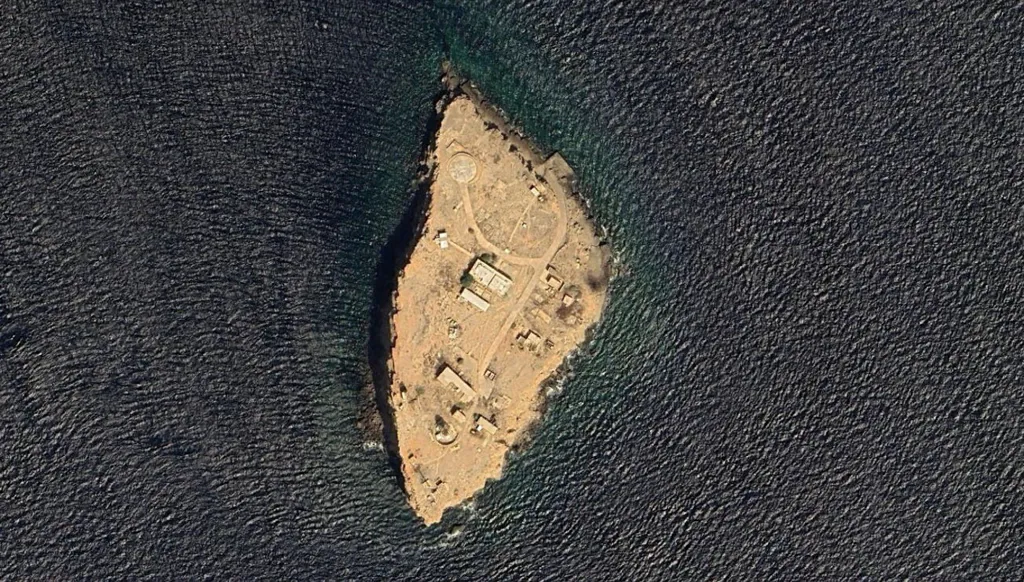
Iran is steadily escalating its attacks on oil and gas tankers in the Strait of Hormuz, as well as on American radar sites in the region that help commercial ships navigate the strait beyond the reach of the Iranian Revolutionary Guards. In response, Iranian radars, missile launch platforms, and drones stationed on islands in the strait and along its coasts have become targets of often undeclared American attacks.
In recent days, Iran has expanded its response to include a radar installation on an Omani island in the strait, as well as a radar at Bahrain's Riffa helicopter air base, two days after an early-warning radar was attacked. This was the largest attack of its kind since last September.
Iran's campaign has clear objectives: disrupting maritime traffic that had previously been authorized by Tehran and reducing the volume of oil leaving the strait. In recent weeks, the U.S. Navy has successfully restored oil flows through the strait to 80% of their previous levels. This has affected oil prices, which have fallen to around $90 per barrel, their lowest level in months.
This situation allowed U.S. President Donald Trump to announce on Thursday that he does not need an agreement with Iran. He instructed his vice president, JD Vance, to abandon efforts to reach a deal with Tehran to end the war and instead focus on domestic issues in the United States. At the same time, Trump confirmed that he would not resume a broad military campaign against Iran unless Tehran or Yemen's Houthis took significant action against American interests.
Trump has also said that Gulf Arab countries have asked him to maintain the policy of economic strangulation against Iran, considering it a better option than returning to a full-scale war. Meanwhile, Iranian officials continue to threaten widespread retaliation without "geographical constraints" should Iran come under a major attack.
A report by The Wall Street Journal highlighted a particularly sensitive issue at this stage, citing U.S. intelligence estimates that Iran still possesses between 1,500 and 2,500 missiles in its arsenal. This gives Tehran significant capabilities to launch large-scale attacks against U.S. and allied forces should the war resume.
These estimates contradict Trump's claims that the United States has destroyed 90% of Iran's military capabilities.
While Trump leans toward maintaining the current status quo with Iran, he is resisting strong pressure from Israeli Prime Minister Benjamin Netanyahu to strike Iran again. Netanyahu has sent the director of Israel's intelligence agency, Mossad, Roman Gofman, to Washington for this purpose.
It is worth recalling that Netanyahu is clinging to the option of war as a last card to keep himself in power, seeking to force the opposition to join a "unity" government under his leadership. Yeshar party leader Gad Eisenkot, who has been tasked with forming the government, has warned Netanyahu against launching a war to serve political objectives.
Trump's reluctance to resume the war immediately raises several questions: Is it driven by a desire to avoid a prolonged military conflict? Has there been progress in mediators' efforts to bridge the gap between Washington and Tehran? Or is the U.S. president, as he prepares to meet Chinese President Xi Jinping and Russian President Vladimir Putin in Shenzhen, China, on the sidelines of the Asia-Pacific Economic Cooperation summit on November 18-19, betting on activating the roles of Beijing and Moscow in persuading their strategic ally, Tehran, to return to the negotiating table?
In any case, Iran, alongside Ukraine, will be a central topic at the tripartite summit.
Disclaimer: The opinions expressed by the writers are their own and do not necessarily represent the views of Annahar.