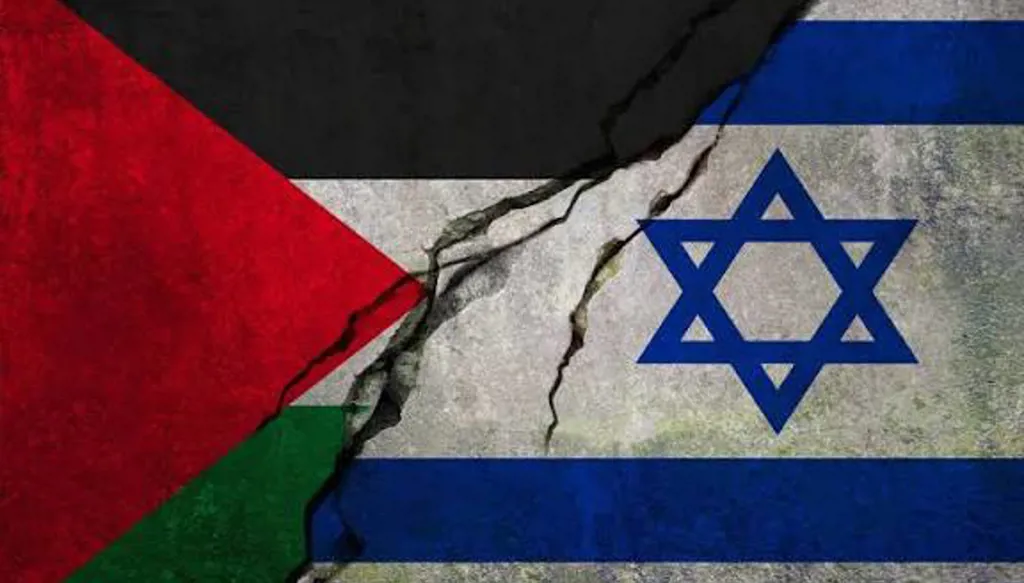
What has happened to the two-state solution to the Palestinian-Israeli conflict? Is it still in a state of "coma," or can we now say that it is dead? An eminent non-Arab Asian researcher answered this question by saying: "I have always been a supporter of the two-state solution, particularly since the early 1970s, when discussing it among both Israelis and Palestinians was considered a form of heresy. At the time, Palestinians aspired to a democratic, civil and secular state in which Jews and Palestinian Arabs would enjoy equal rights. Israel, meanwhile, had remained committed to the idea of a state exclusively for Jews since the 1967 war, when it occupied Jerusalem, the West Bank, the Gaza Strip and Syria's Golan Heights."
Talk of a two-state solution began to gain traction, and at the time, reaching such an agreement seemed possible. The Palestine Liberation Organization (PLO), headed by Yasser Arafat, accepted it in 1988, after some 12 to 14 years of internal deliberations and negotiations with major powers, which in turn engaged with Israel. In return, the United States would recognize the PLO.
This Israeli policy was pursued not by the far right, but by the Labor Party. At the time, Tel Aviv's primary concern was security, not establishing an Israeli state stretching from the sea to the river. The problem then was the rapid growth of Israeli settlements, which were spreading like mushrooms. Then right-winger Menachem Begin became prime minister, and the idea of an Israeli state extending from the sea to the river began circulating in various Israeli circles. At the same time, however, there was also talk of some form of Palestinian self-rule, provided Israel retained responsibility for security. Later, the settlements that had been established would play a major role.
Was Israel's assumption of security responsibility acceptable to the PLO at the time? No, the same researcher replied. Before negotiations with the Palestinians could even begin, Israel demanded that they recognize the State of Israel and its right to exist. This demand had no basis in international law. Israel's second demand was that the Palestinians abandon armed struggle. Negotiations centered on land, which meant that the Palestinians would have to relinquish part of it. The Israelis were effectively telling the Palestinians: Leave your cards at the door, and only then will you be allowed through the gateway to a solution, a settlement and peace.
As for Hamas, recognition, a long-term ceasefire and the abandonment of armed struggle were matters that could be accepted at the end of a settlement process, not at its beginning. What should be noted here, however, is that under Menachem Begin, the ruling party was no longer primarily concerned with security. Its focus had shifted to asserting ownership over Palestinian land and seeking to seize it. Meanwhile, settlements continued to mushroom, and there are now around 750,000 settlers on Palestinian land, in violation of international law.
A subsequent ideological shift took place under Benjamin Netanyahu and his governments, which strengthened religious tendencies within Israel and intensified efforts to seize land after expelling the Palestinians from it. For the two-state solution to become possible today, the parties concerned would have to determine the fate of hundreds of thousands of settlers who would have to come under Palestinian rule, whether within a Palestinian state or in a Palestinian self-governing territory. Israel rejects the second option, leaving it with the choice of either evacuating them from the "Palestinian self-governing territory" or keeping them under Palestinian control. Netanyahu rejects this, leaving everyone facing two bad options, one of which is a single state: Israel. This could pave the way for a civil war or a prolonged period of neither peace nor war, during which the Israelis would control everything, even though such an arrangement would be unsustainable.
Has the two-state solution, which was once again brought up by the Board of Peace established to administer the Gaza Strip following the October 7 attack and Israel's extremely harsh military response, come to an end? Those working towards such a solution continue to speak of it, but without the seriousness required. Nor is it a cure-all for every problem and affliction, the same Asian researcher replied.
We have yet to address what could happen to Palestinians living outside the West Bank or Israel who do not hold Israeli citizenship. But what about those living in refugee camps across several countries in the region, who were displaced from Israel in 1948? Solutions must be found to address their plight. The answer cannot simply be the establishment of a Palestinian state, with that alone being treated as a solution to all problems.
In any case, the two-state solution has become an illusion, a mirage. A single state is the solution. The current situation cannot be maintained and is unacceptable. I therefore believe that everyone is at an impasse.
Have you seen a recent CIA report claiming that Israel is on the brink of collapse? Is it serious? "I do not think so," the same non-Arab Asian researcher replied.
The rejection of a Palestinian state and the new military doctrine, which goes beyond containment and conflict management, are all positions supported by Israelis on both sides of the political divide, in government and in the opposition alike.
If the Israeli opposition comes to power, it will focus on Israel's international standing, rebuilding its image and maintaining a permanent and unwavering alliance with the United States. On the surface, Israelis disagree on many issues, but they do not differ on the fundamentals.
The recent general elections in Israel were not about policy, but about personalities, foremost among them Netanyahu. He now appears to be fighting a defensive battle to save himself, and no one knows whether he will fail or emerge victorious.