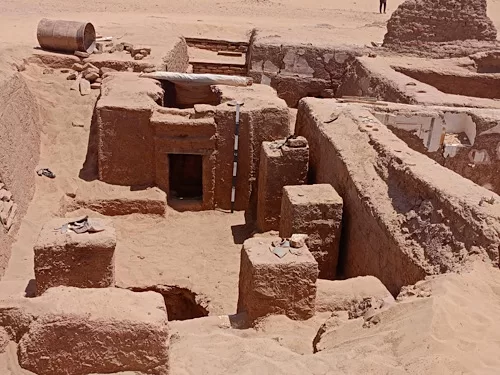
Archaeologists at Marina El‑Alamein brush away centuries of sand to reveal what they describe as one of the most evocative discoveries the ancient port city has yielded in decades, 18 new tombs, each whispering fragments of a long‑lost Mediterranean world. The newly uncovered burials, ranging from rock‑cut chambers plunging eight meters into the bedrock to modest limestone surface graves, add depth to a site already considered one of Egypt’s best‑preserved ancient coastal settlements. With this season’s discoveries, the number of tombs found since the site’s accidental discovery in 1986 rises to 44. The finds are more than architectural remnants. They are intimate traces of the people who once lived in the bustling Hellenistic and Roman‑era city believed to be ancient Leukaspis, a place that flourished as a vibrant node between Egypt and the wider Mediterranean. “There is a human story in every tomb,” said Tourism and Antiquities Minister Sherif Fathy, who described the discovery as a major step towards understanding the cultural identity of Marina El‑Alamein’s ancient inhabitants. “Each find helps us re‑imagine this city as a center of life, trade and ideas.” On the ground, the mission’s work reveals layers of diverse social histories. Lead archaeologists describe families buried in rock‑cut hypogea, workers laid to rest in shallow sandy pits, and a centuries‑old water well that was later repurposed for burials — a poignant sign of evolving funerary customs. Some of the tombs remained sealed since antiquity, their stone‑slab closures untouched by human hands for nearly two millennia. Inside, the team found unbroken pottery vessels, amphorae, lamps and limestone altars. Among the most striking discoveries was a limestone offering altar carved in the form of the ancient Egyptian “false door,” a symbolic threshold for the dead, blending seamlessly with Hellenistic and Roman motifs. Another unexpected treasure emerged from the sands: an unfinished marble statue believed to depict Aphrodite, along with a limestone gravestone showing a seated man cradling a bird — a tender image rarely found in coastal necropolises. But it was the golden tongues, 24 delicate gold pieces placed inside the mouths of the deceased, that drew gasps from the team. Used as ritual tokens to guide the dead in the afterlife, the pieces included one shaped like the Eye of Horus, a powerful symbol of protection in ancient Egyptian belief. Perhaps the most dramatic discovery was a 2.5‑meter granite sarcophagus, still sealed with its original lid. Inside, archaeologists found skeletal remains now undergoing analysis. Nearby lay fragments of a gypsum sphinx, another sign of enduring Egyptian artistic influence during the Hellenistic and Roman periods. Today, Marina El‑Alamein still carries echoes of its ancient past. Beneath modern holiday homes and beachfront towers lie remnants of a city that once thrived with streets, houses, public buildings, a harbor and bustling commercial districts. To help bring that history back to life, the government is developing the site into a full archaeological destination. Plans include a visitor center, electric‑vehicle routes, walking paths and an open‑air theater, with completion expected next year. The post Golden tongues, rock‑cut tombs unearthed at Marina El‑Alamein appeared first on Egyptian Gazette.