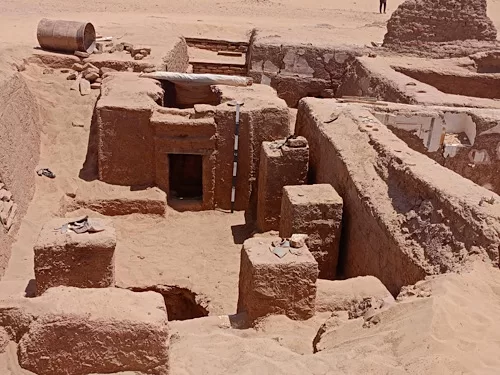
An Egyptian archaeological mission has uncovered new evidence at Tell Abu Saifi in the eastern Nile Delta that could help identify the site with the long-lost ancient Egyptian city of Mesen, the tourism and antiquities ministry said Saturday. The discovery, made near Qantara Sharq in Ismailia province, offers fresh insight into the development of the historic Way of Horus, a strategic military route linking Egypt with its eastern frontier. Among the finds was part of a large sandstone lintel, broken into two pieces and engraved on three sides with the titles of Pharaoh Ramesses II. An inscription refers to restoration work carried out on a statue of “Horus, Lord of Mesen”, providing what officials described as important evidence in determining the identity of the site. The excavation also uncovered the remains of a massive mud-brick enclosure, including gates, internal rooms and several building layers. Archaeologists said the structure was the outer wall of the temple precinct rather than the temple itself, correcting earlier interpretations of the site. Two successive stone roads leading into the temple were also found. The earlier route dates to the Ptolemaic period, while a narrower Roman road was built over it. Inside the temple complex, archaeologists identified a series of storage rooms to the north and larger service rooms to the south, leading to the sanctuary. The sanctuary was later demolished, apparently as a result of quarrying operations during the late Roman period. Other discoveries included part of a schist statue of a military scribe dating to Egypt’s 26th Dynasty, a headless and footless statue from the Late Period, the torso of a royal basalt statue and fragments of falcon statues made of basalt and limestone. The site reached its architectural peak during the Ptolemaic era before parts of it were reused as a Roman military fort, or castrum, in the third century AD, officials said. It was later converted into a lime-production quarry. Excavators found two large circular kilns built over the corners of the sanctuary, containing remnants of burnt limestone. The findings, combined with discoveries from previous excavation seasons, strengthen the hypothesis that Tell Abu Saifi was the location of Mesen, a city mentioned in ancient Egyptian texts dating to the New Kingdom, according to mission officials. The excavation and research will continue in coming seasons as archaeologists seek further evidence to confirm the identification. The ministry said the site demonstrates the successive military, religious and economic roles played by the area and highlights its importance in protecting Egypt’s eastern borders from the Pharaonic period through the Ptolemaic and Roman eras. The post Egyptian dig sheds new light on ancient Horus Military Road, lost city appeared first on Egyptian Gazette.