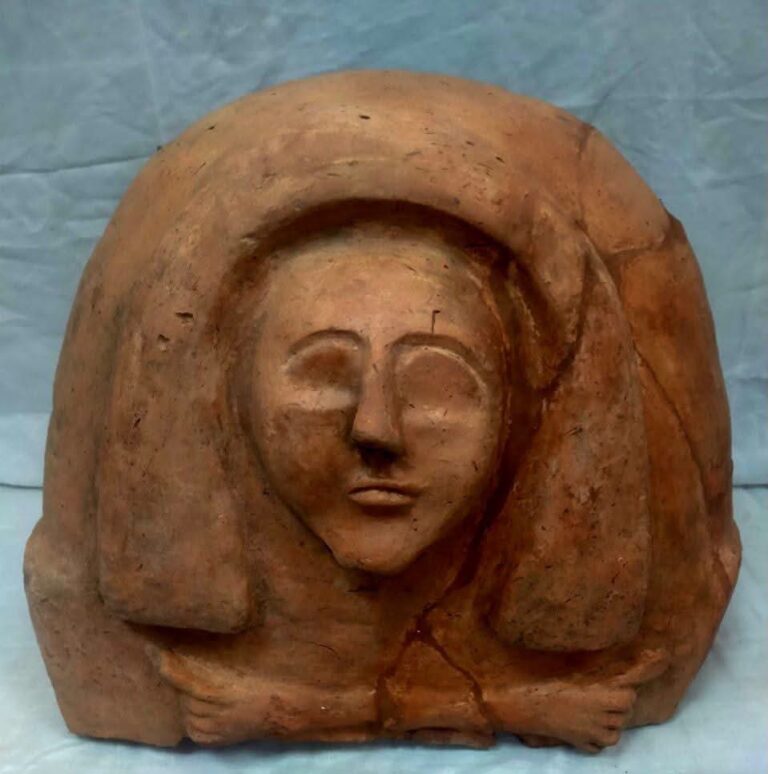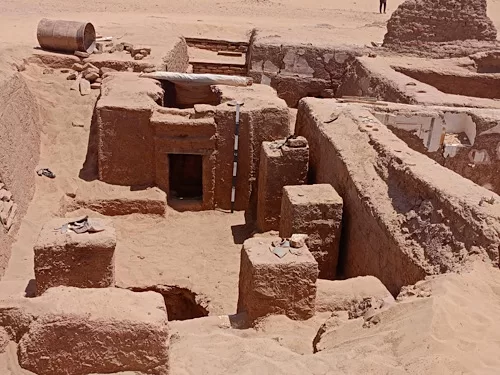
An Egyptian archaeological mission has uncovered a rare pyramid-shaped tomb dating to the Roman period at Bir al-Shaghala, in the Dakhla Oasis of New Valley governorate, the Supreme Council of Antiquities (SCA) said. Built of mudbrick, the tomb was designed to hold the remains of a man and his wife. Its distinctive architecture includes a stone entrance decorated with Egyptian-style reliefs, hieroglyphic inscriptions and funerary spells. The entrance is reached by a 14-step staircase and is topped by a cornice featuring a winged sun disk and cobras, followed by a decorative element shaped like a bundle of papyrus or reeds. Its lintel bears a rare funerary scene depicting the seventh hour of the Imy-Duat, one of ancient Egypt’s books of the afterlife. The entrance was found sealed by a stone block bearing an Osirian design and surrounded by protective spells. Inside, the entrance leads to a vaulted transverse hall built of mudbrick. Two burial chambers lie on the right-hand side, also constructed of mudbrick and covered with plaster, beneath the tomb’s pyramid-shaped superstructure. Among the most notable discoveries was a stone funerary stele set into the southern wall of the pyramid. The rectangular monument, topped by a triangular pediment and a raised sun disk, carries a 19-line funerary elegy written in ancient Greek ink. The poem was dedicated to a man named Pisechthis, who may have served as a judge, according to preliminary studies. It is dated to the late third or early fourth century AD and offers a rare glimpse into the literary and cultural life of the oasis during the Roman era. The excavation also yielded a sandstone offering table and purification basin, a collection of pottery vessels and a bronze coin bearing a relief of the Roman emperor Constantine. Archaeologists said evidence suggested that the tomb may have been reused at a later date. A mudbrick chapel was found above the main entrance, facing a funerary shrine with four square mudbrick pillars. Tourism and Antiquities Minister Sherif Fathy said the discovery highlighted the rich and diverse archaeological heritage of Egypt’s oases and the succession of civilisations that flourished there. SCA Secretary-General Hisham El-Leithy said the tomb’s architectural features, inscriptions and funerary texts would provide important information about religious beliefs, burial practices and cultural life in Dakhla during the Roman period. Bir al-Shaghala is one of the most important archaeological sites in the Dakhla Oasis. It formed part of the necropolis of Mothis, the ancient capital of the oasis during the Ptolemaic and Roman periods. Excavations at the site began in 2002 and have uncovered a series of tombs combining ancient Egyptian architectural traditions with Ptolemaic and Roman influences. Several feature open courtyards, funerary altars, vaulted burial chambers and upper-level shrines crowned by pyramid-shaped structures. The post Roman-era pyramid tomb found in Egypt’s Dakhla Oasis appeared first on Egyptian Gazette.