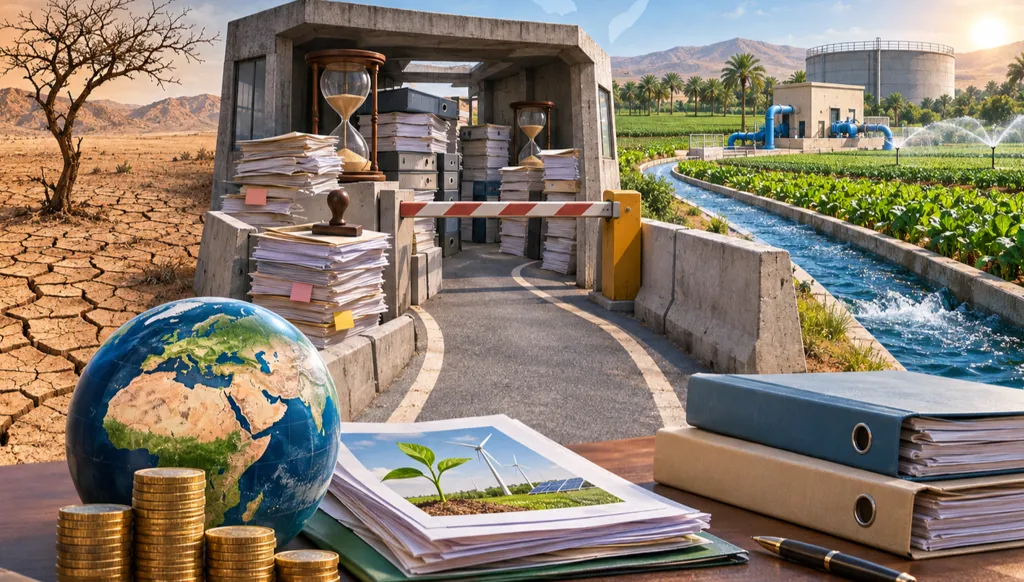
Between announcing climate finance and delivering water to a thirsty field lies a long chain of decisions: preparing projects, identifying implementing agencies, agreeing on financing terms, and then moving through contracting, disbursement, and operation. At COP31, Arab countries need to bridge this gap just as much as they need to increase their financial pledges.
The Adaptation Gap Report 2026, presented by the United Nations Environment Programme on November 4, highlights a significant discrepancy: international public finance flows for adaptation from developed to developing countries ranged between $28.2 billion and $31.7 billion in 2024, compared with estimated annual needs of about $305 billion by 2035. These figures refer to developing countries collectively, not the Arab world's share.
The report warns that institutional barriers hinder implementation, while complex procedures and limited capacities make it more difficult to access support for addressing losses and damages. In practical terms, proving that a country is affected is not enough; a reliable mechanism for putting the funds to use must also be in place.
The challenge begins when a priority is clearly identified, such as protecting a flood-prone area, but the project lacks risk maps, feasibility studies, or a clear identification of beneficiaries. Questions then arise over ownership, procurement, guarantees, and maintenance capacity.
Financing instruments also differ. Grants do not require repayment, concessional loans remain a form of debt, guarantees mitigate risks for funders, and private investment seeks returns. Combining these instruments can make announced financing figures appear larger than the benefits actually experienced by communities, while sometimes concealing repayment obligations and operational costs.
The third phase of Morocco's Saïss Project offers a traceable example. The European Bank for Reconstruction and Development has allocated a sovereign loan of up to €150 million to expand the water distribution network and irrigate 20,000 hectares. The project's webpage indicates that it has entered the disbursement phase.
This phase complements a program aimed at transferring 90–120 million cubic meters of surface water annually from the M'dez dam to the Saïss plain, easing pressure on groundwater resources. However, the bank also links the project's social impact to water service pricing and equitable access: infrastructure can only succeed if farmers can afford the services it provides.
In contrast, the United Nations Development Programme points to a potential Lebanese portfolio of grants and loans linked to the Green Climate Fund worth about $327.5 million. This figure reflects projects under development and financing, but does not establish that the amount has been disbursed or has reached beneficiaries.
The comparison highlights the importance of publicly disclosing the status of each project: proposed, approved, contracted, or implemented? However, it does not, on its own, establish that Lebanon's portfolio has failed or that Morocco's experience is complete.
In Antalya, Arab countries should call for financing for project preparation and technical assistance alongside funding for construction. They should also publish the amounts disbursed, the conditions attached to them, and the results achieved.
The most meaningful measure of success is not the size of the financial announcement, but the number of people who gain protection and continued access to services after the funding ends.