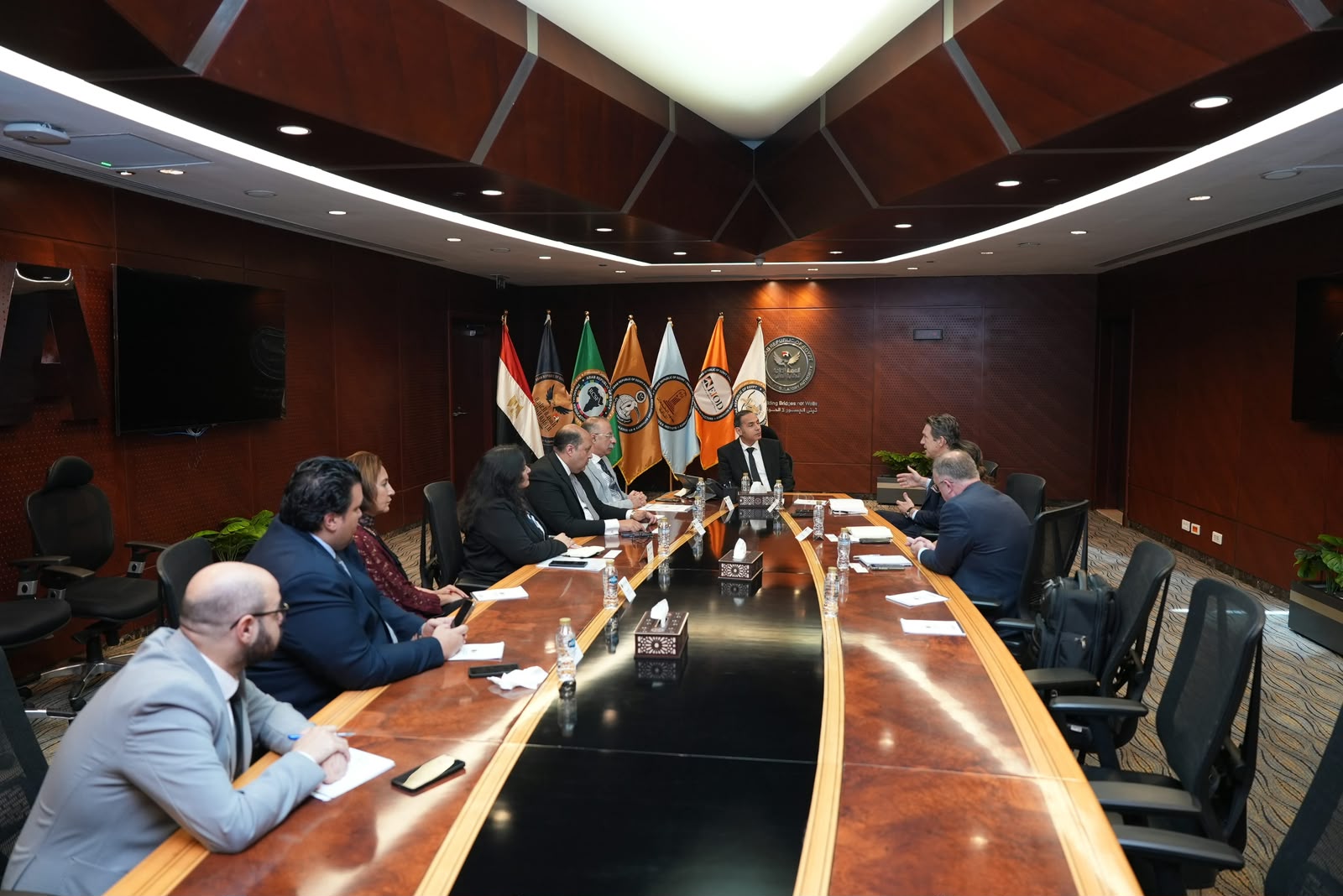
Islam Azzam, Chairperson of the Financial Regulatory Authority (FRA), met on Tuesday with a delegation from the European Bank for Reconstruction and Development (EBRD) to discuss recent government share offerings on the Egyptian Exchange (EGX) and the latest developments in Egypt’s non-banking financial sector.
The delegation comprised Mark Davis, Managing Director for the Southern and Eastern Mediterranean and Head of Egypt at the EBRD; Omnia Benhadi, Co-Head of Private Equity and Listed Equities; and Mike Taylor, Director for Financial Institutions in the Middle East and Africa.
The meeting was attended by FRA Vice-Chairperson Tarek Seif, Chairperson’s Assistant Mahmoud Gabr, and Christine Beshara, Supervisor of the FRA’s Central Department for International Relations.
During the meeting, Azzam reviewed developments in Egypt’s capital market, highlighting the authority’s efforts to broaden the range of available investment instruments, enhance trading efficiency and liquidity, and strengthen the market’s ability to attract new investment.
He pointed to the launch of the financial derivatives market last March and the planned introduction of short selling.
Azzam added that the FRA is also preparing to introduce a market-making mechanism following the launch of short selling. The mechanism is expected to support liquidity and improve securities pricing efficiency by facilitating more effective responses to imbalances between supply and demand.
The FRA Chairperson also reviewed developments in investment funds and the authority’s efforts to introduce new mechanisms capable of accommodating both individual and institutional investments within a secure and regulated framework.
Recent measures include regulating hedge funds for the first time in Egypt, allowing them to invest in derivatives, engage in short selling, and use other actively traded financial instruments.
He also highlighted the forthcoming launch of the first digital platform licensed by the FRA for investment in real estate investment funds. The platform will enable individuals to participate indirectly in the ownership of real estate assets through investment fund units representing shares in the assets held by the funds.
Regarding recent government share offerings, including the commencement of trading in Banque du Caire shares on the EGX and the forthcoming offering of Misr Life Insurance shares, Azzam reaffirmed the FRA’s full support for implementing the second version of the State Ownership Policy Document.
He said the authority is working to facilitate and expedite the necessary procedures while ensuring full compliance with applicable legislation.
The FRA is responsible for regulating offering and trading procedures, reviewing the information and disclosures contained in prospectuses, examining matters relating to the fair value of shares, ensuring that all required documents and regulatory conditions are met, and coordinating listing, trading and settlement procedures.
Azzam described the offerings as important milestones in an ambitious programme aimed at improving asset management efficiency, broadening the ownership base, and attracting investors capable of developing assets.
He added that the programme seeks to increase market capitalisation and deepen the capital market, with these objectives expected to support structural reforms and enhance the competitiveness of the Egyptian economy.
Insurance sector reforms
Turning to the insurance sector, Azzam reviewed the FRA’s efforts to develop the industry since the introduction of Unified Insurance Law No. 155 of 2024.
He said the authority has issued more than 90 regulatory decisions to date, with the latest measures focusing on facilitating product approvals, streamlining procedures, and encouraging insurance companies to introduce products that meet the needs of different customer segments.
The measures also aim to improve underwriting and pricing efficiency for credit and guarantee insurance policies, strengthen risk management, and ensure that insurers rely on more accurate and comprehensive data when assessing risks and determining coverage prices.
In addition, the FRA is modernising electronic connectivity between insurance companies and the authority to facilitate more efficient monitoring of insurance activities and improve the quality of data used for regulatory supervision.
Azzam also discussed efforts to strengthen the financial solvency of insurance companies by raising minimum capital requirements in two phases, enhancing their ability to meet obligations to policyholders and absorb potential risks.
He outlined ongoing work to develop more advanced solvency requirements, particularly through the adoption of the Solvency II framework.
This would support a transition towards risk-based supervision more closely aligned with the risks assumed by insurers, enabling more effective capital management and valuation of insurance liabilities.
Non-banking finance and financial inclusion
In the non-banking financial sector, Azzam outlined key developments aimed at balancing market growth with customer protection.
These include leveraging financial technology to facilitate access to services, strengthening identity verification procedures, and establishing real-time connectivity between financial service providers and the Egyptian Credit Bureau.
He also highlighted tighter creditworthiness assessment standards, including a requirement to obtain customers’ behavioural credit scores.
These assessments draw on patterns in customers’ financial behaviour and data analysis to build more comprehensive credit profiles, helping improve financing decisions and reduce default rates.
Carbon markets and sustainability disclosures
The meeting also addressed developments in Egypt’s voluntary carbon market, which the country launched as Africa’s first regulated and supervised market for trading carbon emission reduction certificates.
Azzam reviewed progress in establishing a regulatory framework covering the registration of emission reduction projects, the issuance, listing and trading of certificates, and the regulation of validation and verification bodies.
The framework also encompasses the approval of trading and settlement rules and the establishment of carbon registries.
He further discussed the FRA’s efforts to implement sustainability disclosure standards issued by the International Sustainability Standards Board (ISSB), particularly IFRS S1 and IFRS S2.
These standards aim to improve the quality and transparency of disclosures relating to sustainability- and climate-related risks and opportunities.
For their part, EBRD representatives expressed appreciation for the progress made in Egypt’s non-banking financial sector, underscoring its importance and strategic role in supporting economic activity and expanding investment opportunities.
Both sides agreed to maintain communication on matters of mutual interest, explore opportunities for cooperation in developing Egypt’s financial markets, and draw on the EBRD’s expertise to support the modernisation of regulatory and supervisory frameworks.