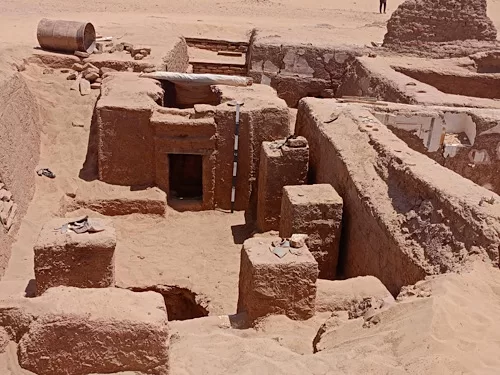
Egyptian archaeologists have uncovered the remains of a building believed to have served as a roadside inn for merchants, pilgrims and travellers in the abandoned town of Asila in North Sinai, the tourism and antiquities ministry said Tuesday. The site lies along the historic Egyptian Pilgrimage Route, which once linked Egypt with the Arabian Peninsula and the Levant. The excavation, carried out by a mission from Egypt’s Supreme Council of Antiquities, revealed walls built of mud brick and red brick, supported at their foundations by large limestone blocks, the ministry said. The structure extends north, east and south and contains internal divisions suggesting the presence of several rooms. Some may have been shops attached to the inn, officials said. The layout resembles that of Khan al-Khuwainat, another important commercial station in North Sinai, although the Asila site is smaller, supporting the theory that it was used as a resting station for pilgrims and merchants. Archaeologists also found large pottery vessels used to store water and provisions, as well as olive-green glazed ware, red-and-white pottery and fragments of oil lamps. The finds suggest that the site dates to the Mamluk period, including pottery associated with the reign of Sultan al-Nasir Muhammad ibn Qalawun, who ruled Egypt during the Bahri Mamluk era. Some artefacts bear Arabic letters that may form part of the word “al-Nasir”, although further study is needed to establish a more precise date and determine the functions of the buildings. “The discovery offers a new window onto the historic routes that connected Egypt with the Arab East,” Tourism and Antiquities Minister Sherif Fathy said, describing it as an important addition to discoveries shedding light on Sinai’s history. Excavations and conservation work are continuing to uncover further architectural details and establish whether the building was indeed a roadside inn. The Egyptian Pilgrimage Route was used for centuries by pilgrims travelling to Mecca, as well as by commercial caravans and travellers between Egypt, the Levant and the Arabian Peninsula. Historical studies indicate that its use declined after political and military developments in the region, including the Crusader threat in the 11th century, led pilgrimage traffic to shift southward via the route linking Aydhab and Jeddah. The post Egypt uncovers ancient inn on Sinai pilgrimage route appeared first on Egyptian Gazette.