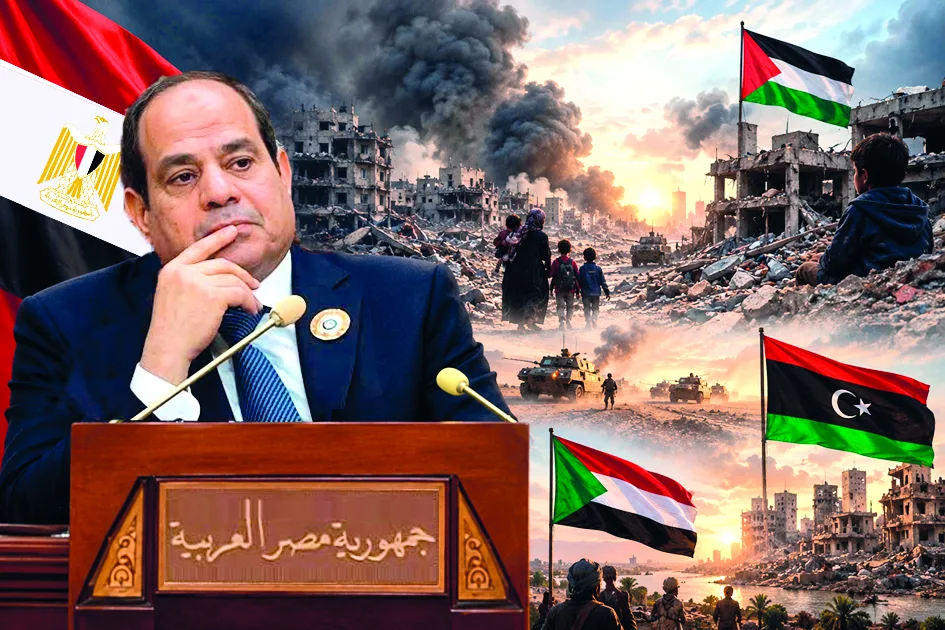
Egypt has experienced something unprecedented in its modern history. Over the past ten years, simultaneous crises erupted in every direction of its national security. Libya to the west. Sudan to the south. Gaza to the east. They are all adjacent to Egyptian territory. Each one poses a threat to peoples bound to Egypt by history and a shared future. The region has been in turmoil since 2011. Egypt’s foreign policy, which regained the initiative after the revolution of 30 June 2013, has been shaped by that turmoil. The strategy rests on three concepts. Protect Arab states’ sovereignty and territorial integrity. Reject foreign interference. Support national institutions, and never let sectarian, ethnic or religious groups and militias fill the vacuum. Behind them sits a belief in citizenship over sectarian, ethnic or religious allegiance. Cairo contends that peoples in crisis, should revitalise the nation-state, not ruin it. Egypt had two objectives. Help shattered Arab countries recover. Assist the others to guard against contagion. Closer economic ties were meant to feed the national development drive launched in 2014. Gaza, the closest wound Palestine has always been at the centre of Egyptian foreign policy. Cairo’s position remains unchanged. A just peace needs an independent Palestinian state on the June 1967 borders, with East Jerusalem as its capital. After the war began on October 7, 2023, Egypt prioritised a permanent ceasefire. When Israel resumed fighting in late March 2025, Cairo led the diplomatic effort alongside the United States and Qatar. But it refused to let the story shrink. It rejected framing Gaza as a humanitarian tragedy. It rejected temporary security fixes, stressing that the conflict did not begin on October 7, 2023, and that there is no alternative to the two-state solution. It also fought the displacement of Palestinians from Gaza and the West Bank. Arab and Islamic support followed. So did a shift abroad. Spain, Norway, Ireland, Slovenia and Armenia recognised a Palestinian state. Others, most recently France, declared that they are considering it. Then came the numbers. 25,635 relief aid trucks, carrying 373,354.7 tonnes, entered Gaza through Rafah border crossing. The World Food Programme says more than 70 per cent of aid reaching the Strip came through Egypt. Cairo imposed no taxes or customs duties. Behind the statistics are people. Egypt treated 6,500 wounded Palestinians free of charge. It also evacuated foreign and dual nationals. After the ceasefire of January 19, 2025, a further 6,406 trucks carrying 105,951 tonnes of relief aid reached Gaza through Rafah. They stopped only when Israel halted deliveries. Diplomatic effort continued unabated. President Abdel Fattah El-Sisi met Palestinian President Mahmoud Abbas repeatedly. Cairo hosted the Cairo Peace Conference on October 21, 2023. It hosted a humanitarian conference on December 2, 2024 that raised over $173 million. It hosted the fourth meeting of the two-state coalition, with more than 45 countries and organisations attending. On March 4, 2025, an extraordinary Arab Summit in Cairo adopted Egypt’s reconstruction plan for Gaza as an Arab plan. In Baghdad on May 17, 2025, President Sisi was blunt. Even if Israel normalised ties with every Arab state, he said, peace would stay out of reach without a Palestinian state. Neighbours in need Libya shares a border of more than 1,000 kilometres with Egypt. In this respect, Cairo’s four principles are clear: unity and territorial integrity; Libyan ownership of the political process; unified national institutions; and simultaneous presidential and parliamentary elections. It has acted on all of them. It hosted the “5+5” Joint Military Committee from October 30, 2021. It hosted constitutional-track talks in 2022. It announced the “Cairo Declaration” in June 2020. Moreover, 169 members of Libya’s two councils met in Cairo in February 2025. And, on January 18, 2025, President Sisi met Field Marshal Khalifa Haftar for the first time since September 2021. Sudan is closer. Egypt’s conviction is simple: Sudan’s stability is integral to its own. It hosted the “Neighbours of Sudan” summit in July 2023. In July 2024, the Sudanese Civilian Forces Conference brought together all civilian forces for the first time ever. On October 3, 2024, Egypt organised a visit to Port Sudan during its presidency of the African Union Peace and Security Council. It managed to mend the rift between the AU and Sudan. And Egypt took people in. It hosted more than 1.2 million Sudanese, offering them all services on an equal footing with the Egyptians. Friends and partners The Gulf is a red line. Egypt treats the security of the Gulf states as non-negotiable. Saudi investment in Egypt has reached about $6.1 billion since 2014. Egyptian investment in Saudi Arabia was about $1 billion in 2023. The visit of Crown Prince Mohammed bin Salman on October 15, 2024 was crowned with the establishment of the Egyptian-Saudi Supreme Coordination Council. The UAE’s president visited Egypt three times in 2024. Ties with Bahrain, Kuwait and Oman have deepened. Jordan sees summits several times a year. A tripartite mechanism with Iraq dates from 2019. In the Maghreb, Egypt-Algeria trade reached $1 billion. Eighteen documents were signed at the ninth joint committee on November 26, 2025. Trade with Morocco hit $1.3 billion in 2024. Egypt backed Tunisian President Kais Saied’s July 2021 measures. The 18th joint committee met in Cairo in September 2025. In Lebanon, Egypt only aids state institutions. Following the 2020 Beirut explosion, it sent an airlift of military and humanitarian supplies, as well as 88 tonnes of aid in 2024. Egypt also contributed to the Quintet Committee that helped elect President Joseph Aoun in January 2025. On Syria, Cairo backs Resolution 2254. After the change of government in December 2024, it insists on Syrian ownership of the solution and on the country’s unity. The measure of it Policy papers speak of principles. Summits speak of communiqués. Yet the truest ledger of this decade is written in trucks, hospital beds and shared neighbourhoods. Egypt’s diplomacy is about states. Its sacrifice has been borne by people. Mohamed Fahmy Editor-in-Chief of The Egyptian Gazette The post Egypt kept its door open while every border burned appeared first on Egyptian Gazette.