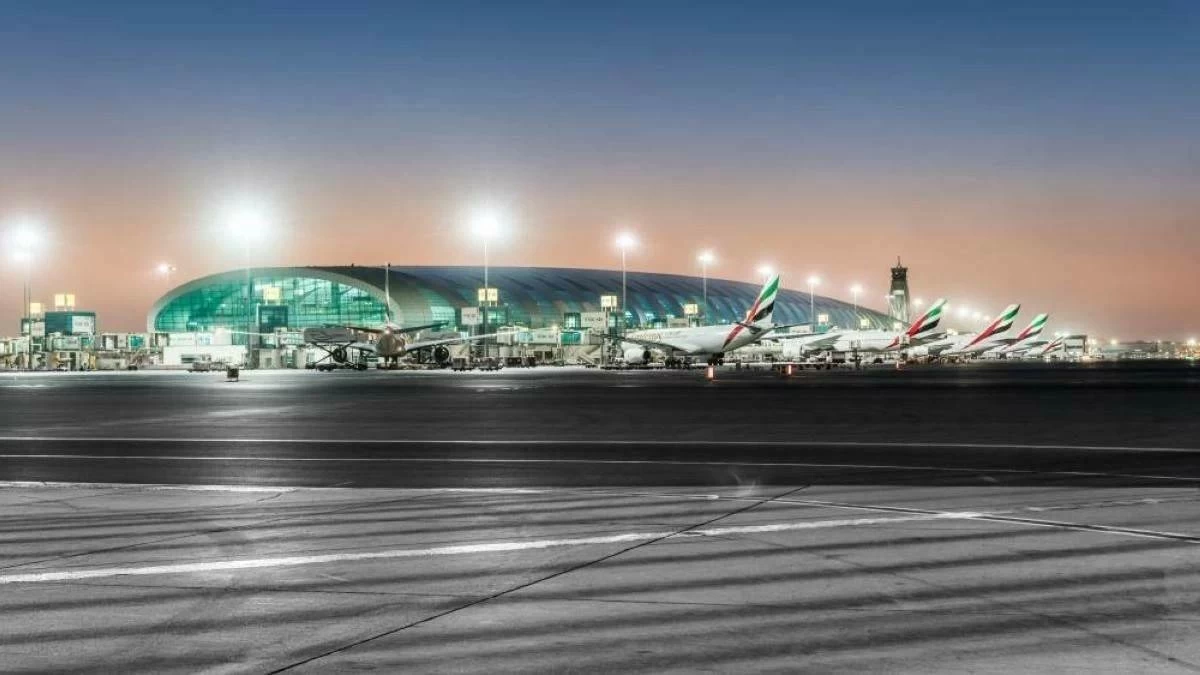
Dubai: Dubai International Airport maintained its position as the world’s busiest airport for scheduled international capacity in November, with airlines scheduling 4.47 million international departure seats, or 8.94 million seats in both directions, according to OAG.
Dubai continued to lead the world’s 10 largest international airports by seat capacity, ahead of London Heathrow Airport, which ranked second with approximately 3.79 million international seats. The difference between the two airports was nearly 680,000 seats.
Seoul Incheon Airport in South Korea ranked third with approximately 3.7 million seats, followed by Singapore Changi Airport in fourth with 3.58 million and Amsterdam Schiphol Airport in the Netherlands in fifth with 3.25 million.
Hong Kong International Airport ranked sixth with 3.19 million seats, followed by Istanbul Airport in seventh with 3.16 million and Paris Charles de Gaulle Airport in eighth with 3.08 million. Bangkok Airport in Thailand ranked ninth with 2.82 million seats, while Frankfurt Airport in Germany completed the top 10 with 2.65 million seats during November.
Dubai International continues to strengthen its position as a major hub for air travel between East and West, benefiting from an extensive network of destinations and flights connecting Dubai with global markets.
Its role is reinforced by Emirates and flydubai, which use the airport as a hub for their operations. Both airlines continue to expand their networks by adding new destinations and increasing frequencies to existing destinations.
The airport also supports the operations of other airlines flying through Dubai International, broadening travel options for passengers and strengthening air traffic through one of the world’s leading international aviation hubs.
Dubai International maintained its position as the world’s largest airport by international passenger numbers in 2025 for the 12th consecutive year, according to the annual report of Airports Council International.
The airport welcomed 95.2 million passengers in 2025, an increase of 3.1 per cent compared with the previous year, making it the busiest year in the airport’s history.
It also handled 31.5 million passengers during the first six months of 2026, as airlines continued to restore operational capacity and demand increased during the second quarter. By the end of the first half of the year, Dubai International was served by 50 international airlines, providing direct connections to 217 destinations across 99 countries.